Morocco’s Berbers take on Africa’s richest silver mine – and the king

Movement on the road '96, africa's richest silver mine, berbers, moroccan silver mine, king of morocco, berber activists, environmental activism, water issues, water management, pollution

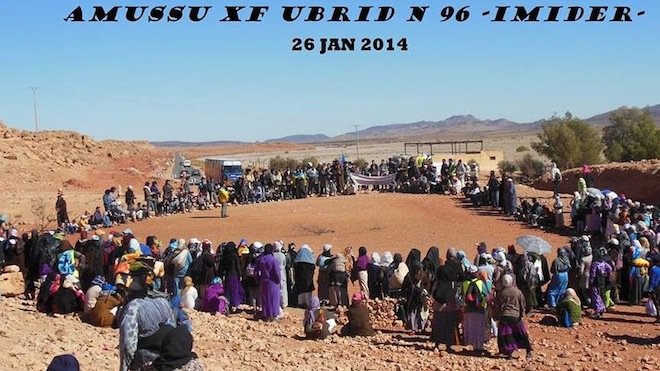
Africa’s largest silver mine has been operating in the Atlas mountains since 1969, but the Berber people living in the surrounding villages remain among the most poverty-stricken people in Morocco. Now Movement on the Road ’96 are living in an “occupation” camp to protest a silver mine’s water use and pollution. They are also fighting for a fair share in the nation’s resource .
Since August, 2011, the group of activists from Imider, who call themselves Movement on the Road ’96have been living in an occupation camp on Mount Alebban in order to protest the mine’s polluting practices.

While Africa’s resources are historically usurped by international companies, the Imiter Mettalurgic Company operating the silver mine is mostly owned by Morocco’s royal family, according to the New York Times. Which makes the lack of a sufficient “trickle down” effect perhaps more egregious.

“The king forgot about us. He tours the country helping people, and he never comes to this region,” one woman told the New York Times: “He is our father, and he has forgotten about his children.”

The group claims that the mine has used up more than their fair share of water, depleting aquifers that the agricultural communities in the area use for their terraced crops.

Read here about how the Berber’s had a perfect water use system in place.

Backed in part by the Free Academy in Rome (LAR), the Movement on the Road ’96 also claims that the toxic byproduct of the mining process, including cyanide and mercury used to treat the ore, has caused disease, killed livestock and exacerbated desertification.

“…even small plots at the foot of the mountain seem doomed to due to the shortage of water and poisons from the mine,” according to LAR.
Movement on the road '96, africa's richest silver mine, berbers, moroccan silver mine, king of morocco, berber activists, environmental activism, water issues, water management, pollution

Morocco’s Berbers are historically independent, organized and resilient, and once enjoyed a deeply entrenched system of water management that has been disrupted by international groups in recent years. The mine is said to have taken up to 66 percent of the water allocated in a special system to each village.

In 2011, some of the villagers from Imider climbed the mountain to cut off water supply to the mine. This resulted in a 40 percent capacity loss in 2012 and a 30 percent loss 2013.

Meanwhile, Farid Hamdaoui, a mine manager, denied allegations that they are improperly disposing waste, and says that the mine recycles 62 percent of the water they use.

The group, which takes its name from a 1996 uprising that the government violently suppressed, is demanding that local employees should make up 75 percent of the total workforce. Independent commentators say this is impossible, and the company accuses the group’s organizers of turning down offers for a feasible employment ratio.

Hamdaoui insists that the mine spends $1 million a year on the local communities, but LAR says that since operations began in 1969, very few infrastructural improvements have taken place.

“At Imider there are no schools (except a small garrison basic), there is no electricity in most homes, the internet [or] even kiosks with newspapers, while the nearest hospital is located 200 km away (Ouarzazate).”
:: New York Times

Tafline Laylin
Tafline Laylinhttp://www.greenprophet.com
As a tour leader who led “eco-friendly” camping trips throughout North America, Tafline soon realized that she was instead leaving behind a trail of gas fumes, plastic bottles and Pringles. In fact, wherever she traveled – whether it was Viet Nam or South Africa or England – it became clear how inefficiently the mandate to re-think our consumer culture is reaching the general public. Born in Iran, raised in South Africa and the United States, she currently splits her time between Africa and the Middle East. Tafline can be reached at tafline (at) greenprophet (dot) com.

Read More

TRENDING

Essaouira Offshore Wind and what it means for surfers, music festivals and the wild

Morocco’s proposed 1,000 MW offshore wind project near Essaouira promises climate leadership and renewable energy for this Magreb country, but along this stretch of Atlantic coast, wind is more than energy. The coastline is culture, economy, and identity.

Haman’s Fingers, A Moroccan Purim Specialty

There’s feasting at home on the night and the next day, and to make sure everyone gets good things to eat, families send out packages of treats to friends and neighbors. Traditional goodies are hamentaschen, and other treats like our chocolate nut clusters .

Atlas Mountain eco retreat at the Kasbah

Walking well-trodden mountain pathways, eating fresh local food, and learning about the transformative work embedded in the Kasbah’s approach to tourism has now been imparted to our children. We hope, in turn, these experiences will serve to inform their contributions in the world as they continue to grow. Don’t wait, Morocco is on everyone’s bucket list. Growth and change are inevitable. 

Arab agricultural land is on the brink

Across the Arab world, croplands face a perfect storm of stressors. Excessive fertilizers and pesticides erode soil ecology. Poor drainage and over-irrigation drive salinization, leaving fields crusted with salt. Rising temperatures, dwindling groundwater, and more frequent sand-and-dust storms—all amplified by climate change—compound the crisis.

Regenx builds urban mines for the rarest of metals

Regenx from Canada has evolved the concept of mining: they are urban mining in the classic sense and pointing the way to cleaner and more sustainable ways of recovering minerals from industry.

Yerukim Forms a New Green Economy Where the Money is Really Green

The Yerukim members who pick up the recyclables get to keep the monetary reward, the public earns "green" bills that can be used in shops, and business owners get to be associated with environmentalism.

Choosing Riyadh over Dubai? What Investors Should Know

Saudi Arabia is deploying capital at unmatched scale to catalyze tourism and advanced industry while rewiring its power-and-water backbone. The investable frontier is widening—especially in renewables, grid storage, water efficiency/desal retrofits, and hospitality operating platforms. Prudent investors will insist on phased delivery, enforceable KPIs (energy, water, biodiversity), and RHQ/zone compliance—while pricing political-economy and reputational risks alongside growth upside.

Sell your cooking oil for biodiesel money

Want to make money on old french fry oil? Sell it.

Qatar Alternative Energy Summit Pairs Investors And Innovators

Alternative energy investors and innovators can meet n' greet in Doha, Qatar March 16 and 17.

Here’s How To Implement The Four Pillars Of Employee Engagement

If you throw a party for your work team and they are vegans, don't make it a barbecue. Know the sustainability values of your team to boost moral and retain good people.

Locals From Rishon Fight IKEA

Big Box stores are a pretty new concept in Israel, and thank God that not every Israeli city wants them in their backyard. A word from someone who has see the beautiful farmland around her hometown Newmarket, Ontario stripped and converted into vulgar strip malls of big box shops: they have no place in a healthy and sustainable town or city.

The Jewish National Fund Meets An Inconvenient Truth

According to the JNF, it has transformed thousands of acres of barren land into green forests in Israel. They state that each person emits about 23 tons of carbon per year, estimating that each tree planted can absorb one ton of carbon in its lifetime. That's a whole lot of trees you'd need to be planting. Could so many fit in Israel?

How to quiet noise from construction in your office

Streets need to be resurfaced in New York but the humming and grinding noise is unsettling. Noise is environmental pollution. 

Popular Categories