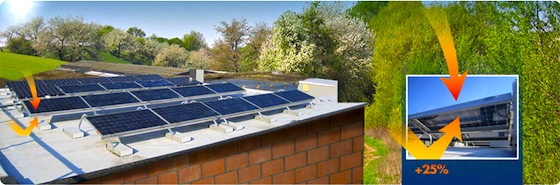
Israel’s bSolar Designs Promising Double-Sided Solar Cell

bSolar, cleantech, renewable energy, startup, Israel, solar energyBifacial solar panel can boost energy yield by 50%.

Researchers have been trying to develop double-sided solar cells that can capture both direct and reflected sunlight for the last forty years, and now an Israeli startup believes they have come up with the winning formula. bSolar, a venture-backed project founded in 2007, showcased their bifacial solar cells at a trade show in Germany last month. According to Yossi Kofman, co-founder and CEO, their cells could produce up to 20% more energy than conventional cells. But it won’t be easy.

The challenge of double-sided solar cells:

As Bhushan Sopori, a researcher at the National Renewable Energy Laboratory told GigaOm, there’s a reason that bifacial solar cells have not been successful to date.

bsolar double sided solar panel, israelBoron is the main component of the bSolar bifacial cell that allows the silicon wafers to capture reflected light on both sides. Although aluminum has historically been used to prevent the loss of electrodes when convert sunlight into electricity, boron won’t bend or break increasingly thin silicon wafers. Plus this chemical element increases efficiency.

But boron is hard to source and hard to use in production. For help understanding why, we’ve included a little clip from our friend Wikipedia:

Because boron is produced entirely by cosmic ray spallation and not by stellar nucleosynthesis,[8] it is a low-abundance element in both the solar system and the Earth’s crust. However, boron is concentrated on Earth by the water-solubility of its more common naturally occurring compounds, the borate minerals. These are mined industrially as evaporites, such as borax and kernite.

Perseverance conquers:

If bSolar can find a way to source boron, which creates a strong, lightweight and refractory compound that is resistant to thermal shock, then they might be successful. But they have to make their efficiency gains cost competitive as well.

“A conventional silicon solar panel is covered in layers of polymer materials to protect solar cells and a piece of glass as the top cover to let the light in,” wrote GigaOm. And bSolar has to do this on both sides of their cells.

“The technologies are there. The big question is the additional costs of doing it – how much reflected light can be harvested and do the benefits justify the cost?” according to Sopori.

Despite the challenges, more than one company trusts that bSolar has what it takes to finally make bifacial solar cells marketable. With $10 million financial backing, a 730 KW plant in Japan in the pipeline, and three solar companies already interested in their product (including Aleo Solar, Asola Solarpower and Solar-Fabrik), the firm seems poised to persevere.

GigaOm warns, however, that $10 million is not a lot of money to bring a technology into commercial production, so bSolar will have to step up their fundraising efforts. If they are successful, bifacial solar cells might finally become a widespread reality.

:: GigaOm

::bSolar website

More on Solar Cell Technology:
Saudi to Maintain Energy Hegemony with Postage Stamp-Sized Solar Cells
DIY Solar Panels Made of Grass that Anyone Can Build
6 Hot Solar Projects From the Middle East and North Africa

Tafline Laylin
Tafline Laylinhttp://www.greenprophet.com
As a tour leader who led “eco-friendly” camping trips throughout North America, Tafline soon realized that she was instead leaving behind a trail of gas fumes, plastic bottles and Pringles. In fact, wherever she traveled – whether it was Viet Nam or South Africa or England – it became clear how inefficiently the mandate to re-think our consumer culture is reaching the general public. Born in Iran, raised in South Africa and the United States, she currently splits her time between Africa and the Middle East. Tafline can be reached at tafline (at) greenprophet (dot) com.

Read More

3 COMMENTS
  1. It is good to see. Most of the solar technology and applications I work with take a long time to repay the initial investment, particularly without government incentives.

LEAVE A REPLY

Please enter your comment!
Please enter your name here

TRENDING

Desalination experts debunk Aqua Solaire, the floating desalination barge

AI makes it easy to dream, develop, and create images of what could be world-changing ideas, until the reality sets in. A new project making the rounds is Aqua Solaire, an allged French concept for a solar-powered desalination vessel designed to bring drinking water to coastal communities facing drought, storms, and infrastructure failures.

AI data centers are triggering panic, instead of cleantech opportunities

AI may unintentionally become the economic engine that finally modernizes America’s aging grid. California is experiencing a massive AI data center boom, ranking 3rd in the U.S. with 227 operating centers and 54 more in development as of April 2026, according to Stanford.

24 7 renewable energy: how solar, wind, batteries and AI SaaS replace fossil fuels

A new report from the International Renewable Energy Agency based in Abu Dhabi makes something clear that many in the industry already suspected. When solar and wind are paired with battery storage, they can deliver reliable, round the clock electricity at costs that compete with, and often beat, fossil fuels.

Japan wants to build a solar panel ring around the moon

Unlike solar power on Earth, which is limited by night cycles, weather, and seasons, the Moon offers something close to uninterrupted exposure to the Sun. By placing solar infrastructure in orbit or along the lunar surface, engineers could generate continuous clean energy at a scale that may exceed global electricity demand,  the Japanese scientists say.

Korean researchers create battery from greenhouse gases

Professor Ji-Soo Jang, in collaboration with Professor Taekwang Yoon of Ajou University and Professor Hansel Kim of Chungbuk National University, has developed a novel energy device that generates electricity during the process of capturing greenhouse gases.

How to quiet noise from construction in your office

Streets need to be resurfaced in New York but the humming and grinding noise is unsettling. Noise is environmental pollution. 

EarthX and a blueprint for sustainable investing

Trammell S. Crow, a Dallas-based businessman and father of four, is focusing his efforts on impact investing, and media that focuses on saving the planet through EarthX.

Mining Afghanistan’s Mineral Discoveries Similar to Avatar

Now that American forces in Afghanistan are commemorating the longest period of any war that America has been involved in, including the 1965-73 Vietnam War, the recent discoveries of large and extremely valuable mineral and metal deposits may finally bring to light a reason to continue the presence of US fighting forces in this war torn and backward country.

From Pilot Plant to Global Stage: How Aduro Clean Technologies’ 2026 Expansion Signals a Turning Point for Chemical Recycling Investors Like Yazan Al Homsi

The company's Next Generation Process (NGP) Pilot Plant in London, Ontario, has officially moved into initial operating campaigns, generating the kind of structured, repeatable data that separates laboratory promise from commercial viability.

Nobul’s Regan McGee on Shareholder Value: “Complacency Is the Silent Killer” 

Why the governance framework designed to protect shareholders so...

Should You Invest in the Private Market?

startustartup Unlike public stock exchanges, which offer daily trading, strict...

How to build a 100-year-company

Kongō Gumi is a Japanese construction company, purportedly founded in 578 A.D., making it the world's oldest documented company. What can we learn about building sustainable businesses from them?

How AI Helps SaaS Companies Reduce Repetitive Customer Support Work

SaaS products are designed for large numbers of users with different levels of experience, and also in renewable energy.

Popular Categories