The revolutions that have been taking place in the Arab world since December 2010 have had a significant impact on the economy, not only in the countries involved, but also the rest of the World. How is the Arab Spring, which has caused massive financial losses on one side, also able to influence growth and development of renewable and green sources of energy?
There is no doubt that the Arab Spring has had a significant influence on oil prices. Mohammed Al Hamli, the United Arab Emirates’ oil minister, recently said that a reasonable price for oil would be around $80 to $100 a barrel. This is a significant increase from $50 a barrel, which is what OPEC oil ministers defined as a reasonable price just five years ago.
The International Monetary Fund (IMF) stated in their latest bi-annual “Regional Economic Outlook: Middle East and Central Asia”-report that breakeven oil price for the UAE has risen from $60 in 2008 to $80 a barrel.
Geopolicity published “The Cost of the Arab Spring” back in October 2011, the same month as the war in Libya ended, and concluded that “Oil exporters were winners and oil importers were losers.” – with the exception of Libya, where revenues had dropped by 84 percent.
“More than 740,000 people have fled the country since the start of the conflict, and the severe disruption in the hydrocarbon sector has devastated the economy.”
According to the same report, Egypt, Syria and Libya paid the highest financial price as a result of the Arab Spring.
On the other hand, big oil-exporting countries such as Saudi Arabia, United Arab Emirates Kuwait that have avoided the worst uprisings, and some of which have only have had minor protests, have seen great increases in revenue since the Arab Spring started. In fact, public revenues are up as much as 31% in UAE.
Renewable energy has become more attractive
Net importers of energy face great economical challenges caused by the high and unstable oil prices. In countries such as Egypt, where fuel subsidies are rooted in the financial structure of the country’s budget, the high oil prices encourages the development of renewable energy power.
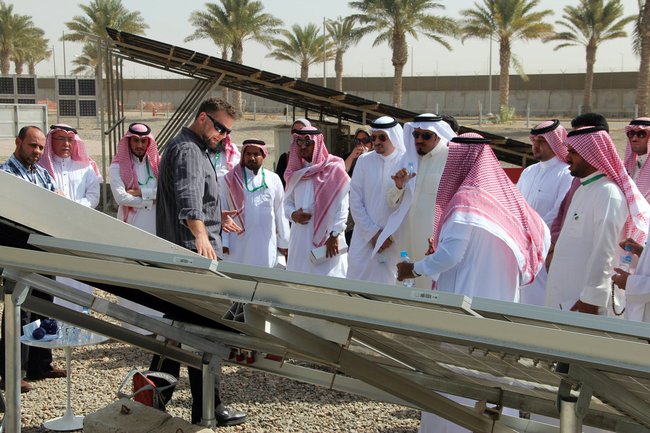
Rising fuel costs and increasing demand in solar power reduces the need of governmental incentives to support the growth of renewable energy. According to Emirates Solar Industry Association (ESIA), photovoltaics have reached a level of cost-competitiveness on par with conventional electricity generation based on fossil fuels.
Has the Arab Spring lead to renewable growth so far?
Investments are happening that possibly wouldn’t have taken place if it weren’t for the Arab Spring and high oil prices. Major projects have been announced during the last six months.
Desertec Foundation, a non-profit organization that develops solar power in the MENA region, has several large projects ongoing already. The first of them, 500 MW Moroccan Ouarzazate Concentrated Solar Power (CSP) plant, was announced in November 2011.
January this year, Desertec Foundation announced the World’s largest CSP-plant to be built in Tunisia, which when finished would have a total power capacity of 2 GW. In comparison, the largest photovoltaic solar power station, Golmud Solar Park in China, only has a peak power capacity of 200 MW.
Same month, Abu Dhabi’s Enviromena Power Systems and American owned Petra Solar announced an alliance, stating that they would work together to develop integrated solar power and smart grid projects in the Middle East North Africa region.
And lastly, just a few days ago, Germany’s Centrotherm Photovoltaics announced that they are building a a new polysilicon plant in Saudi Arabia.
Stability is still a problem in the post Arab Spring world, especially in the countries that have had the greatest losses. Investor confidence has to be rebuilt. With new governments in place in Tripoli, Tunis and Cairo, all located in countries where sun and space is abundant, new investors from abroad are likely starting to get involved. High oil prices combined with the European power demand to meet green quotas, makes further development of the renewable resources inevitable.
Ban Ki-Moon, the UN Secretary General, stated the following earlier this year at the World Future Energy Summit in Abu Dhabi:
“Investing in the green economy is not simply a luxury of the developed countries. It represents opportunity for job creation and economic growth in developing countries.”
Renewable energy will bring many new jobs to the table, spur economic growth and make industries and countries less vulnerable against volatile energy prices. The transition to democracy seems to be an intrinsic part of fighting global warming.
Mathias Aarre Mæhlum is doing a masters degree in energy and environmental engineering at NTNU in Norway. In his spare time he runs EnergyInformative where he writes about green energy and increasing energy efficiency.