

 Commuters will ride for free. But will the toll-run “fast lane” help solve Tel Aviv’s increasing traffic nightmare?
Looking for a faster way to get to Tel Aviv from Jerusalem every day? Instead of being stuck in the daily traffic jam, a daily routine for drivers coming from both Israel’s capital and the bedroom communities of Modiin and Beit Shemesh, why not try the fast lane?
It’s now possible to take the new “fast lane” which will enable those traveling on it to reach the main traffic artery of Tel Aviv, the Ayalon Freeway, in only 11 minutes instead of commuter times of up to two hours. The new 13 km stretch will actually be a toll road to cars with less than 4 passengers. Busses and cars with at least four passengers will get to use it for free.
According to estimates in the Marker, between 1,600 to 2,000 cars an hour are forecast to use the lane during busy times. The toll is expected to be between NIS 17 and NIS 20 during rush hour. When the measured speed will drop to below 70p km per hour, the toll cost will increase, due to more cars using the lane. How will this impact the environment?
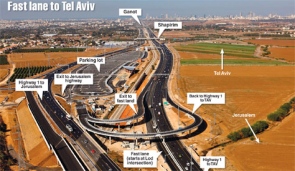 The “fast lane”
The whole idea of this new lane is to reduce traffic flow into Israel’s largest city,while at the same time making it more convenient to get into the city that never sleeps.
Commuters will have to option to park their cars in parking lots at the beginning of the new lane and from there take special free commuter shuttle buses into the city.
The idea is to save both on the amount of cars going into Tel Aviv daily on Highway One, as well as reduce the amount of fuel used and be less polluting to the environment.
Special lanes to reduce traffic flow into Tel Aviv is not new, and numerous plans have been in the works, including a plan already in effect to ban trucks coming into Tel Aviv between the hours of 6 and 9 a.m.
Another plan, involving the construction of a light rail line, similar to the one now being built in Jerusalem, has been in the planning stage for years, and involves a number of proposed rail lines going into and through the city.
But perhaps an even idea better idea for reducing the amount of air pollution on the roads going into Tel Aviv could be the use of electric powered vehicles and other less polluting types of cars. The year 2011 is supposed to see the beginning of electric cars being driven on the roads in Israel, thanks to the efforts being made by Shai Agassi’s Better Place company.
Taking this in mind, maybe building a special lane for the exclusive use of electric powered vehicles might be an even better idea than the new fast lane entering Tel Aviv from Highway One. Or rent a van (van locator online) so you can commute in bulk with all your pals.
Read more on traffic:
Will the Tel Aviv Light Rail Line Ever Happen? Do We Want it to?
Tel Aviv Will Ban Trucks during Morning hours to Reduce Congestion
How do You Stop Traffic Congestion in Cairo? With helicopters!




Karin – you’re right.
If drivers would play nicely in the traffic (obey the law), it would help. Too bad there is no white line though – just a solid metal barrier.
We also know there is poor traffic enforcement.
Bottom line is simply big business and politicians looking after each other.
There ought to be an independent body of experts involved with major public projects; from proposal stage through to design, implementation and follow-up.
Another factor is what will happen when an accident occurs on this single lane toll road? Cars behind will simply be in a “log jam”.
How does the Fast Lane promote traffic safety?
There is only a single lane with emergency lane. Do you think the average Israeli driver will be happy to drive in single file, constant speed, without overtaking?
The predicted rate of traffic of 1600 to 2000 cars per hour (that’s 2.25 to 1.8 cars PER SECOND) is dangerous!
Accidents or breakdowns could bring all traffic to a stop, not to mention drivers being run over while tending to their vehicles…
Emergency vehicles will have difficulty responding to problems, especially if Road 1 is backed up too.
The park and ride area is within meters of the Tel Aviv railway line – yet nobody thought it smart to build a train station on the site? Trains would be a huge benefit to people entering the city, as well as reducing traffic and pollution.
And another thing: The fast lane “stole” a lane from Road 1, between Kibbutz Galuyot and La Guardia, reducing Road 1’s capacity at a crucial section. Could this have been intentional?
Looks like the fast lane’s owners/designers did not consider the human factor, road safety, and common sense.
Toronto has a fast lane, a commuter lane that is used only by those with 2 or more riders. What happens is that speed is determined by the slowest driver. It ends up being “fast” because you don’t get blocked in traffic. It runs really smoothly. I use it every time I go to Toronto, with passengers. The trick is to enforce how it is used. The white line must be treated like a wall drivers can’t cross, and drivers must adhere to the rule of a certain number of commuters. I think 4 is too many. Three would be more reasonable.
Too true. BRT sounds way to advanced for Israeli politicians. Sorry – but I just don’t believe this will happen. I don’t believe there will ever be a train that works either. Not as long as the infrastructure ministry continues to be in bed with the old industrialists that like to promote cars and road development.
I think that this article is over-looking the solution of BRT (Bus Rapid Transit). Even if all cars in Israel were electrically powered, congestion would still be a grave issue.