

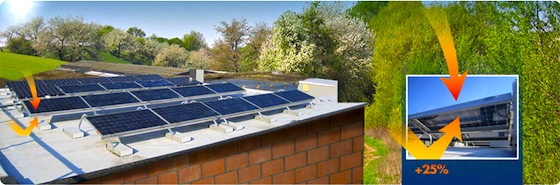
 Bifacial solar panel can boost energy yield by 50%.
Researchers have been trying to develop double-sided solar cells that can capture both direct and reflected sunlight for the last forty years, and now an Israeli startup believes they have come up with the winning formula. bSolar, a venture-backed project founded in 2007, showcased their bifacial solar cells at a trade show in Germany last month. According to Yossi Kofman, co-founder and CEO, their cells could produce up to 20% more energy than conventional cells. But it won’t be easy.
The challenge of double-sided solar cells:
As Bhushan Sopori, a researcher at the National Renewable Energy Laboratory told GigaOm, there’s a reason that bifacial solar cells have not been successful to date.
 Boron is the main component of the bSolar bifacial cell that allows the silicon wafers to capture reflected light on both sides. Although aluminum has historically been used to prevent the loss of electrodes when convert sunlight into electricity, boron won’t bend or break increasingly thin silicon wafers. Plus this chemical element increases efficiency.
But boron is hard to source and hard to use in production. For help understanding why, we’ve included a little clip from our friend Wikipedia:
Because boron is produced entirely by cosmic ray spallation and not by stellar nucleosynthesis,[8] it is a low-abundance element in both the solar system and the Earth’s crust. However, boron is concentrated on Earth by the water-solubility of its more common naturally occurring compounds, the borate minerals. These are mined industrially as evaporites, such as borax and kernite.
Perseverance conquers:
If bSolar can find a way to source boron, which creates a strong, lightweight and refractory compound that is resistant to thermal shock, then they might be successful. But they have to make their efficiency gains cost competitive as well.
“A conventional silicon solar panel is covered in layers of polymer materials to protect solar cells and a piece of glass as the top cover to let the light in,” wrote GigaOm. And bSolar has to do this on both sides of their cells.
“The technologies are there. The big question is the additional costs of doing it – how much reflected light can be harvested and do the benefits justify the cost?” according to Sopori.
Despite the challenges, more than one company trusts that bSolar has what it takes to finally make bifacial solar cells marketable. With $10 million financial backing, a 730 KW plant in Japan in the pipeline, and three solar companies already interested in their product (including Aleo Solar, Asola Solarpower and Solar-Fabrik), the firm seems poised to persevere.
GigaOm warns, however, that $10 million is not a lot of money to bring a technology into commercial production, so bSolar will have to step up their fundraising efforts. If they are successful, bifacial solar cells might finally become a widespread reality.
:: GigaOm
More on Solar Cell Technology:
Saudi to Maintain Energy Hegemony with Postage Stamp-Sized Solar Cells
DIY Solar Panels Made of Grass that Anyone Can Build
6 Hot Solar Projects From the Middle East and North Africa




It is good to see. Most of the solar technology and applications I work with take a long time to repay the initial investment, particularly without government incentives.
Borax is also the waste of some specific fuel cells, and with mirrors behind the panels on the floor for ex, efficiency could even be improved !
Thanks for weighing in Guillaume!