
Recipe: Turkish Red Pepper Paste

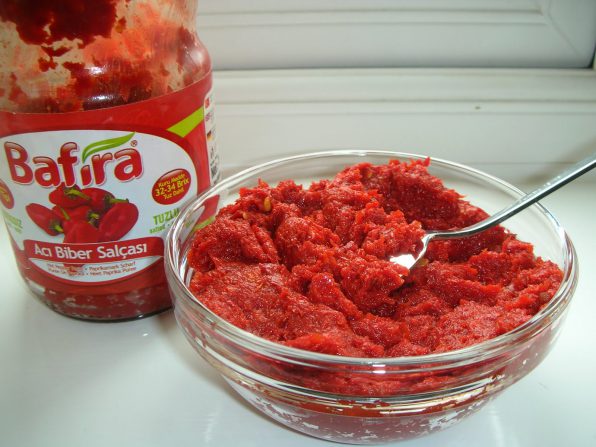
If you love Turkish food and crave its flavors at home, you’ll soon find yourself stirring up the Turkish pantry staple, spicy red pepper paste. It’s a basic flavoring ingredient for many dishes in southern Turkish cuisine. There are no tomatoes in the paste; its deep red color comes from slow-cooking red bell peppers and chilies. The ingredients are simple, but the finished paste gives your food spicy complexity.

A typical red pepper paste will be hot. But vary the heat factor to your taste. If it suits you better, make it milder, with fewer chilies or even none at all. Or ratchet the heat up with the hottest chilies you can find. The paste lasts four weeks refrigerated. You can freeze part of it for later.

The first step will be to char the peppers and chilies. The way that yields the best flavor is to place them on a grill over a flame and let them cook, turning them from side to side, until the skins are blackened and the flesh is soft. You may need to do this in two batches. Keep your kitchen window open, as the odor will be strong. You can also char the peppers under the broiler in your oven, but they won’t have that hint of smokiness that you get from charring them on the stovetop (or even better, over charcoal in the open air).

The rest comes easy: pureeing the peppers in a food processor or blender, then cooking them with the rest of the ingredients, stirring every so often.

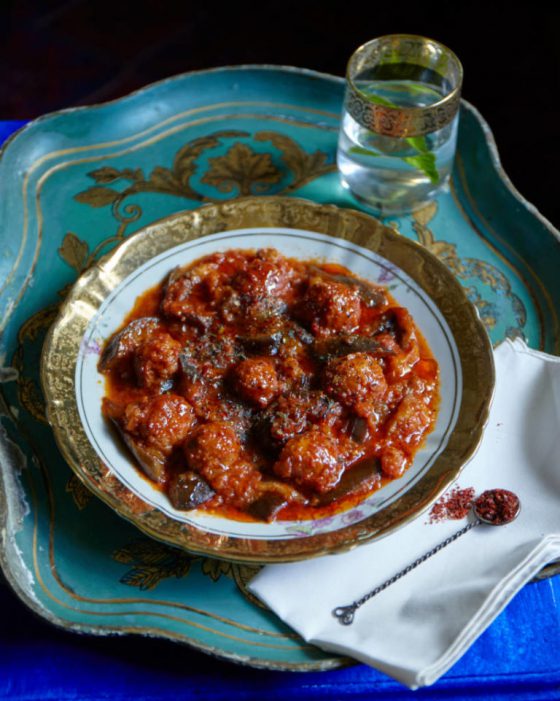
How to use this spicy red gem? First, find some fascinating Turkish recipes like Bulgur Balls in Eggplant and Tomato Sauce. Or just use your culinary imagination. I like to slip a spoonful of red pepper paste into a pot of beans, beat a little into eggs for a spicy omelet, or mix it with za’atar, smear it on open pita halves and pop the bread into a hot oven to toast. Once you taste the finished pepper paste, you’ll know what to do with it.

Turkish Red Pepper Paste

Ingredients:

6 large red bell peppers

6 meaty red chilies

3 teaspoons any variety paprika (sweet, hot, or smoked), according to taste

2 tablespoons lemon juice

2 tablespoons olive oil

1 1/2 teaspoons salt

More olive oil to cover the finished paste

Place the peppers and chilies on a metal grill over an open flame, toasting them and turning them to their uncooked sides every so often. This should take about 10 minutes. The skins should be blackened and the vegetables starting to ooze a little juice.

Place the peppers and chilies in a large bowl and cover them with dish or a re-used plastic bag. The skins will loosen as the vegetables cool down.

Skin the peppers and chilies. Take off the stems and and seeds. You may want to wear gloves when handling the chilies if they’re a really hot variety. Turkish chef Ozlem Warren recommends scraping the flesh off the chilies’ skins with a knife, rather than peeling them.

Process the vegetables in a food processor or blender until smooth.

Pour the pureed peppers and chilies into a large pan. Add the paprika, lemon juice, olive oil and salt. Cook over medium heat until the combination simmers, then reduce the heat to low. Stir often. It will take up to 50 minutes for the moisture to evaporate until a thick paste forms. As for jam, test by dragging a spoon over the base of the pan. If you see a trail, the paste is ready.

Once the paste has cooled, spoon it into a very clean, very dry jar. Pour a little additional olive oil over the surface to seal it. Place the lid on the jar and keep the paste refrigerated.

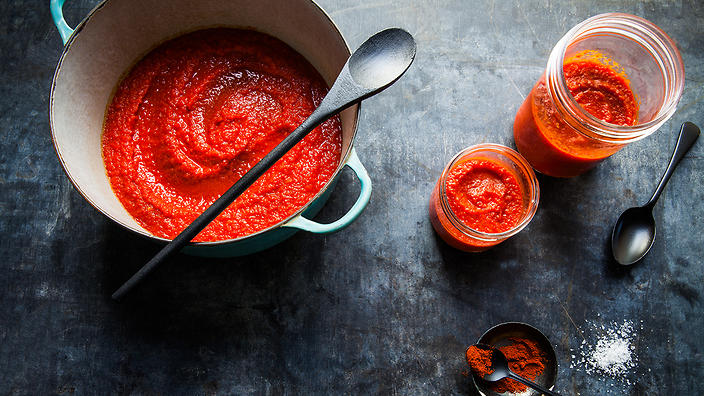
Photo of Turkish red pepper paste via here
Miriam Kresh
Miriam Kreshhttps://www.greenprophet.com/
Miriam Kresh is an American ex-pat living in Israel. Her love of Middle Eastern food evolved from close friendships with enthusiastic Moroccan, Tunisian and Turkish home cooks. She owns too many cookbooks and is always planning the next meal. Miriam can be reached at miriam (at) greenprophet (dot) com.

Read More

1 COMMENT

TRENDING

What’s in season in June – plus recipes and forager’s notes

Middle Eastern markets are bursting with the color and aromas of summer's soft fruits. This is the guide to getting the most out of June. 

Jailhouse Booze For Home Bootleggers

You don’t have to languish in jail to make Jailhouse Booze. It’s an easy, fun project you can make in your own kitchen, with fruit juice. Old-time jailbirds used to call it Pruno. We also have another, no-waste, alternative wine recipe: Pea Pod Wine.

Make Guarapo De Piña (it’s fermented pineapple juice)

In Cuba, guarapo is simply freshly-pressed sugar cane juice, and is drunk on the spot, without waiting for it to ferment. But in Colombia, Venezuela, Peru and Mexico, they homebrew guarapo from pineapples or oranges, and the fragrant fluid sits on the kitchen counter top to ferment until it's bubbly.

Bake a New York Cheesecake for Shavuot

This light, creamy cheesecake fits into your green Shavuot, especially if you make it with organic cheese and eggs. It's also light on sugar.

Baby teeth read like tree rings paint a picture of toxins in early life

A new study from the Icahn School of Medicine at Mount Sinai in New York offers a striking insight into how the environments we are born into can quietly shape our brains years later. By analyzing naturally shed baby teeth, the ones tucked under pillows for the tooth fairy, researchers have reconstructed a detailed timeline of exposure to environmental metals during pregnancy and early infancy.

Locals From Rishon Fight IKEA

Big Box stores are a pretty new concept in Israel, and thank God that not every Israeli city wants them in their backyard. A word from someone who has see the beautiful farmland around her hometown Newmarket, Ontario stripped and converted into vulgar strip malls of big box shops: they have no place in a healthy and sustainable town or city.

The Jewish National Fund Meets An Inconvenient Truth

According to the JNF, it has transformed thousands of acres of barren land into green forests in Israel. They state that each person emits about 23 tons of carbon per year, estimating that each tree planted can absorb one ton of carbon in its lifetime. That's a whole lot of trees you'd need to be planting. Could so many fit in Israel?

How to quiet noise from construction in your office

Streets need to be resurfaced in New York but the humming and grinding noise is unsettling. Noise is environmental pollution. 

EarthX and a blueprint for sustainable investing

Trammell S. Crow, a Dallas-based businessman and father of four, is focusing his efforts on impact investing, and media that focuses on saving the planet through EarthX.

Mining Afghanistan’s Mineral Discoveries Similar to Avatar

Now that American forces in Afghanistan are commemorating the longest period of any war that America has been involved in, including the 1965-73 Vietnam War, the recent discoveries of large and extremely valuable mineral and metal deposits may finally bring to light a reason to continue the presence of US fighting forces in this war torn and backward country.

From Pilot Plant to Global Stage: How Aduro Clean Technologies’ 2026 Expansion Signals a Turning Point for Chemical Recycling Investors Like Yazan Al Homsi

The company's Next Generation Process (NGP) Pilot Plant in London, Ontario, has officially moved into initial operating campaigns, generating the kind of structured, repeatable data that separates laboratory promise from commercial viability.

Nobul’s Regan McGee on Shareholder Value: “Complacency Is the Silent Killer” 

Why the governance framework designed to protect shareholders so...

Should You Invest in the Private Market?

startustartup Unlike public stock exchanges, which offer daily trading, strict...

Popular Categories