Sustainable plastics that emerge from the sea

red algae, agar-agar, agar, veganism, Morocco

A new Tel Aviv University study describes a process to make bioplastic polymers that don’t require land or fresh water — resources that are scarce in much of the world. The polymer is derived from microorganisms that feed on seaweed. It is biodegradable, produces zero toxic waste and recycles into organic waste.

The invention was the fruit of a multidisciplinary collaboration between Dr. Alexander Golberg of TAU’s Porter School of Environmental and Earth Sciences and Prof. Michael Gozin of TAU’s School of Chemistry. Their research was recently published in the journal Bioresource Technology.

Red gold seaweed harvest Morocco

According to the United Nations, plastic accounts for up to 90 percent of all the pollutants in our oceans, yet there are few comparable, environmentally friendly alternatives to the material.

“Plastics take hundreds of years to decay. So bottles, packaging and bags create plastic ‘continents’ in the oceans, endanger animals and pollute the environment,” says Dr. Golberg. “Plastic is also produced from petroleum products, which has an industrial process that releases chemical contaminants as a byproduct.

“A partial solution to the plastic epidemic is bioplastics, which don’t use petroleum and degrade quickly. But bioplastics also have an environmental price: To grow the plants or the bacteria to make the plastic requires fertile soil and fresh water, which many countries, including Israel, don’t have.

red algae seaweed morocco

“Our new process produces ‘plastic’ from marine microorganisms that completely recycle into organic waste.”

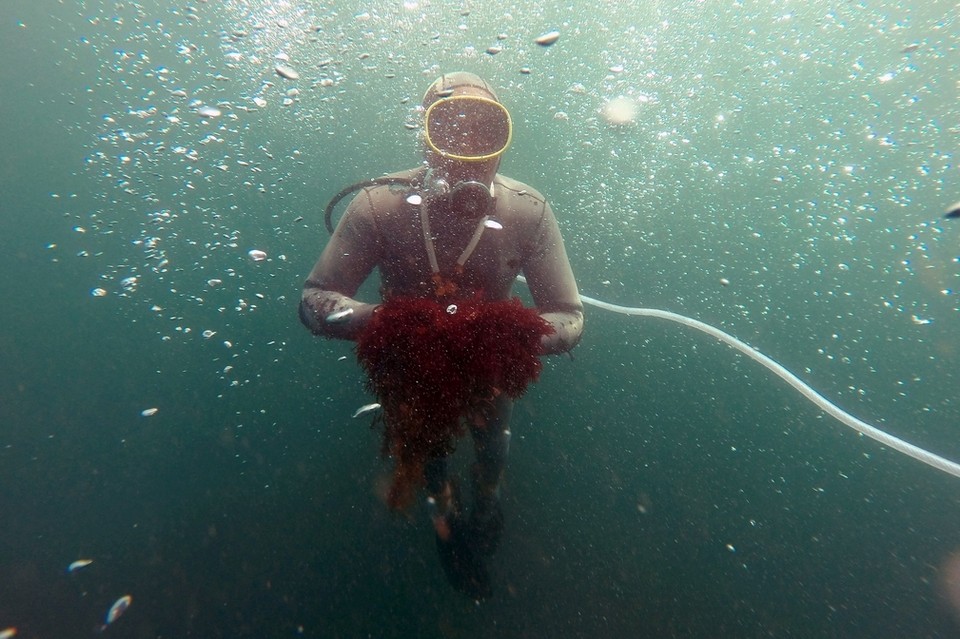
The researchers harnessed microorganisms that feed on seaweed to produce a bioplastic polymer called polyhydroxyalkanoate (PHA). “Our raw material was multicellular seaweed, cultivated in the sea,” Dr. Golberg says. “These algae were eaten by single-celled microorganisms, which also grow in very salty water and produce a polymer that can be used to make bioplastic.

“There are already factories that produce this type of bioplastic in commercial quantities, but they use plants that require agricultural land and fresh water. The process we propose will enable countries with a shortage of fresh water, such as Israel, China and India, to switch from petroleum-derived plastics to biodegradable plastics.”

According to Dr. Golberg, the new study could revolutionize the world’s efforts to clean the oceans, without affecting arable land and without using fresh water. “Plastic from fossil sources is one of the most polluting factors in the oceans,” he says. “We have proved it is possible to produce bioplastic completely based on marine resources in a process that is friendly both to the environment and to its residents.

“We are now conducting basic research to find the best bacteria and algae that would be most suitable for producing polymers for bioplastics with different properties,” he concludes.

The research was partially funded by the TAU-Triangle Regional R&D Center in Kfar Kara under the academic auspices of Tel Aviv University, and by the Israeli Ministry of Energy and Infrastructures.

Bhok Thompson
Bhok Thompsonhttp://www.greenprophet.com
Bhok Thompson is an “eco-tinkerer” who thrives at the intersection of sustainability, business, and cutting-edge technology. With a background in mechanical engineering and a deep fascination with renewable energy, Bhok has dedicated his career to developing innovative solutions that bridge environmental consciousness with profitability. A frequent contributor to Green Prophet, Bhok writes about futuristic green tech, urban sustainability, and the latest trends in eco-friendly startups. His passion for engineering meets his love for business as he mentors young entrepreneurs looking to create scalable, impact-driven companies. Beyond his work, Bhok is an avid collector of vintage mechanical watches, believing they represent an era of precision and craftsmanship that modern technology often overlooks. Reach out: [email protected]

Read More

TRENDING

Recommended Precious Metals Companies: A Due Diligence Checklist for Retirees

The CFTC, FINRA, and NASAA have jointly warned retirees about precious metals fraud targeting retirement accounts. This checklist provides a structured framework for evaluating any company before transferring savings — and illustrates what credible providers look like across 7 measurable criteria.

Appalachian lithium could supply America with EV batteries for 300 years

A vast and largely untapped lithium reserve may be hiding beneath one of North America’s oldest landscapes, the Appalachian Mountains, offering a surprising twist in the global race for clean energy materials. According to new findings from the U.S. Geological Survey (USGS), as much as 2.5 million tons of lithium could be buried across the region, stretching from the Carolinas up through New England.

OPEC and energy stocks in the UAE – insight from eToro

Energy equities are responding unevenly to the evolving landscape. Companies with direct exposure to UAE production growth and infrastructure are benefiting from increased activity expectations, while global oil majors face a more mixed outlook.

10 Surprising AC Water Uses Cities Are Ignoring

All air conditioners release water. That's Physics. Cities like Los Angeles pour billions of water down the drain every year. And while home owners who are savvy to water reuse are finding ways to use AC water in the garden (here are 5 ways to use air con water at home), or in art studios (it's basically free distilled water), cities could save water in meaningful ways by using creative ideas. These are solutions you can send to urban planners and those running smart city accelerator programs. Pick one of them and you might win the grant! 

Hormuz 2026 Conflict Poses an Energy and Food Security Dilemma in a Warming World

As tensions rise in one of the world’s most critical maritime chokepoints, the ripple effects go far beyond oil—touching food systems, climate pressures, and regional stability

Mining Afghanistan’s Mineral Discoveries Similar to Avatar

Now that American forces in Afghanistan are commemorating the longest period of any war that America has been involved in, including the 1965-73 Vietnam War, the recent discoveries of large and extremely valuable mineral and metal deposits may finally bring to light a reason to continue the presence of US fighting forces in this war torn and backward country.

From Pilot Plant to Global Stage: How Aduro Clean Technologies’ 2026 Expansion Signals a Turning Point for Chemical Recycling Investors Like Yazan Al Homsi

The company's Next Generation Process (NGP) Pilot Plant in London, Ontario, has officially moved into initial operating campaigns, generating the kind of structured, repeatable data that separates laboratory promise from commercial viability.

Nobul’s Regan McGee on Shareholder Value: “Complacency Is the Silent Killer” 

Why the governance framework designed to protect shareholders so...

Should You Invest in the Private Market?

startustartup Unlike public stock exchanges, which offer daily trading, strict...

How to build a 100-year-company

Kongō Gumi is a Japanese construction company, purportedly founded in 578 A.D., making it the world's oldest documented company. What can we learn about building sustainable businesses from them?

How AI Helps SaaS Companies Reduce Repetitive Customer Support Work

SaaS products are designed for large numbers of users with different levels of experience, and also in renewable energy.

Pulling Water from the Air

Faced with water shortage in Amman, Laurie digs up...

Turning Your Energy Consultancy into an LLC: 4 Legal Steps for Founders in Texas

If you are starting a renewable energy business in Texas, learn how to start an LLC by the books.

Popular Categories