
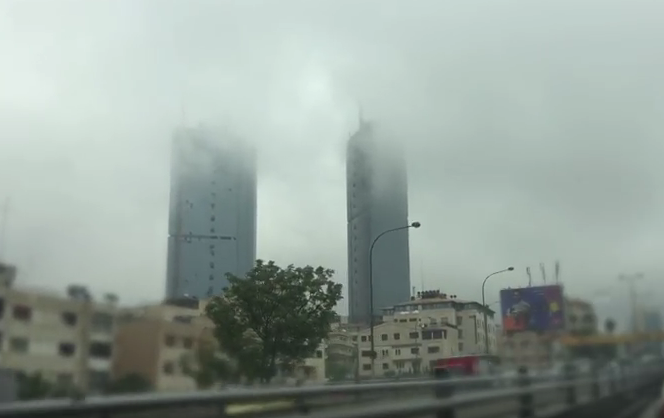

 For five years a set of unfinished twin towers have stood watch over Amman, Jordan, construction halted – allegedly crippled by lawsuits. The filthy glass facades soar above a street-level footprint ringed by old hoarding, abandoned building material and trash. The empty skyscrapers stand in silent testimony to both the 2008 world financial crisis and a more localized crisis in smart urban planning.
Now a young architect throws out a nationwide challenge, posting on his website, “Amman, it’s time to talk!”
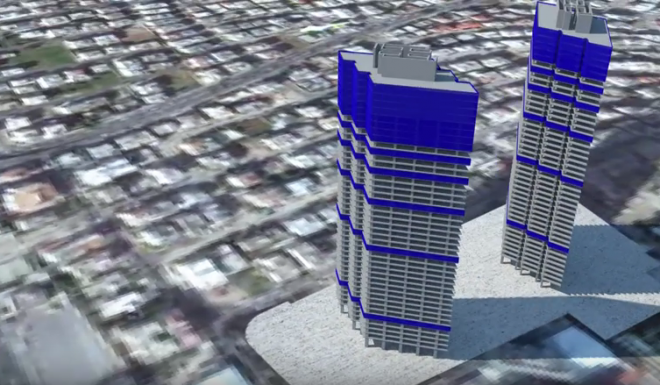
Hanna Salameh, founder of the design firm that bears his name, has collaborated with architects on his staff to propose a radical solution to these faulty towers. Renaming Jordan Towers as Jordan Gate Park, they envision a facility that returns a sense of place and scale to its neighborhood while serving as a fully visible beacon to renewable energy and the industry’s best practices in green design. If realized, it would transform them into the most sustainable development in the kingdom.
Green Prophet met up with Salameh to get the full story.
Green Prophet: Congratulations! You’ve been the man of the moment on social media and radio; clearly you’ve touched on a something many locals are passionate about.
Hanna Salameh: Thanks, the response is overwhelming. We are getting comments on our Facebook page, company website, and the phone hasn’t stopped ringing.
GP: What’s the story of the site?
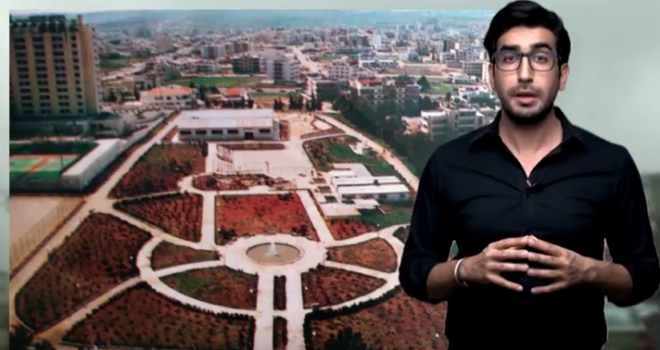
HS: The towers were built on what used to be a public park that was created on lands donated to the city for that purpose. It’s not clear how the site was made available for private development. The park was surrounded by a dense residential neighborhood and was very popular. It had a large emotional legacy to those who grew up in that part of Amman.
The Jordan Gate project was riddled with problems. The site cannot support the added car traffic that the planned offices and commercial spaces would generate. Servicing its enormous water and sewage demands would be problematic too.
GP: What’s your story?
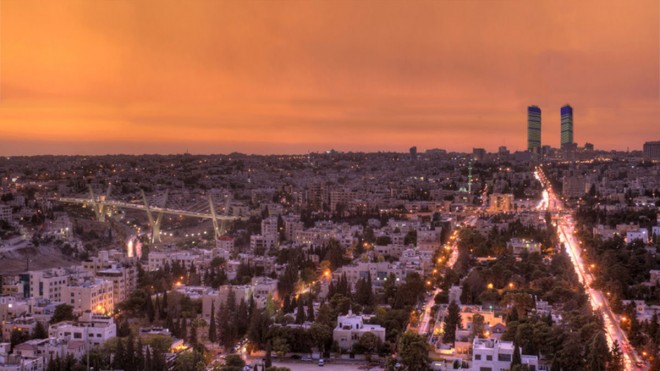
HS: I grew up in Jordan, and studied architecture at McGill University in Montreal. I returned home and in 2012 I started my company in Amman, Hanna Salameh Design. “Green” is in my blood. I grew up surrounded by examples of sensible, sustainable design.
When I was a kid, my grandfather would take me with him to visit the many ancient castles in Jordan. I was always amazed how the interiors were cool, in sharp contrast to the intense heat and sunshine outside. He taught me about natural air conditioning, and skillful use of shade. I became passionate about smart passive design, using materials to decrease dependence on mechanical heating and cooling. My company is known for green design, our buildings use 50-70 percent less energy than those built according to standard practices.
GP: Regulations related to planning, design and construction in Jordan seem a bit lax. Building codes don’t seem to adopt international best practices, with many buildings under-insulated, with far too much exterior glass for the climate. There’s little evidence of robust planning around the impacts of new construction on traffic, parking, emergency services. Do you think stronger, centralized codes would make sure developments were of better quality?
HS: Rigorous planning and clear codes of course would help. But my focus is on raising public awareness. There’s a lack of education about how our buildings could be better, without driving up costs or adding complication. A big part of the Jordan Gate Park project is about showing people how a large project can bring real benefits to its community. This can generate renewable energy, provide needed public areas for people to relax and interact, it can even supply a steady, organic food supply – all of this open to the public to explore and learn about, and maybe even merge into their own homes.
 GP: What motivated you to take on this project?
HS: As a Amman-based architecture firm, we decided to suggest a radical solution that could turn this potential disaster into a positive project that contributes to the sustainability of our country. Jordan has big energy and water problems. We can use these towers to fix part of these problems.
 GP: What’s your approach?
HS: We start by removing most of the glass that now wraps the buildings – about 25,000 panels that we’ll re-purpose for other uses on and off site. We’ll sheath the southern facades with photovoltaic (PV) panels – we estimate using 1,500 PV panels, the equivalent of placing eight panels on every house in the surrounding 800 m2 neighborhood.
The towers have 180 m tall shafts for elevators and services. We will open several of these shafts to act as wind towers, siphoning hot air from ground level up through the roof, creating strong air currents in the process, which can be harvested by wind turbines to generate even more electricity.
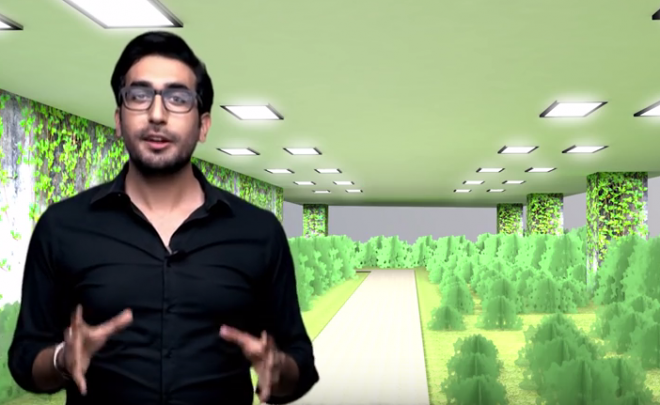 HS: But the most important thing we want to do is start urban farming, and turn these towers into vertical farms right in the middle of the city. Each floor is a potential farm with an area of 2,500 m2. Farmers can cultivate popular crops such as cucumbers and tomatoes that grow in natural sunlight, and introduce more exotic varieties in special-purpose controlled environments, enclosed in glass and illuminated by low-consumption LED lights.
The towers offer a total planting area of 200,000 m2, equivalent to transforming the entire street level community into a center-city farm!
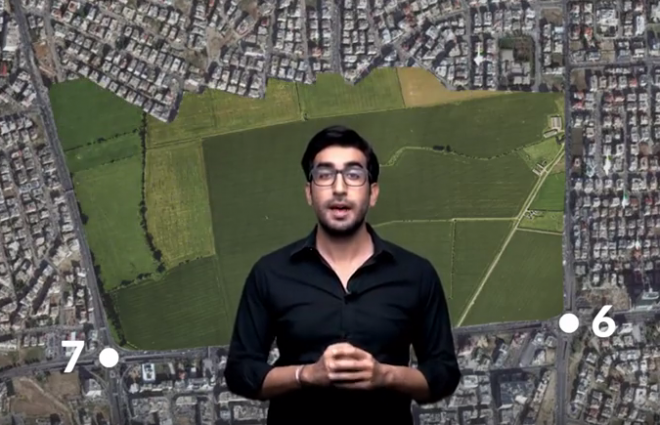
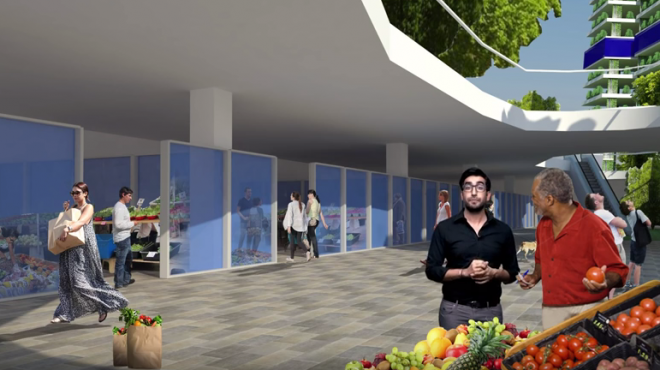
HS: Another important aspect of our design is turning the site back into a public park, and help make these skyscrapers relate to human scale. We’ll open up the roof of the first-level basement to admit sunlight and connect it to the park above. We’ll re-purpose about 10,000 of the glass wall panels into stalls for a new farmers’ market. Tower farmers can sell their fresh produce directly to consumers, cutting out the middleman, shipping costs, and harmful CO2 emissions.
HS: As for the rest of those glass panels? We’ll build 1,900 bus stops across Amman and the kingdom. They can be signed in interesting ways to promote tips of energy and water saving to create further awareness.
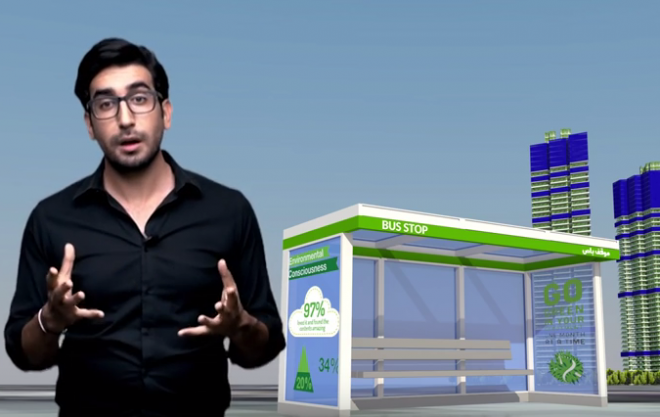
HS: There is a lot more we can do with these towers. Like creating a viewing deck on the top floor to enjoy the beautiful views of Amman. And a tower-top restaurant that serves food cooked from the delicious organic products grown in the towers. We want to create a green gym with sports equipment that generates electricity.
There’s so much more potential – we could add extreme entertainment such as bungee jumping off the towers, zip-lining between them, installing hi-tech roller coasters – you can see more about this in the video we created (below). And of course we’ll have an educational part to explain how the project works and educated the public further about green design and energy and water saving.
[youtube]https://youtu.be/5FA-OMYiIHQ[/youtube]
HS: So as you can see, we are hitting about 15 birds with one stone. Most importantly, we are protecting our city from a big problem and transforming these two towers into a positive project that generates power, produces food and gives us back our park.
We believe that the cost of implementing these ideas is less than finishing the original planned project. And the new functions will generate significant income for the tower owners, returning first investment and creating new revenue streams from renewable energy generation and food production.
GP: Any parting words for us?
HS: Let’s turn these towers into a landmark that represents progress and sustainability. Their presence will raise awareness on issues of energy and water, and through them we can prove to the world that we can learn from our mistakes and turn them into big positives for our city and country. Help us make this vision a reality. Connect with us through our website or Facebook or Twitter using the #JordanGatePark.
Images from the project YouTube video



Today is #Jordan ‘s independence day.
A day not possible without the grandfather of #KingAbdullahII (on his father’s side) #PrinceTalal forming the government and constitution of the #HashemiteKingdom, then afterwards being checked into a mental institution by the British government in the #UK after attempting to murder his ten year old son and his wife.
And a day, impossible without the grandfather of #KingAbdullahII (on his mother’s side) #WalterPercyGardiner fighting against Palestinians for the British in 1936.
Happy Independence Day!