
Scientists make spray-on solar cells efficiencies close to silicon

david-lidzey-spray-on-solar
To date the most efficient way of making solar cells is using silicon. Now a team of scientists at the University of Sheffield in the UK is the first to fabricate perovskite solar cells using a spray-painting process – a discovery that could help cut the cost of solar electricity.

Cutting the cost of solar energy, PV and CSP is the reason why last year was a record year for solar energy uptake globally – as we reported.
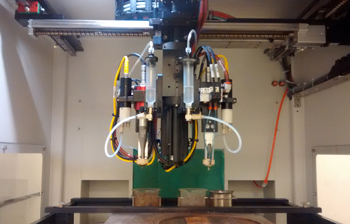
spray on solar, david lidzeyThe Sheffield team found that by spray-painting the perovskite they could make prototype solar cells with efficiency of up to 11 per cent. Lead researcher Professor David Lidzey said: “There is a lot of excitement around perovskite based photovoltaics.

“This study advances existing work where the perovskite layer has been deposited from solution using laboratory scale techniques. It’s a significant step towards efficient, low-cost solar cell devices made using high volume roll-to-roll processing methods.”

Experts from the University’s Department of Physics and Astronomy and Department of Chemical and Biological Engineering have previously used the spray-painting method to produce solar cells using organic semiconductors – but using perovskite is a major step forward.

Efficient organometal halide perovskite based photovoltaics were first demonstrated in 2012. They are now a very promising new material for solar cells as they combine high efficiency with low materials costs.

The spray-painting process wastes very little of the perovskite material and can be scaled to high volume manufacturing – similar to applying paint to cars and graphic printing.

“Remarkably, this class of material offers the potential to combine the high performance of mature solar cell technologies with the low embedded energy costs of production of organic photovoltaics.”

While most solar cells are manufactured using energy intensive materials like silicon, perovskites, by comparison, requires much less energy to make. By spray-painting the perovskite layer in air the team hope the overall energy used to make a solar cell can be reduced further.

Professor Lidzey (pictured above) said: “The best certified efficiencies from organic solar cells are around 10 per cent.

“Perovskite cells now have efficiencies of up to 19 per cent. This is not so far behind that of silicon at 25 per cent – the material that dominates the world-wide solar market.”

He added: “The perovskite devices we have created still use similar structures to organic cells. What we have done is replace the key light absorbing layer – the organic layer – with a spray-painted perovskite.

“Using a perovskite absorber instead of an organic absorber gives a significant boost in terms of efficiency.”

Solar power is becoming an increasingly important component of the world-wide renewables energy market and continues to grow at a remarkable rate despite the difficult economic environment.

Professor Lidzey said: “I believe that new thin-film photovoltaic technologies are going to have an important role to play in driving the uptake of solar-energy, and that perovskite based cells are emerging as likely thin-film candidates. “


Karin Kloosterman
Karin Kloostermanhttp://www.greenprophet.com
Karin Kloosterman is an award-winning journalist, innovation strategist, and founder of Green Prophet, one of the Middle East’s pioneering sustainability platforms. She has ranked in the Top 10 of Verizon innovation competitions, participated in NASA-linked challenges, and spoken worldwide on climate, food security, and future resilience. With an IoT technology patent, features in Canada’s National Post, and leadership inside teams building next-generation agricultural and planetary systems — including Mars-farming concepts — Karin operates at the intersection of storytelling, science, and systems change. She doesn’t report on the future – she helps design it. Reach out directly to [email protected]

Read More

LEAVE A REPLY

Please enter your comment!
Please enter your name here

TRENDING

24 7 renewable energy: how solar, wind, batteries and AI SaaS replace fossil fuels

A new report from the International Renewable Energy Agency based in Abu Dhabi makes something clear that many in the industry already suspected. When solar and wind are paired with battery storage, they can deliver reliable, round the clock electricity at costs that compete with, and often beat, fossil fuels.

Japan wants to build a solar panel ring around the moon

Unlike solar power on Earth, which is limited by night cycles, weather, and seasons, the Moon offers something close to uninterrupted exposure to the Sun. By placing solar infrastructure in orbit or along the lunar surface, engineers could generate continuous clean energy at a scale that may exceed global electricity demand,  the Japanese scientists say.

Batteries from salt? New grid projects suggest the idea is becoming real

Peak Energy makes storage batteries from salt making us one step closer to cleaner, endless energy from the wind and the sun

Turning Your Energy Consultancy into an LLC: 4 Legal Steps for Founders in Texas

If you are starting a renewable energy business in Texas, learn how to start an LLC by the books.

Astro uses AI to help procure land for renewable energy

For oil-rich, environmentally vigilant Gulf states, Astro isn’t just another startup story. It is a blueprint for accelerating an energy transition that is now existential, not optional.

How to quiet noise from construction in your office

Streets need to be resurfaced in New York but the humming and grinding noise is unsettling. Noise is environmental pollution. 

EarthX and a blueprint for sustainable investing

Trammell S. Crow, a Dallas-based businessman and father of four, is focusing his efforts on impact investing, and media that focuses on saving the planet through EarthX.

Mining Afghanistan’s Mineral Discoveries Similar to Avatar

Now that American forces in Afghanistan are commemorating the longest period of any war that America has been involved in, including the 1965-73 Vietnam War, the recent discoveries of large and extremely valuable mineral and metal deposits may finally bring to light a reason to continue the presence of US fighting forces in this war torn and backward country.

From Pilot Plant to Global Stage: How Aduro Clean Technologies’ 2026 Expansion Signals a Turning Point for Chemical Recycling Investors Like Yazan Al Homsi

The company's Next Generation Process (NGP) Pilot Plant in London, Ontario, has officially moved into initial operating campaigns, generating the kind of structured, repeatable data that separates laboratory promise from commercial viability.

Nobul’s Regan McGee on Shareholder Value: “Complacency Is the Silent Killer” 

Why the governance framework designed to protect shareholders so...

Should You Invest in the Private Market?

startustartup Unlike public stock exchanges, which offer daily trading, strict...

How to build a 100-year-company

Kongō Gumi is a Japanese construction company, purportedly founded in 578 A.D., making it the world's oldest documented company. What can we learn about building sustainable businesses from them?

How AI Helps SaaS Companies Reduce Repetitive Customer Support Work

SaaS products are designed for large numbers of users with different levels of experience, and also in renewable energy.

Popular Categories