

Public awareness of healthy food products that are free of chemical additives, along with a worldwide demand to reduce industrial pollution, has led in recent years, to the development of organic farming. It is commonly presumed that organic agriculture causes only minimal environmental pollution. But a new study conducted by researchers from Israel reveals a worrying trend.
Ben-Gurion University of the Negev and The Volcani Center has found that there is a dark side to organic farming: Intensive organic agriculture relying on solid organic matter, such as composted manure that is mixed in to the soil prior to planting, researchers find, resulted in significant down leaching of nitrate through the vadose zone to the groundwater.
On the other hand, similar intensive agriculture that implemented liquid fertilizer through drip irrigation, as commonly practiced in conventional agriculture, resulted in much lower rates of pollution of the vadose zone and groundwater.
While groundwater pollution is usually attributed to a large array of chemicals, the main cause for drinking-water well shut downs is a high nitrate concentration in the aquifer water.
The study compared the quality of the percolating water across the entire unsaturated zone under organic and conventional greenhouses using new vadose zone monitoring technology. The enhanced down-leaching of nitrate under intensive organic farming is attributed to unsynchronized nutrient release from the compost to the soil during the early stages of the growing season. In this stage, nutrient uptake capacity of the young plants is very low and down-leaching of nitrate to the deeper parts of the vadose zone and groundwater is unavoidable.
The study was done in commercial greenhouses on the southern part of the coastal aquifer in close cooperation with local farmers.
The study was conducted by Ofer Dahan and his student, Avshalom Babad, of the Zuckerberg Institute for Water Research at BGU, Naftali Lazarovitch of the French Associates Institute for Agriculture and Biotechnology of Drylands, Efrat E. Russak of the Department of Geological and Environmental Sciences and Daniel Kurtzman, Water and Environmental Sciences, Agricultural Research Organization, The Volcani Center.
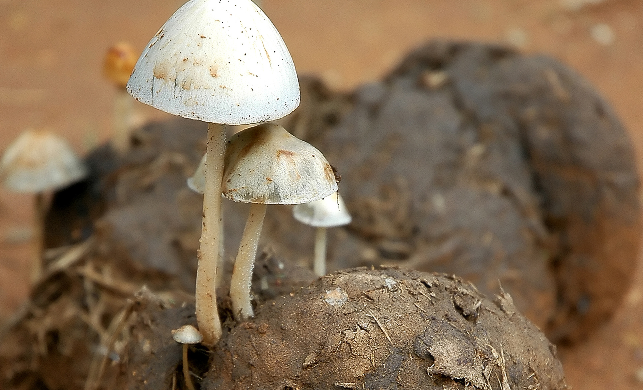
Image of mushrooms on manure from Shutterstock




Hey There. I discovered your blog using msn. That is a really smartly written article. I will be sure to bookmark it and return to learn extra of your helpful information. Thank you for the post. I will certainly return.
fake dr dre beats http://www.religionandnature.com/beats/fake-dr-dre-beats.html
The problem is the addiction to endless growth. Gently reduce the human population back to a balance with Nature and every family can eat out of their own garden. I know because that’s how I grew up from our own family garden.
I have been pointing out for years that organic farming is actually harder on the environment than modern farming. For the reason Karin describes in this excellent article, and many other reasons – not the least of which is the fact that it emits MORE CO2 then conventional farming, which is fine because CO2 is like Oxygen to plants – organic farming must remain a niche and never be allowed to reach the declared goal of the Organic Trade Association of 15% of farmland.
It is a huge mistake for organic agriculture to try to compete with massive million acre incorporated mega farms. Instead, smaller family-owned farms should be the basic policy. Then each town and village can feed itself both affordably and healthfully.
[…] Nitrate leeching a concern for organic systems too. Intensive is still intensive. Click here […]
http://www.hydrol-earth-syst-sci.net/18/333/2014/hess-18-333-2014.pdf
Thanks
Please list the resource reference for this report. Properly composted organic solids are relatively inert. It is the uncomposted manures that typically leach nitrates. I suspect the study author was looking at the traditional practice of applying raw manures, not compost. A compost is a mixture of ingredients to allow for nearly complete decomposition of material to a stable humus type component. This material absorbs or holds nutrients from water leaching while slowly releasing them in the presence of plant roots.
Many people do try to rush nature with applications of fresh or partially decomposed manures. This has been know for quite some time to lead to high nitrate levels. Does the study offer new information about compost or simply validate prior knowledge about manure. As a term, “compost” is often misused to imply proper biological degradation when this is really not the case.