
Desert plants fed with saltwater produce amazing new biofuel for Boeing and Etihad

salt-tolerant plants, halophytes, MIST biofuel research, aviation biofuel, Boeing, Etihad Airways, aviation industry biofuel research, aviation industry environmental impact, global emissions from planes, clean tech, desert research

In 2012, the world’s airlines transported three billion people, emitting 689 million tonnes of CO2 into the atmosphere. To mitigate the aviation industry’s future environmental impact, Boeing, Etihad Airways and the Masdar Institute of Technology are working on a groundbreaking new jet fuel made from desert plants fed with saltwater.

While the aviation industry only contributed two per cent of the world’s total CO2 emissions, its environmental impact is significant enough, and fossil fuels sufficiently infinite, that major airlines such as Boeing and Etihad are concerned to find new sources of clean energy.

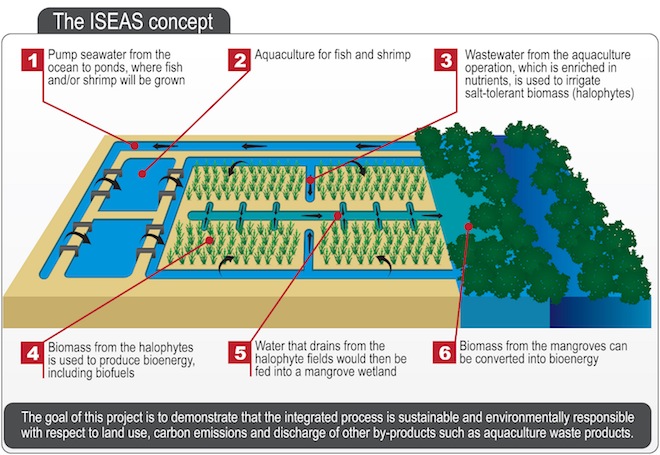
On January 18 the group announced that they have discovered that halophytes (plants that can grow in saline conditions) fed with nutrient rich wastewater produce an efficient biofuel. The leftover water from this can then be used to feed mangrove forests, where it is purified before returning to the Persian Gulf.

(Related post: UN says aquaculture could solve fish collapse)

The Sustainable Bioenergy Research Consortium (SBRC), affiliated with MIST at Masdar City, announced plans to test two halophyte crops in the United Arab Emirates in 2014.

“Plants called halophytes show even more promise than we expected as a source of renewable fuel for jets and other vehicles,” said Dr. Alejandro Rios, Director of the SBRC. “The U.A.E. has become a leader in researching desert land and seawater to grow sustainable biofuel feedstocks, which has potential applications in other parts of the world.”

This new biofuel, grown in parts of the desert that can’t be used to produce food, is expected to emit up to 80 per cent less carbon throughout its lifecycle than conventional fossil fuels.
salt-tolerant plants, halophytes, MIST biofuel research, aviation biofuel, Boeing, Etihad Airways, aviation industry biofuel research, aviation industry environmental impact, global emissions from planes, clean tech, desert research

SBRC produced the above infographic, which demonstrates how seawater will be pumped into a fish or shrimp farm. The byproduct of that, which is rich with nutrients, will be used to nourish the halophytes, and that wastewater will in turn be purified by the UAE’s ubiquitous mangrove forests before returning to the Gulf.

“This project can have a global impact, since 97 percent of the earth’s water is ocean and 20 percent of the earth’s land is desert,” Dr. Rios said.

“Boeing is committed to finding ways to reduce aviation’s carbon emissions, and sustainable aviation biofuels is a key component of our strategy,” said Jeffrey Johnson, president, Boeing Middle East at the World Future Energy Summit during Abu Dhabi Sustainability Week.

“Masdar Institute’s biofuel research is showing tremendous potential, and we applaud Abu Dhabi’s leadership and innovation in this critical area.”

On January 18, Etihad Airways completed a test flight with a 777-300ER that was powered with in part with biofuel refined in the UAE.

Lead image of salt-tolerant halophytes / Shutterstock

Tafline Laylin
Tafline Laylinhttp://www.greenprophet.com
As a tour leader who led “eco-friendly” camping trips throughout North America, Tafline soon realized that she was instead leaving behind a trail of gas fumes, plastic bottles and Pringles. In fact, wherever she traveled – whether it was Viet Nam or South Africa or England – it became clear how inefficiently the mandate to re-think our consumer culture is reaching the general public. Born in Iran, raised in South Africa and the United States, she currently splits her time between Africa and the Middle East. Tafline can be reached at tafline (at) greenprophet (dot) com.

Read More

11 COMMENTS
  1. To prevent ecocide and extinction two things must be done soon:

    1. Safely recycle 100% of all human-generated waste materials.
    2. Gently reduce the human population with family planning programs.

    Otherwise , the biosphere will collapse and the Earth will look like planet Mars

TRENDING

Atmospheric Water Generators won’t work until we create clean energy to power them

Water from air sounds like magic: machines pull moisture from the atmosphere and turn it into drinking water. But atmospheric water generation comes with an energy cost, making clean energy essential if the technology is going to help solve water scarcity without worsening climate change.

A billion dollar bet on Pacific Fusion’s New Mexico campus

Pacific Fusion is building a $1 billion fusion research facility in New Mexico, betting that enormous electrical pulses can help push fusion energy beyond the laboratory and toward practical clean power.

How to Read Your PG&E Bill After Installing a Heat Pump — and What to Expect the First Year

Electricity bill went up after your heat pump installation? Before you call the contractor, read this. A wrong rate plan, unadjusted thermostat schedule, and a missed baseline allowance are usually the culprit — not the system.

What Features to Check for the Best Air Operated Double Diaphragm Pump? Top 6 Important Qualities to Consider

Pumps are used in the cleantech industry to sustainably manage chemicals that may be dangerous to the environment

Life-Cycle Thinking Under Fire: Industrial Ecology Mission Amid Geopolitical Conflict

the relationship between the natural environment and industrial processes to promote sustainable development. The aim of this idea is to minimize environmental impacts and promote efficiency by integrating production and consumption development.

Scientists make lead-free perovskite solar cells that can weather the elements

Scientists have developed a “raincoat” for lead-free tin perovskite solar cells, helping them withstand air, moisture and heat while maintaining high efficiency.

The Essential Guide To Sustainability in Project Management

Sustainability is an approach where businesses and individuals balance the environmental, social, and economic aspects of a project such that current and future stakeholders are not overburdened with the impacts of the project in future.

Yerukim Forms a New Green Economy Where the Money is Really Green

The Yerukim members who pick up the recyclables get to keep the monetary reward, the public earns "green" bills that can be used in shops, and business owners get to be associated with environmentalism.

Choosing Riyadh over Dubai? What Investors Should Know

Saudi Arabia is deploying capital at unmatched scale to catalyze tourism and advanced industry while rewiring its power-and-water backbone. The investable frontier is widening—especially in renewables, grid storage, water efficiency/desal retrofits, and hospitality operating platforms. Prudent investors will insist on phased delivery, enforceable KPIs (energy, water, biodiversity), and RHQ/zone compliance—while pricing political-economy and reputational risks alongside growth upside.

Sell your cooking oil for biodiesel money

Want to make money on old french fry oil? Sell it.

Qatar Alternative Energy Summit Pairs Investors And Innovators

Alternative energy investors and innovators can meet n' greet in Doha, Qatar March 16 and 17.

Here’s How To Implement The Four Pillars Of Employee Engagement

If you throw a party for your work team and they are vegans, don't make it a barbecue. Know the sustainability values of your team to boost moral and retain good people.

Locals From Rishon Fight IKEA

Big Box stores are a pretty new concept in Israel, and thank God that not every Israeli city wants them in their backyard. A word from someone who has see the beautiful farmland around her hometown Newmarket, Ontario stripped and converted into vulgar strip malls of big box shops: they have no place in a healthy and sustainable town or city.

Popular Categories