
Building Integrated Photovoltaics Slash Energy Costs in Abu Dhabi

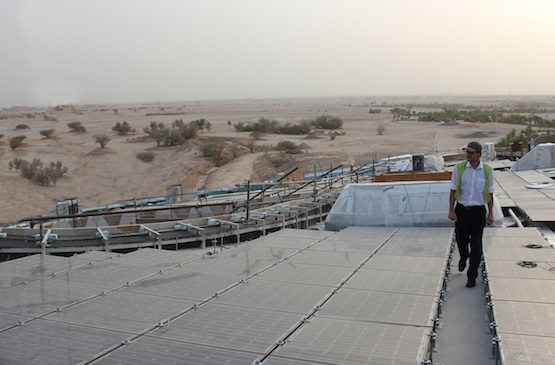
building integrated PV, BIPV, Dieter MoorDieter Moor of ertex solar examines the installation of his company’s solar project in Al Ain.

Finally the Middle East is attuned to the numerous benefits of solar energy, and large scale Photovoltaic (PV) and Concentrated Solar Power (CSP) plants are popping up all over the region. There’s Shams 1 outside of Abu Dhabi, the largest CSP plant in the world, Egypt’s hybrid CSP plant, Kuraymat, and most recently, Masdar inaugurated the largest PV plant in Africa, which is now generating a whopping 10 percent of Mauritania’s energy supply.

But small scale solar is catching on less quickly. In addition to being prohibitively expensive for most people, the government offers very little incentive for residents of the Middle East and North Africa (MENA) to coat their roofs with costly solar modules. It’s a shame, because a new study shows that affixing Building Integrated Photovoltaics (BIPV) to windows in Abu Dhabi could slash energy costs by as much as 33.5 percent.

BIPV = very good

Mohammad Katanbaf, an architect at KEO International Consultants Abu Dhabi, recently set out to determine how much energy businesses would save if they incorporated a certain number of BIPVs on their windows, according to The National.

For the sake of accuracy, he used very sophisticated computer modeling to match the United Arab Emirates’ specific climate, since temperature, wind, dust and other climatic conditions affect the efficiency of solar modules.

He told the paper that although he was expecting savings, their full extent surprised him. Trouble is, it’ll be a cold day in the desert if they are ever widely used, since the cost of BIPV modules is 30 percent higher than regular PV panels and even those aren’t hugely popular.

Elsewhere, feed-in-tariffs, a government protocol that purchases clean energy from whoever’s got extra, encourages residents and corporations to incorporate BIPVs or regular panels as a long term investment.

But in MENA, not only are governments a little slow to establish attractive FiT plans, but they also subsidize energy costs such that none but the most devout environmentalists are really motivated to spend the money necessary to either get off or reduce their dependence on the grid.

(Curiously, Iran did quit dirty energy subsidies and survived the ordeal – before the west intensified sanctions.)

Daniel Pedroso, Regional Manager of BIPV manufacturer Isofoton told The National that BIPVs won’t become a viable option in the Emirates until the government creates incentives that make the investment worthwhile.

The option is on the table, and Dubai’s Electricity and Water Authority (Dewa) is looking into it, but nobody is going to make sudden moves given the overall instability gripping the region.

And if you want to geek out on the stats, Katanbaf published his findings in the January edition of the journal Engineering.

Top image via ertex solar
Tafline Laylin
Tafline Laylinhttp://www.greenprophet.com
As a tour leader who led “eco-friendly” camping trips throughout North America, Tafline soon realized that she was instead leaving behind a trail of gas fumes, plastic bottles and Pringles. In fact, wherever she traveled – whether it was Viet Nam or South Africa or England – it became clear how inefficiently the mandate to re-think our consumer culture is reaching the general public. Born in Iran, raised in South Africa and the United States, she currently splits her time between Africa and the Middle East. Tafline can be reached at tafline (at) greenprophet (dot) com.

Read More

TRENDING

Scientists make lead-free perovskite solar cells that can weather the elements

Scientists have developed a “raincoat” for lead-free tin perovskite solar cells, helping them withstand air, moisture and heat while maintaining high efficiency.

Atmospheric Water Generators won’t work until we create clean energy to power them

Water from air sounds like magic: machines pull moisture from the atmosphere and turn it into drinking water. But atmospheric water generation comes with an energy cost, making clean energy essential if the technology is going to help solve water scarcity without worsening climate change.

A billion dollar bet on Pacific Fusion’s New Mexico campus

Pacific Fusion is building a $1 billion fusion research facility in New Mexico, betting that enormous electrical pulses can help push fusion energy beyond the laboratory and toward practical clean power.

How to Read Your PG&E Bill After Installing a Heat Pump — and What to Expect the First Year

Electricity bill went up after your heat pump installation? Before you call the contractor, read this. A wrong rate plan, unadjusted thermostat schedule, and a missed baseline allowance are usually the culprit — not the system.

Wave wind energy for Nvidia’s next AI energy boom?

As AI factories consume unprecedented amounts of electricity, NVIDIA is looking beyond chips and data centers to the ocean. The company recently spotlighted Israel's Eco Wave Power and its wave energy projects in Jaffa and Los Angeles, highlighting how AI, digital twins and renewable energy can work together to meet future power demands. The collaboration reflects a growing realization that the future of artificial intelligence may depend as much on clean energy infrastructure as it does on computing power.

Scientists make lead-free perovskite solar cells that can weather the elements

Scientists have developed a “raincoat” for lead-free tin perovskite solar cells, helping them withstand air, moisture and heat while maintaining high efficiency.

The Essential Guide To Sustainability in Project Management

Sustainability is an approach where businesses and individuals balance the environmental, social, and economic aspects of a project such that current and future stakeholders are not overburdened with the impacts of the project in future.

Yerukim Forms a New Green Economy Where the Money is Really Green

The Yerukim members who pick up the recyclables get to keep the monetary reward, the public earns "green" bills that can be used in shops, and business owners get to be associated with environmentalism.

Choosing Riyadh over Dubai? What Investors Should Know

Saudi Arabia is deploying capital at unmatched scale to catalyze tourism and advanced industry while rewiring its power-and-water backbone. The investable frontier is widening—especially in renewables, grid storage, water efficiency/desal retrofits, and hospitality operating platforms. Prudent investors will insist on phased delivery, enforceable KPIs (energy, water, biodiversity), and RHQ/zone compliance—while pricing political-economy and reputational risks alongside growth upside.

Sell your cooking oil for biodiesel money

Want to make money on old french fry oil? Sell it.

Qatar Alternative Energy Summit Pairs Investors And Innovators

Alternative energy investors and innovators can meet n' greet in Doha, Qatar March 16 and 17.

Here’s How To Implement The Four Pillars Of Employee Engagement

If you throw a party for your work team and they are vegans, don't make it a barbecue. Know the sustainability values of your team to boost moral and retain good people.

Locals From Rishon Fight IKEA

Big Box stores are a pretty new concept in Israel, and thank God that not every Israeli city wants them in their backyard. A word from someone who has see the beautiful farmland around her hometown Newmarket, Ontario stripped and converted into vulgar strip malls of big box shops: they have no place in a healthy and sustainable town or city.

Popular Categories