
Shams 1: World’s Largest Concentrated Solar Plant Goes Live

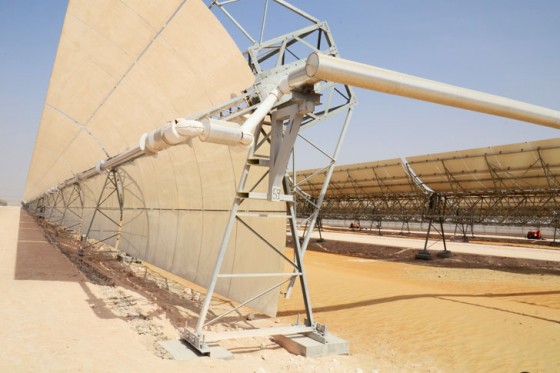
cleantech, Masdar, Shams 1, World's Largest CSP plant, solar power, renewable energy, The Shams 1 Concentrated Solar Plant (CSP) in Abu Dhabi is the largest of its kind in the world and it has finally gone live. Green Prophet visited the 100MW plant in the western region of the United Arab Emirates earlier this year as part of a Masdar-sponsored media tour during the World Future Energy Summit (WFES), and we were deeply impressed with the project’s progressive scope and size.

With 258,000 mirrors on 768 tracking parabolic trough collectors harnessing the sun’s energy to power a steam turbine, the plant developed by Shams Power Company occupies an area of 2.5 square kilometers or 285 football fields. Now that it is live, it is expected to generate sufficient energy to power 20,000 homes and divert 170,000 tons of CO2 emissions from the atmosphere each year.

It cost $600 million USD and took three years to build Shams 1 about 120km outside of Abu Dhabi. It features the most current parabolic trough technology, which made the most sense at the time that the project was conceived, and includes a natural gas-powered booster that maximizes the steam generation’s efficiency.

Masdar owns 60 percent of the plant, while Total and Abengoa each have a 20 percent stake in what Masdar claims is the largest plant of its kind.

“The inauguration of Shams 1 is a major breakthrough for renewable energy in the Middle East,” said Dr. Sultan Ahmed Al Jaber, CEO of Masdar.

“Just like the rest of the word, the region is faced with meeting its rising demand for energy, while also working to reduce its carbon footprint. Shams 1 is a significant milestone, as large-scale renewable energy is proving it can deliver electricity that is sustainable, affordable and secure.”

Probably more than any other Gulf nation, the United Arab Emirates has employed an aggressive strategy to scale up its renewable energy portfolio.

Not only are several solar power plants in the works, but in January the government-backed Masdar initiative announced plans to develop desalination plants that are powered by clean energy to further reduce fossil fuel consumption.

“Abu Dhabi is investing and incubating a new energy industry, domestically and internationally,” said Dr. Al Jaber.

“Through Masdar, the UAE is redefining the role it plays in providing the world with energy. From precious hydrocarbon exports to sophisticated renewable energy systems, we are balancing the energy mix and diversifying our economy – moving toward a more sustainable future. Today, the UAE is the only OPEC nation delivering both hydrocarbons and renewable energy to the international market.”

Now that Shams 1 is online, renewable energy produced by Masdar accounts for 68 percent of the Gulf’s capacity and 10 percent of the world’s CSP capacity. This is in part due to projects that Masdar has partnered with abroad, including the Gemasolar CSP plant in Spain.

“The Middle East holds nearly half of the world’s renewable energy potential,” said Santiago Seage, CEO of Abengoa Solar. “The abundance of solar energy is an opportunity to integrate sustainable, clean sources of power that address energy security and climate change. The region needs more projects like Shams 1, and we look forward to pushing the boundaries of future energy.”

Tafline Laylin
Tafline Laylinhttp://www.greenprophet.com
As a tour leader who led “eco-friendly” camping trips throughout North America, Tafline soon realized that she was instead leaving behind a trail of gas fumes, plastic bottles and Pringles. In fact, wherever she traveled – whether it was Viet Nam or South Africa or England – it became clear how inefficiently the mandate to re-think our consumer culture is reaching the general public. Born in Iran, raised in South Africa and the United States, she currently splits her time between Africa and the Middle East. Tafline can be reached at tafline (at) greenprophet (dot) com.

Read More

TRENDING

Wave wind energy for Nvidia’s next AI energy boom?

As AI factories consume unprecedented amounts of electricity, NVIDIA is looking beyond chips and data centers to the ocean. The company recently spotlighted Israel's Eco Wave Power and its wave energy projects in Jaffa and Los Angeles, highlighting how AI, digital twins and renewable energy can work together to meet future power demands. The collaboration reflects a growing realization that the future of artificial intelligence may depend as much on clean energy infrastructure as it does on computing power.

Collecting kinetic energy from roads; REPS turns traffic into a power plant

REPS announced a $23.6M equity financing round to scale...

AI data centers are triggering panic, instead of cleantech opportunities

AI may unintentionally become the economic engine that finally modernizes America’s aging grid. California is experiencing a massive AI data center boom, ranking 3rd in the U.S. with 227 operating centers and 54 more in development as of April 2026, according to Stanford.

Meet Seramic Materials from Abu Dhabi

Based in Masdar City, Abu Dhabi, Seramic Materials was founded in 2019 by Dr. Nicolas Calvet and Dr. Jean-François Hoffmann, researchers working at the intersection of renewable energy and materials science. The company grew out of the Masdar Institute ecosystem and is supported by clean tech programs like The Catalyst, with early backing of around $150,000 and more than $2 million invested in research and development over time.

Korean researchers create battery from greenhouse gases

Professor Ji-Soo Jang, in collaboration with Professor Taekwang Yoon of Ajou University and Professor Hansel Kim of Chungbuk National University, has developed a novel energy device that generates electricity during the process of capturing greenhouse gases.

Yerukim Forms a New Green Economy Where the Money is Really Green

The Yerukim members who pick up the recyclables get to keep the monetary reward, the public earns "green" bills that can be used in shops, and business owners get to be associated with environmentalism.

Choosing Riyadh over Dubai? What Investors Should Know

Saudi Arabia is deploying capital at unmatched scale to catalyze tourism and advanced industry while rewiring its power-and-water backbone. The investable frontier is widening—especially in renewables, grid storage, water efficiency/desal retrofits, and hospitality operating platforms. Prudent investors will insist on phased delivery, enforceable KPIs (energy, water, biodiversity), and RHQ/zone compliance—while pricing political-economy and reputational risks alongside growth upside.

Sell your cooking oil for biodiesel money

Want to make money on old french fry oil? Sell it.

Qatar Alternative Energy Summit Pairs Investors And Innovators

Alternative energy investors and innovators can meet n' greet in Doha, Qatar March 16 and 17.

Here’s How To Implement The Four Pillars Of Employee Engagement

If you throw a party for your work team and they are vegans, don't make it a barbecue. Know the sustainability values of your team to boost moral and retain good people.

Locals From Rishon Fight IKEA

Big Box stores are a pretty new concept in Israel, and thank God that not every Israeli city wants them in their backyard. A word from someone who has see the beautiful farmland around her hometown Newmarket, Ontario stripped and converted into vulgar strip malls of big box shops: they have no place in a healthy and sustainable town or city.

The Jewish National Fund Meets An Inconvenient Truth

According to the JNF, it has transformed thousands of acres of barren land into green forests in Israel. They state that each person emits about 23 tons of carbon per year, estimating that each tree planted can absorb one ton of carbon in its lifetime. That's a whole lot of trees you'd need to be planting. Could so many fit in Israel?

How to quiet noise from construction in your office

Streets need to be resurfaced in New York but the humming and grinding noise is unsettling. Noise is environmental pollution. 

Popular Categories