Who’s Got the Wind Power in the Middle East?

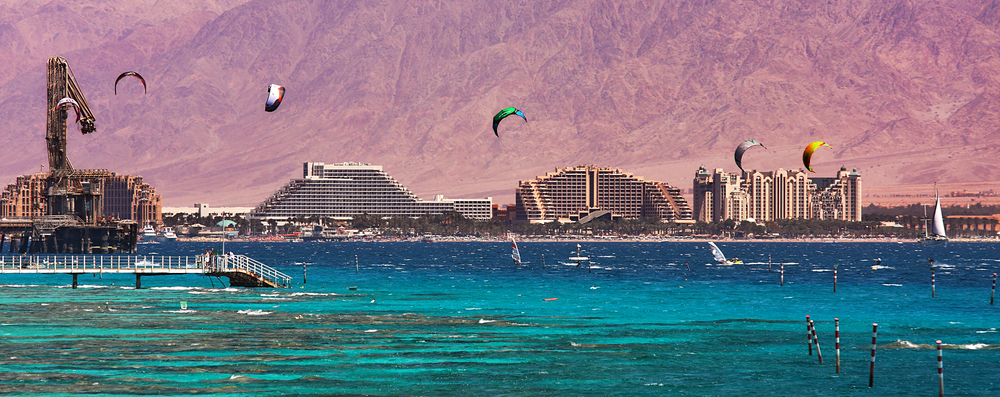
kite surfing red sea, Eilat, IsraelWho’s got the wind in the Middle East? Morocco and Egypt have the biggest wind power plants, but don’t discount Iraq, Qatar, Saudi Arabia and the United Arab Emirates.

Wind power has taken a backseat to solar power across the Middle East and North Africa, but there are still some ambitious projects in wind power being undertaken across the region. Leading that charge is Egypt and Morocco, who have continued to push forward on alternative energy despite facing political turmoil in their respective countries. But don’t count out Iraq, Qatar, Saudi Arabia and the United Arab Emirates, who are all currently looking to develop wind energy.

Adapting a sophisticated climate model, researchers show that there is plenty of wind available to supply half to several times the world’s total energy needs within the next two decades. If the world is to shift to clean energy, electricity generated by the wind will play a major role, and there is more than enough wind for that, according to research from Stanford and the University of Delaware.

The Middle East North Africa region has been instrumental in the push for solar power, but wind projects are finally beginning to take form, or in development across what we call the MENA region. Two of the largest wind farms in the world are in the region, in Morocco and Egypt.

Morocco’s Tarfaya Wind Farm

Morocco’s state utility Office National d’Electricite (ONE) awarded a $350 million, 20-year PPA contract for the 300 MW Tarfaya wind power plant to a consortium consisting of the local firm Nareva and the UAE-based Karabel Fez/International Power (a subsidiary of GDF Suez Energy International) and International Power from the UK after months of haggling over the details.

The plant, which will be financed by Attijariwafa Bank, Banque Marocaine du Commerce Extérieur (BMCE) and France’s Banque Populaire, will be built astride the Atlantic ocean in southern Morocco.

It is said to be the largest such plant on the African continent.

Egypt’s Zaafarana and Elsewedy Towers

Touted as the largest wind turbine towers site in the MENA region, Egypt hopes that this project will help generate a massive amount of electricity to the country. According to reports, it is strategically located near Ain Sokhna on the Red Sea, which will allow it easy transportation to the Zaafarana farm a few kilometers to the south, and to the Suez Canal for global exportation to the MENA region, Europe and the United States.

At its location are 700 wind turbines that produce a total capacity of 550 megawatts (MW). It is still yet to be fully operational, but the government hopes to boost capacity in the near future.

Wind at the Red Sea

The Red Sea has the ability to be transformed by Egypt, Israel, Jordan and Saudi Arabia and over the past two years, this is finally becoming reality. Egypt is leading that charge, as seen with the Zaafarana and Elsewedy projects. But in the past few months, Saudi officials have said they are looking to take advantage of the Red Sea coastal areas in establishing potential wind farms to help boost renewable energy output.

Of note:

Iraq has announced that it is to put forward $1.6 billion in the next three years aimed at establishing an alternative energy sector, of which a large portion will be in the wind turbine sector.

Also aiming to enter the wind industry is Saudi Arabia, which has in recent months named five areas as targets for future wind turbine farms, which the government hopes to unveil and begin work on the projects next year.

While wind is still in the works as countries look to solar power as the number one renewable source of energy and electricity, as we have seen in the UAE, Saudi Arabia, Qatar and Iraq, wind power is finally becoming a focal point of energy strategies. This may take some time, but all countries in the region seem keen on developing this sector.

Image of kite surfing on the Red Sea from Shutterstock

Read More

TRENDING

Dan Zaslavsky’s energy tower dream is rising again in Iran and China

The Energy Tower idea never made the leap from drawings and engineering studies to full-scale construction. But nearly two decades after most people stopped talking about it, the concept is quietly evolving in two unexpected places: China and Iran. The concept let dreamers dream and doers do - figuring out more pleasing designs and engineering.

A visit to Amirim, Israel’s first all-vegetarian village in the Galilee

Just 15 kilometers from Tzfat there is a moshav that was founded in the late 50s that was ideologically influenced by organic, vegetarian and vegan principles. My hostess at Ohn-Bar, the tzimmer where I stayed, explained that the people of Amirim were among the pioneers of Israel’s strong vegetarian movement.

Israeli Hydrogen Startup H2Pro Are Trying to Solve Clean Energy’s Hardest Problem

The company has attracted backing from major investors including Breakthrough Energy Ventures, the climate fund founded by Bill Gates, along with industrial partners such as Sumitomo, ArcelorMittal, and Temasek, a multi-billion dollar company that owns Singapore airlines. H2Pro has raised more than $100 million USD and is moving from pilot projects toward commercial-scale deployments.

Desalination experts debunk Aqua Solaire, the floating desalination barge

AI makes it easy to dream, develop, and create images of what could be world-changing ideas, until the reality sets in. A new project making the rounds is Aqua Solaire, an allged French concept for a solar-powered desalination vessel designed to bring drinking water to coastal communities facing drought, storms, and infrastructure failures.

Hormuz 2026 Conflict Poses an Energy and Food Security Dilemma in a Warming World

As tensions rise in one of the world’s most critical maritime chokepoints, the ripple effects go far beyond oil—touching food systems, climate pressures, and regional stability

Here’s How To Implement The Four Pillars Of Employee Engagement

If you throw a party for your work team and they are vegans, don't make it a barbecue. Know the sustainability values of your team to boost moral and retain good people.

Locals From Rishon Fight IKEA

Big Box stores are a pretty new concept in Israel, and thank God that not every Israeli city wants them in their backyard. A word from someone who has see the beautiful farmland around her hometown Newmarket, Ontario stripped and converted into vulgar strip malls of big box shops: they have no place in a healthy and sustainable town or city.

The Jewish National Fund Meets An Inconvenient Truth

According to the JNF, it has transformed thousands of acres of barren land into green forests in Israel. They state that each person emits about 23 tons of carbon per year, estimating that each tree planted can absorb one ton of carbon in its lifetime. That's a whole lot of trees you'd need to be planting. Could so many fit in Israel?

How to quiet noise from construction in your office

Streets need to be resurfaced in New York but the humming and grinding noise is unsettling. Noise is environmental pollution. 

EarthX and a blueprint for sustainable investing

Trammell S. Crow, a Dallas-based businessman and father of four, is focusing his efforts on impact investing, and media that focuses on saving the planet through EarthX.

Mining Afghanistan’s Mineral Discoveries Similar to Avatar

Now that American forces in Afghanistan are commemorating the longest period of any war that America has been involved in, including the 1965-73 Vietnam War, the recent discoveries of large and extremely valuable mineral and metal deposits may finally bring to light a reason to continue the presence of US fighting forces in this war torn and backward country.

From Pilot Plant to Global Stage: How Aduro Clean Technologies’ 2026 Expansion Signals a Turning Point for Chemical Recycling Investors Like Yazan Al Homsi

The company's Next Generation Process (NGP) Pilot Plant in London, Ontario, has officially moved into initial operating campaigns, generating the kind of structured, repeatable data that separates laboratory promise from commercial viability.

Nobul’s Regan McGee on Shareholder Value: “Complacency Is the Silent Killer” 

Why the governance framework designed to protect shareholders so...

Popular Categories