
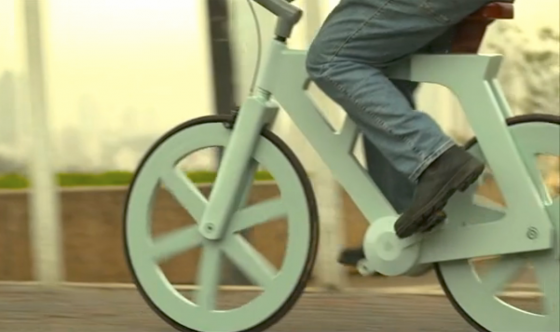


Could it be a world-changer? A cheap solution to help African kids get to schools and clinics? Israel’s Izhar Gafni (who we interviewed here) had an outlandish idea to create a durable cardboard bike from scratch with raw materials sum totalling about $9. Add in some labor costs and you can get a pretty cheap ride, one worth buying in a world where bike theft is rampant.

News reports are circling around the world that Gafni’s cardboard bike (see photos here) is headed to market. No doubt after articles and videos about his project infected the world’s media. Reuters is reporting:
“When we started, a year and a half or two years ago, people laughed at us, but now we are getting at least a dozen emails every day asking where they can buy such a bicycle, so this really makes me hopeful that we will succeed,” he said.
Hus business partner Nimrod Elmish, Gafni’s business partner says that by using cardboard and other recycled materials there can be a huge change in production norms. Companies could get grants and rebates for local production, offering no real reason to make them in poor and cheap labor markets.
[youtube]http://www.youtube.com/watch?v=txSboSNQINs[/youtube]
At a cost of about $20, and made on automated production lines, the workforce could employ pensioners and the disabled, while the business model he has penned could work a lot like Tom’s shoes, which gives away a free pair of shoes for every pair sold to a western buyer.

Estimated to last 10 years, the cardboard bike will also weigh two-thirds the weight of a regular bike. If it breaks or melts you can recycle it and buy a new one.
Millions of people are emailing us for Izhar Gafni’s cardboard bike contacts. Please reach out to him via his Facebook page. Ride on Gafni! We are rooting for you.




I wrongly assumed that it was in the US at first. To discover
it was here in the UK is quite saddening.
The picture on the Facebook page http://www.facebook.com/izhar.gafni doesn’t look like Mr. izhar gafni at all.
Is it really his Facebook page or just someone else with the same name???
Well it is him. I have been in contact with him through this Facebook account.
Anybody could give me the email of Izhar Gafni or someone whom I can contact to buy in bulk these bikes plz. Thank you very much guys 🙂
If he is able he will respond to you via Facebook:
http://www.facebook.com/izhar.gafni
The cardboard bikes are not yet on the market, but are going to market, as we’ve learned.
Actually I am inspired by Gafni’s enthusiasm and optimism. But that does not mean that what I say about the components is not essentially correct. Now let us write a a checklist of all the components of the bicycle. We can sort the components into three categories: cardboard, conventional materials, or absent. What would the list look like? Gafni’s video says that eventually almost all of it will eventually be cardboard. But what he has shown the world is the prototype, and for the prototype, my guessed list seems to be as follows. I would be glad to see this list corrected by Gafni:
Frame: Cardboard
Suspension: Absent
Pedals: Conventional
Cranks: Unknown, “no metal inside”
Transmission: Conventional
Gears: Absent:
Gear shifters and cables: Absent
Headset: Conventional
Bottom bracket: Conventional
Wheel bearings: Conventional
Axles: Conventional
Wheel attachment: Conventional
Wheel stucture (replaces spokes and rims): Cardboard
Tires: Solid recycled, or pneumatic non-recycled
Paint: Conventional
Brake levers: Conventional
Brake cables: conventional
Brake mechanisms: 1 conventional, 1 absent
Brake surfaces: Absent
Saddle: cardboard
Saddle adjustment: Absent
Lights: Absent
Handlebars: Cardboard
A bike is so much more than a pair of wheels and a frame: If you make a complete bike by filling in all the absent components, and then add in all the parts that must be made conventionally, the total is not a cardboard bike, and it cannot be made with $9 of materials. Most of the expensive components of the bike must still be conventional. “Cannot” is still part of my vocabulary, but I have a great and happy life. My family has 8 conventional bikes and a tandem.
J. Frank. I just wrote an email to the inventor of the cardboard bike, Izhar Gafni, and this is what he wrote to me in response to your last comment:
“Hi Karin
The only comment I have in mind is that a person with the vocabulary of cannot and impossible reputably used will not be able to change any given thing in is life and I feel sorry for him. The only way to change and innovate new idea is to think of ways to overcome the issues we are facing and by doing so we can create what we dream of and same goes to our lives. As for the cranks are metal inside I’m really sorry to disappoint you but there are no metal inside
think positive it will make your life way better.”
A well-built cardboard frame is not impossible for a bicycle. As such, this is not really so original: The BBC showed a student’s cardboard bicycle 4 years ago. See here : http://news.bbc.co.uk/2/hi/uk_news/england/7457220.stm
However, many of the critical and expensive components of a bike cannot be made of cardboard. An example I quoted above is the cranks. It seems that this “alpha” prototype is not really as much cardboard as the uniform paint job might lead you to think. My guess is that the cranks are metal inside, otherwise, as I said, the pedals would fall right off. Same for the headset bearing area, the bottom bracket, the support area (“dropouts”) for the bearings of both wheels. Same for the wheel hubs. Cardboard handlebars can work, until you apply significant force to them, so they are intrinsically very unsafe. You could ride on a cardboard saddle for the duration of a video, but after a few miles, it would be prohibitively uncomfortable. would need a skin transplant. Either the tires are conventional, non recycled and pneumatic, or they are solid and made of recycled rubber, as the inventor has claimed, in which case there is no need for the inflation valves. Still there is lots of definite bluffing going on. The rear brake, with just a lever but no cable or mechanism, os definitely a bluff. The front brake, as I said, if used, would crush or rip a cardboard wheel. So now imagine a “cardboard bike” which uses conventional components for tires, braking surfaces, brake mechanisms, transmission, gears, axles, hubs, dropouts, headset, bottom bracket, cranks, pedals, handlebars, lights and brake levers. It’s not really a cardboard bicycle, is it? And certainly, it’s not going to be sold anywhere for $9 or $20. This is a bluff.
And by the way, do you remember my nay-saying with Innowattech a couple of years ago? Have they made dollar’s worth of electricity yet? In retrospect, do you now agree I was right to label their claims as as nonsense?
I already read on other websites that bike will cost at least $20. Add shipping or licensing fees if it going to built in Africa. It will cost at least $30. Personally, I do not believe even for a second that it is going to be mass-produced.
Well I guess we’ll have to wait and see who finances it.
The $9 is the cost of materials.
This cardboard bike is all over the internet, but has anybody noticed that no independent journalist has taken a ride on this prototype bike? The only thing we see is the video issued by the inventor. There is good reason for this. It’s not what it promises to be. Either it’s not cardboard, or it will fall apart as soon as somebody tries riding it on anything other than a very smooth and flat path. Take a close look. First, note the pedals. They are conventional pedals. If you screw these into cardboard, or even into wood, they will just break off. The stress concentrated where the pedals attach is so great that if you pedal this thing even a little hard, or ride over a bump by standing up on the pedals, the pedals will come right off. Next note the brakes. The front brake uses a conventional mechanism but the brake shoes rub against the coated cardboard. The forces here are huge. No cardboard wheel could survive this. There are no scratches where the brakes would rub the wheel: proof that the brake has not been used. Anyway just this brake mechanism costs more than $9!. As for the rear brake, that’s a real bluff. There is just a lever: no cable and no brake mechanism. Next look at the seat: You can’t adjust its height. Gears: None. Suspension: None. What about the inflation valve that is on just one of the two wheels. Another bluff: We are told that the tires are solid! The belt transmission looks too flimsy for any real pedaling. That is why no other bikes uses such belts; they are much lighter than bike chains, but no commercial lightweight bikes use them, and for good reason. How did he calculate the cost of manufacture at $9? Another bluff. So here is a bike that will not survive any test. Pedals can’t work, transmission too weak, no seat adjustment, no suspension, no brakes, in short, it’s no use. Certainly not on a 3rd world dirt path.
He said the materials cost $9. Izhar looks pretty hefty. If it can carry his weight then why is it a bluff? He seems like a genuinely guy not a money-hungry business man. I hope your prophecy of doom doesn’t come true.