

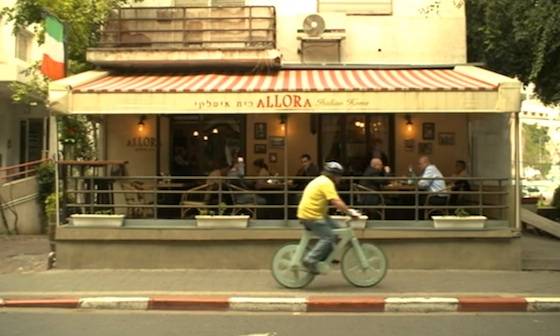
 We interview Izhar Gafni, the inventor of the cardboard bike.
Izhar Gafni, inventor of innovative cardboard bike plans to keep production local, he tells Green Prophet: “I’m not interested in selling to some huge concern that will slap a “Made in China” label on the bike,” he says. “I’d like production to take place in local factories, ones employing challenged or special-needs people.”
Gafni’s green vision expands to encompass, “One hundred future projects made out of cardboard.” Even a cardboard car using solar and human energy.
Why not? ‘Obstacle’ doesn’t seem to be a word that this mechanic without limits recognizes. (Israeli ingenuity with cardboard has already produced no-tools-needed furniture.) “I want to help stop our dependence on petroleum,” Gafni adds. Since our first post on the cardboard bicycle, readers have been asking questions about it. Read on for answers.
GP:Are the bikes on the market yet?
Gafni: No, my partner and I are still negotiating with investors. We hope to sell in Israel, Europe and the US, when we start production. I want to see the bike anywhere I travel.
We assured Gafni that the cardboard bike already has fans just waiting to snap some up.
GP: How long did it take to produce the bike?
Gafni: It took six prototypes and three years. There’s very little scientific knowledge about cardboard’s engineering and structural limits. I had to find out everything myself, through experimenting. For example, the bike’s water resistance isn’t due to the painted-on colors. It’s due to the cardboard itself.
GP: One reader asked if the bike’s seat is comfortable. What can you tell us about that?
Gafni: I designed it for comfort. It’s modeled on the British Brooks leather seat. The design may still be modified, or an option such as a bucket seat may be offered. We are working on making the seat height adjustable too.
GP: How long is the bike’s expected life?
Gafni: Two years, maybe longer.
GP: Two rainy winters too?
Gafni: (laughing) Oh yes, it should get through two winters also. Its life will depend on how it’s used, like any other product. It hasn’t been around long enough to say for sure, but I’m confident that each bike will last two years at least.
GP: What other advantages does the bike have to the consumer, beside the low cost?
Gafni: It’s a low-carbon vehicle and good for the environment. In addition, it doesn’t need pre-assembly and doesn’t even need maintenance.
GP thinks: Can this be the end of punctured tires and bicycle pumps?
GP: Tell us a little about previous projects you’ve worked on.
Gafni: I lived in California for years, where I designed the robot that sewed the New Balance company’s shoes. I like to say I sewed President Clinton’s sneakers. In Israel, I put together a press to extract pomegranate juice for the boutique winery Rimon. These are just some of my past projects.
GP: Did you study engineering and design?
Gafni: I taught myself almost everything I know.
Thanks, Izhar Gafni, and we’re holding our breath till the cardboard bike hits the road.
Previous posts about cardboard design on Green Prophet:
- The $9 Cardboard Bike From Israel: Photos
- Cardboard Mounted Deer Heads for the Eco-Conscious Decorator
- Sanserif Creatius Carves a Cardboard Table with Arabic Devotion
Photograph: Uri Ackerman



I am very interested this new hi-tech project!How can I contact Mr Izhar Gafni?
Thanks
Congratulation. Hope that there is a Nobel Price for this invention.
Ishar, would like to be first person in Mexico City to own one and would love to be your representative for Mexico.
Hope that you get this e-mail.
ABFAB.
Volkhard
Izhar,your endeavors give me joy to be alive, to be able to see what we are indeed capable of accomplishing you are more than an inspiration, if only our leaders (politicians) had a little of your creativity and intelligence we could go very far. Thank you for not giving up and continuing to dream and create amazing things!!!
What a beautiful, green innovation. I am working for New York Business Consultants LLC, a business development company in NY and we will try to get an investor. I’d love to be able to ride a cardboard bike one day.
Malko Ebers, CEO NYBC
Readers looking to contact Izhar Gafni will find him on Facebook and LinkedIn.
Izhar… you gave me joy.
Hi
How can I contact Mr Gafni?
Thanks
Jeffrey
Try via Facebook
How can I contact Mr Izhar Gafni?
Thanks
What will they think of next? 😛