Earth. Energy. Everything next.

Perseid Meteor Shower Attracts Hundreds to Mideast Deserts

The show isn’t over yet.

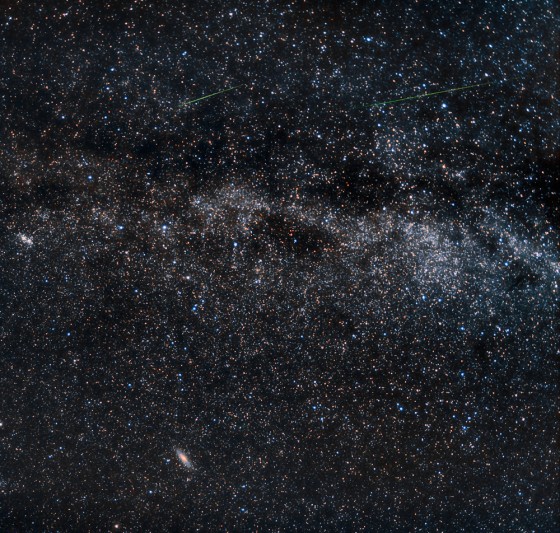
Sky gazers traveled to Mitspeh Ramon, a town on the edge of the Ramon Crater in the Negev desert this weekend. Others followed onthegotours.com to Jordan’s Mt Nebo, Madaba and Wadi Rum. Still others traveled with adventurecompany.co.uk to the Sinai desert in Egypt.  These isolated places all have a resource that Tel Aviv and other great Middle Eastern cities lost long ago.  The skies here are relatively free of clouds and air pollution and they are very dark. Dark enough to see the wispy remnants of a dying comet.  The Perseid meteor shower appears reliably every year as the earth passes through the debris of Comet Swift-Tuttle in August.  It comes at a convenient time for those in the northern hemisphere who are enjoying the great outdoors and spending warm evenings outdoors, around campfires.  This year’s peak came during the weekend of August 11 to 12 when the crescent moon rose too late to wash out the display.

You don’t need a telescope or even binoculars to see the Perseids and this year’s show isn’t over yet.  The stream lasts until the last week in August or until the next full moon washes out all but the brightest meteors.  All you need is a clear dark sky.

Sometimes it is helpful to have a comfortable chair or blanket to lie on so you can look up for hours.  Some of the astronomy guides say to wait until after midnight (I will say that waiting at least an hour after dark will minimize the number of mosquitoes you’ll encounter.)

They say to look near the constellation Perseus in the northeastern sky. But since a meteor can appear anywhere in the sky, just pick a spot where you’ll be comfortable and where the sky looks dark (e.g. if a city or the neighbors to your north shines lights into your eyes, look south.)  I looked straight up while lying inside an canoe until the clouds came.

Dark starry skies are increasingly rare around the world and yet, to see stars, planets, meteors and comets as they were meant to be seen it isn’t necessary to travel to outer space.  It is only necessary to find a place away from city lights and pollution and look up.

Image of meteor shower from Shutterstock

Brian Nitz
Brian Nitzhttp://www.greenprophet.com
Brian remembers when a single tear dredged up a nation's guilt. The tear belonged to an Italian-American actor known as Iron-Eyes Cody, the guilt was displaced from centuries of Native American mistreatment and redirected into a new environmental awareness. A 10-year-old Brian wondered, 'What are they... No, what are we doing to this country?' From a family of engineers, farmers and tinkerers Brian's father was a physics teacher. He remembers the day his father drove up to watch a coal power plant's new scrubbers turn smoke from dirty grey-back to steamy white. Surely technology would solve every problem. But then he noticed that breathing was difficult when the wind blew a certain way. While sailing, he often saw a yellow-brown line on the horizon. The stars were beginning to disappear. Gas mileage peaked when Reagan was still president. Solar panels installed in the 1970s were torn from roofs as they were no longer cost-effective to maintain. Racism, public policy and low oil prices transformed suburban life and cities began to sprawl out and absorb farmland. Brian only began to understand the root causes of "doughnut cities" when he moved to Ireland in 2001 and watched history repeat itself. Brian doesn't think environmentalism is 'rocket science', but understanding how to apply it within a society requires wisdom and education. In his travels through Europe, North America, Asia and the Middle East, Brian has learned that great ideas come from everywhere and that sharing mistakes is just as important as sharing ideas.

Read More

TRENDING

Cities promise net zero. A new UN-aligned checklist asks them to prove it

At COP31 in Türkiye, a new climate checklist challenges cities to prove their net-zero promises with measurable action, transparent reporting and real emissions cuts.

Petra by Night returns as Jordan tries brings tourists back to Wadi Rum

The Nabataeans understood that prosperity in the desert depended on respecting environmental limits. Two thousand years later, Petra's greatest attraction may still be the wisdom of the people who learned to live within them.

The pulsing planet and the earthquakes that shape our world

One of the most persistent questions in seismology concerns whether scientists will eventually be able to predict major earthquakes before they happen.

Amman’s traffic crisis is about more than cars. It’s about how we think

I believe Jordan needs a cultural transformation alongside its infrastructure investments. We must begin by redefining social prestige. Why should ownership of an expensive car be considered a greater achievement than making an environmentally responsible transportation choice? Why should travelling by bus carry a social stigma?

Why water-starved Amman keeps flooding and how underground rain tanks could help

Jordan's capital faces a troubling paradox: chronic water shortages and destructive winter floods. Hydrogeological expert Dr. Osama MN Gazal explains how underground rainwater tanks and green infrastructure could help Amman capture precious rainfall, reduce flooding and build a more water-secure future.

Why Bronwyn Finnegan Chose the Nonprofit Sector Over Politics or Corporate Life

Bronwyn Finnegan could have pursued a career in politics or corporate leadership. Instead, she chose the nonprofit sector, where she focuses on financial sustainability, governance and helping mission-driven organizations build the capacity to survive and grow.

Scientists make lead-free perovskite solar cells that can weather the elements

Scientists have developed a “raincoat” for lead-free tin perovskite solar cells, helping them withstand air, moisture and heat while maintaining high efficiency.

The Essential Guide To Sustainability in Project Management

Sustainability is an approach where businesses and individuals balance the environmental, social, and economic aspects of a project such that current and future stakeholders are not overburdened with the impacts of the project in future.

Yerukim Forms a New Green Economy Where the Money is Really Green

The Yerukim members who pick up the recyclables get to keep the monetary reward, the public earns "green" bills that can be used in shops, and business owners get to be associated with environmentalism.

Choosing Riyadh over Dubai? What Investors Should Know

Saudi Arabia is deploying capital at unmatched scale to catalyze tourism and advanced industry while rewiring its power-and-water backbone. The investable frontier is widening—especially in renewables, grid storage, water efficiency/desal retrofits, and hospitality operating platforms. Prudent investors will insist on phased delivery, enforceable KPIs (energy, water, biodiversity), and RHQ/zone compliance—while pricing political-economy and reputational risks alongside growth upside.

Sell your cooking oil for biodiesel money

Want to make money on old french fry oil? Sell it.

Qatar Alternative Energy Summit Pairs Investors And Innovators

Alternative energy investors and innovators can meet n' greet in Doha, Qatar March 16 and 17.

Here’s How To Implement The Four Pillars Of Employee Engagement

If you throw a party for your work team and they are vegans, don't make it a barbecue. Know the sustainability values of your team to boost moral and retain good people.

Popular Categories