
Wild Grains And Our Daily Bread Threatened by Global Warming

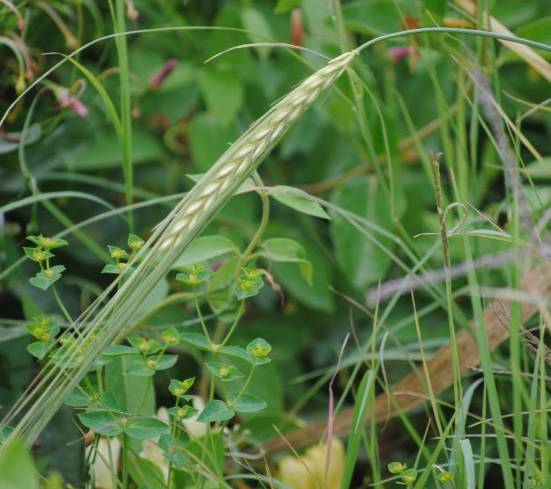
wild grains global warmingSturdy wild wheat and barley are essential for humanity’s survival. New study shows we are losing  genetic diversity

Israel’s wild wheat and barley are known to be the ancestors of our modern grains.  When Man  cultivated them, their genetic resistance to drought and disease carried over to cultivated varieties. This aided mankind’s struggle to grow predictable harvests and put fresh bread on the shelf every day.  Great, but all that’s history, right? One would think that with the modern world’s stores of cultivated grain, and seed banks to back up those supplies, our future food sources are safe. At least in regard to that essential staple, bread.

It’s not so simple. Threats to our food supply, and that of future generations, are now coming from man-made time bombs like Monsanto’s sterile GMO seeds. Monsanto is currently working on producing GMO wheat. In addition, according to researchers at the University of Haifa’s Institute of Evolution, global warming has already caused disturbing genetic changes in wild wheat and barley.  In a chain of dependency, science borrows wild grains’ genetic material to improve modern wheat and barley’s ability to survive a hotter, drier world. And to feed our hunger. The question is, how much longer will we be able to depend on them?

Prolonged drought has already caused half a million people to abandon their homes in Syria alone. More droughts are predicted around the world. Together with a rising world population and consequent rising food demands, science’s ability to transfer drought-resistant genetic characteristics from wild grains is crucial.

In a recent study led by Prof. Eviatar Nevo from the Institute of Evolution, wheat and barley grains taken from locations across Israel over 1980, 2008 and 2009 were green-house grown upon gathering. The grains flowered an average of 10 days early.

This sounds like adaptability and increased drought resistance on one hand – grains with welcome new genetic material which we can use to improve cultivated varieties.

On the dark side, the same study shows that grains grown in 2008 have less genetic diversity compared to those grown in 1980. It’s not clear if this  foretells the opposite – erosion of  desirable characteristics for grain survival.

Israel’s territory contains a multitude of ecosystems, but many have shrunk away because of too-few nature reserves, and those too small to preserve ecosystems in their entirety. In spite of ongoing conservation efforts by the Israel Nature Reserves Authority, there’s less open land in which wild grains can thrive.

“We have a large gene bank and are constantly trying to find ways to upgrade cultivars,” Prof Nevo told Haaretz newspaper. “The findings of the current research prove a need for much more massive action to allow wild strains to flourish in nature as well.”

This calls for special protection measures and  legal management of wild spaces. Will the government wake up and put the needed conservation legislation in place?

:: Haaretz

More on wheat and food from Green Prophet:

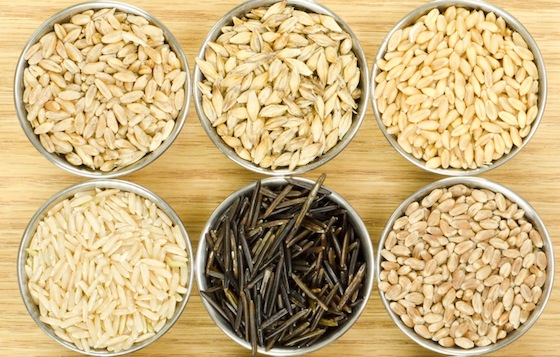
Image of grains from Shutterstock

Miriam Kresh
Miriam Kreshhttps://www.greenprophet.com/
Miriam Kresh is an American ex-pat living in Israel. Her love of Middle Eastern food evolved from close friendships with enthusiastic Moroccan, Tunisian and Turkish home cooks. She owns too many cookbooks and is always planning the next meal. Miriam can be reached at miriam (at) greenprophet (dot) com.

Read More

1 COMMENT

TRENDING

Dan Zaslavsky’s energy tower dream is rising again in Iran and China

The Energy Tower idea never made the leap from drawings and engineering studies to full-scale construction. But nearly two decades after most people stopped talking about it, the concept is quietly evolving in two unexpected places: China and Iran. The concept let dreamers dream and doers do - figuring out more pleasing designs and engineering.

A visit to Amirim, Israel’s first all-vegetarian village in the Galilee

Just 15 kilometers from Tzfat there is a moshav that was founded in the late 50s that was ideologically influenced by organic, vegetarian and vegan principles. My hostess at Ohn-Bar, the tzimmer where I stayed, explained that the people of Amirim were among the pioneers of Israel’s strong vegetarian movement.

Billie Eilish’s Mom Takes the Stage at Hollywood Climate Summit — But Does Hollywood Still Care About Climate Change?

Hollywood once promised to help save the planet. Leonardo DiCaprio warned of climate catastrophe from awards stages. Celebrities flew to climate conferences. Studios pledged greener productions. Streaming platforms rushed to commission environmental documentaries. But in 2026, with the aftermath of wildfires, heatwaves and floods becoming routine, a question lingers: Does Hollywood still care about climate change?

Can Scientists Predict Coral Bleaching Before It Happens?

Now researchers at the Woods Hole Oceanographic Institution (WHOI) in the US say they have developed a way to predict coral bleaching five to six months before it occurs, potentially giving reef managers enough time to intervene and save vulnerable corals.

Israeli Hydrogen Startup H2Pro Are Trying to Solve Clean Energy’s Hardest Problem

The company has attracted backing from major investors including Breakthrough Energy Ventures, the climate fund founded by Bill Gates, along with industrial partners such as Sumitomo, ArcelorMittal, and Temasek, a multi-billion dollar company that owns Singapore airlines. H2Pro has raised more than $100 million USD and is moving from pilot projects toward commercial-scale deployments.

Locals From Rishon Fight IKEA

Big Box stores are a pretty new concept in Israel, and thank God that not every Israeli city wants them in their backyard. A word from someone who has see the beautiful farmland around her hometown Newmarket, Ontario stripped and converted into vulgar strip malls of big box shops: they have no place in a healthy and sustainable town or city.

The Jewish National Fund Meets An Inconvenient Truth

According to the JNF, it has transformed thousands of acres of barren land into green forests in Israel. They state that each person emits about 23 tons of carbon per year, estimating that each tree planted can absorb one ton of carbon in its lifetime. That's a whole lot of trees you'd need to be planting. Could so many fit in Israel?

How to quiet noise from construction in your office

Streets need to be resurfaced in New York but the humming and grinding noise is unsettling. Noise is environmental pollution. 

EarthX and a blueprint for sustainable investing

Trammell S. Crow, a Dallas-based businessman and father of four, is focusing his efforts on impact investing, and media that focuses on saving the planet through EarthX.

Mining Afghanistan’s Mineral Discoveries Similar to Avatar

Now that American forces in Afghanistan are commemorating the longest period of any war that America has been involved in, including the 1965-73 Vietnam War, the recent discoveries of large and extremely valuable mineral and metal deposits may finally bring to light a reason to continue the presence of US fighting forces in this war torn and backward country.

From Pilot Plant to Global Stage: How Aduro Clean Technologies’ 2026 Expansion Signals a Turning Point for Chemical Recycling Investors Like Yazan Al Homsi

The company's Next Generation Process (NGP) Pilot Plant in London, Ontario, has officially moved into initial operating campaigns, generating the kind of structured, repeatable data that separates laboratory promise from commercial viability.

Nobul’s Regan McGee on Shareholder Value: “Complacency Is the Silent Killer” 

Why the governance framework designed to protect shareholders so...

Should You Invest in the Private Market?

startustartup Unlike public stock exchanges, which offer daily trading, strict...

Popular Categories