Turkey’s Early Hydroelectric Dams Featured in Exhibit

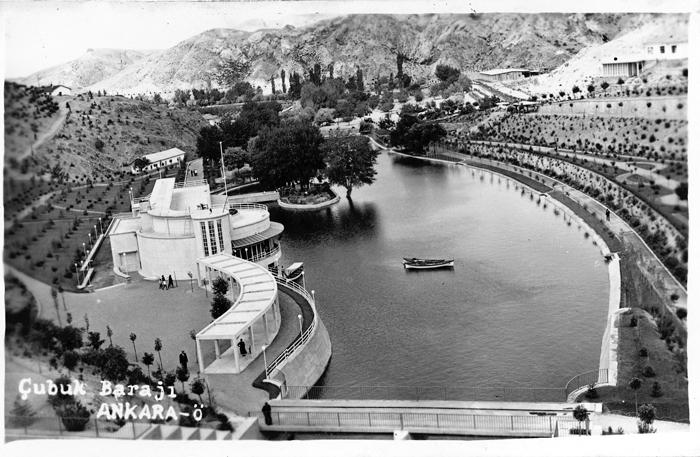
ankara dam turkeyThe first hydroelectric dam built in Ankara, Turkey’s capital city, the Çubuk Dam was promoted as “Ankara’s Bosphorus”.

A new exhibit at Istanbul’s avant-garde SALT Galata gallery, Graft, throws open the archive of material about Turkey’s first major hydroelectric projects in the 1930s. The display critically analyzes the motives behind these early endeavors — and the effects of the extensive hydroelectric industry they spawned in Turkey.

Marmara reservoir, Atatürk Model Farm, Ankara<br ></a>Aslıhan Demirtaş archive<br />

The “Marmara Basin” was an irrigation reservoir on a model farm in Ankara constructed by Atatürk, the founder of the Turkish Republic. It refers to the Marmara Sea, which lies south of Istanbul. The farm featured another reservoir named after the Black Sea.

Based on a Turkish architect’s PhD dissertation at the Massachusetts Institute of Technology, Graft traces the construction  and administration of dams during Turkey’s Republican Period, the first two decades after the founding of the republic in 1923.

In an effort to generate more energy and emulate more industrialized nations, many of Turkey’s river basins and lakes were turned into dams in the 1930s, especially in the dry, barren land around the new capital city of Ankara.

Aslıhan Demirtaş, the architect behind the SALT exhibit, locates these developments in a broader historical context: humankind’s ongoing quest to shape nature to its purposes.

“As well as being a necessity in the post-industrial world, it was also a reflection of man’s desire to dominate nature,” she told reporters at the exhibit’s recent opening, according to the Hürriyet Daily News.

Çubuk Dam, Ankara<br ></a>Aslıhan Demirtaş archive<br />

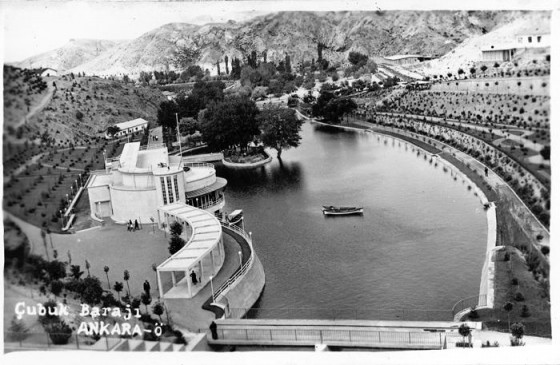
Another view of the Çubuk Dam, showing the height of its walls.

Demirtaş sees these projects as efforts to “graft” a modern, expansion-focused infrastructure onto the rural Anatolian plain of old — hence the exhibit’s name.

“These modern projects of a ‘modern’ geography are cultivars, propagated by grafting an Ottoman scion onto an Anatolian root: Istanbul’s waterfront geography, onto Ankara’s barren land,” reads the description of the exhibit on SALT’s website.

The website further explains how these early projects of the 1930s became the prototypes for the 700 hydroelectric dams all over modern Turkey:

The singular Directorate of Public Works of the 1930s, which propagated the cultivars of Ankara, proliferated into a complex machine of multiple ministries and government organizations to develop regional development plans through the 1950s. As a result, the cultivar of Ankara was re-grafted all over the country. Multiplied in a massive scale on the riverbeds of Anatolia and Eastern Thrace, the cultivars, consequently, transformed and mutated into a wild species of aggressive and invasive nature.

Opening of Çubuk Dam, 1936, Ankara<br ></a>Necati Kazancı archive

Each of Turkey’s current 26 regions, which were delineated after the 1950s, was located around a corresponding river basin so that each would have a steady supply of energy and irrigation water.

The exhibit also includes two 1/50,000 size models of Turkey’s major dams on the Tigris and Euphrates Rivers.

“This is to concretize, at least partly, the physical aspect of Turkey’s modernization process,” Demirtaş told the Hürriyet Daily News.

That modernization process has come a long way since the early, hopeful days of the Republic. Turkey’s dams are now notorious for hogging water supplies and degrading their surrounding environments.

The hydroelectric dams on the Tigris and Euphrates are now violating the human rights of communities downstream of Turkey, according to a report by the United Nations last year. They are the biggest source of contention between Turkey and Iraq. And a planned hydroelectric project in northeastern Turkey could similarly poison relations with another neighbor, Georgia.

Turkey’s hydroelectric industry is long overdue for internal inspection and reform. This exhibit about its origins is an excellent place for the country to start.

:: Hürriyet Daily News

Read more about hydroelectric dams in Turkey:
Hydroelectric Dam In Turkey May Cause Environmental Catastrophe In Georgia
Turkish Water Projects Stirring Resentment Around The Region
Turkey’s Dams Are Violating Human Rights, UN Report Says

Images via SALTonline

Julia Harte
Julia Hartehttp://www.greenprophet.com
Julia spent her childhood summers in a remote research station in the Rocky Mountains of Colorado, helping her father with a 25-year-old experiment in which he simulated global warming over a patch of alpine meadow. When not measuring plant species diversity or carbon flux in the soil, she could be found scampering around the forests and finding snowbanks to slide down. Now she is a freelance journalist living in Istanbul, where her passion for the environment intersects with her interest in Turkish politics and grassroots culture. She also writes about Turkish climate and energy policy for Solve Climate News.

Read More

1 COMMENT

TRENDING

Abortion Pills, Plan B and Mifepristone and what the new US mail ban means

Abortion pills, often confused with Plan B (the morning-after pill), and historically referred to as RU486 (mifepristone), are part of a broader category of reproductive health medications that women have been using for decades. But they are not the same thing.

Sink holes from over-watering farmers’ fields

Sinkholes are rapidly appearing in Turkey’s central Anatolian farming region, particularly around Konya and Karapınar. These giant gaping holes in the ground in areas of farmland, known locally as obruk, are not random geological events. They are linked to prolonged drought, climate-driven heat stress, and heavy groundwater extraction for agriculture in one of the country’s most important breadbaskets.

Arap Koftesi burgul balls in a garlicky yogurt sauce

This bit of Turkish home cuisine is called Arap Koftesi, and I discovered it in Özlem's Turkish Table. We can call them burgul balls.

Americans probe the alleged biblical ark on Mount Ararat in new study

The Durupınar formation's dimensions strikingly mirror the biblical description of Noah's Ark, as detailed in Genesis 6:15. Ground-penetrating radar (GPR) surveys have revealed internal features, including rectangular shapes and what appears to be a central chamber, located approximately 22 feet beneath the surface. These findings suggest the possibility of man-made structures within the formation.

Make Lahmacun, crispy Turkish flatbreads with meat

Lahmacun, or lahmajoun are fun to eat folded over and out of hand, as a snack or finger food. If you prefer to make bigger pastries, they also make a satisfying meal.

Yerukim Forms a New Green Economy Where the Money is Really Green

The Yerukim members who pick up the recyclables get to keep the monetary reward, the public earns "green" bills that can be used in shops, and business owners get to be associated with environmentalism.

Choosing Riyadh over Dubai? What Investors Should Know

Saudi Arabia is deploying capital at unmatched scale to catalyze tourism and advanced industry while rewiring its power-and-water backbone. The investable frontier is widening—especially in renewables, grid storage, water efficiency/desal retrofits, and hospitality operating platforms. Prudent investors will insist on phased delivery, enforceable KPIs (energy, water, biodiversity), and RHQ/zone compliance—while pricing political-economy and reputational risks alongside growth upside.

Sell your cooking oil for biodiesel money

Want to make money on old french fry oil? Sell it.

Qatar Alternative Energy Summit Pairs Investors And Innovators

Alternative energy investors and innovators can meet n' greet in Doha, Qatar March 16 and 17.

Here’s How To Implement The Four Pillars Of Employee Engagement

If you throw a party for your work team and they are vegans, don't make it a barbecue. Know the sustainability values of your team to boost moral and retain good people.

Locals From Rishon Fight IKEA

Big Box stores are a pretty new concept in Israel, and thank God that not every Israeli city wants them in their backyard. A word from someone who has see the beautiful farmland around her hometown Newmarket, Ontario stripped and converted into vulgar strip malls of big box shops: they have no place in a healthy and sustainable town or city.

The Jewish National Fund Meets An Inconvenient Truth

According to the JNF, it has transformed thousands of acres of barren land into green forests in Israel. They state that each person emits about 23 tons of carbon per year, estimating that each tree planted can absorb one ton of carbon in its lifetime. That's a whole lot of trees you'd need to be planting. Could so many fit in Israel?

How to quiet noise from construction in your office

Streets need to be resurfaced in New York but the humming and grinding noise is unsettling. Noise is environmental pollution. 

Popular Categories