

 What would you call solar panels if attached to this Tesla S2 sports coupe: spoilers?
One of the more challenging aspects of developing electrics is finding ways to extend the cruising range of electric cars, which are anywhere from 40 to 160 kilometers on a single charge. Companies dealing with the technologies involved in producing electric cars and the lithium ion battery systems used to power them, include those like Better Place, who recently entered into a partnership with the GE electricity appliances giant in order to further improve the infrastructure needed for the public use of electric cars. Some electric car manufacturing companies, such as Tesla Motors, even claim that their high price electric sports models are capable of achieving cruising ranges of 160 miles or 257 km.
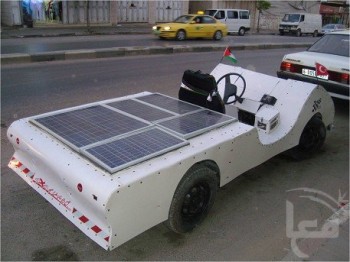
Solar “spoilers”, Palestinian style
With solar energy now being a popular energy source for providing electricity to homes, businesses and many other energy users, there has also been the thought to find ways to enable electric cars to have their batteries recharged by solar energy.
But in doing so, more aesthetic ways of integrating solar panels into either the car’s body or window glass have to be found. Otherwise, it involves attaching unsightly solar panels to the cars roof or hood, as was done in an experimental project by Palestinian students at a polytechnic university in Hebron.
To find out what innovations are being developed for solar powered cars, I queried this subject with Mr Jerry Schranz , a public relations consultant for the Beckerman Company that is working with a pioneer in solar panel coatings, New Energy Technologies Inc (NET). NET is currently working on developing more advanced types of solar panels for homes and businesses. Jerry checked this issue involving solar energy for cars with Mr. John Conklin, President and CEO of NET, who told him that the company is “assessing various methods of applying the electricity generating coating to different materials.
Even so, the R&D and product development for coatings on these materials is still at very early stages. Regarding car windows being considered as possible “platforms” for solar energy conduction, Conklin told Schranz:
“Car door windows are not the simple glass panes you might find in residential or commercial windows. The car window manufacturing process is made of flat glass which is poured using the float glass process; fusion occurs at a temperature of 1500 – 1600 degrees Celsius. Various solar energy glass panels like our SolarWindow™ or OPV cannot maintain structure at that temperature. We are exploring the advancement of coating various films (i.e., PET) which may provide application to car windows and the possibility there’s enough power for generation of electricity to recharge car batteries.”
Using the sun to recharge electric car batteries while a car is in motion or parked outside on sunny days appears to be an excellent idea. But at present, the technology involved in making this idea become reality is still in the works.
Read more on electric cars, and the technology being developed to power them:
Better Place Gets a “Charge” With GE Partnership
GM’s Volt Vs the Renault-Nissan Better Place Edition
Palestine’s First Solar Powered Electric Car Takes to the Streets of Hebron




I would like to make Engg project on solar hybrid car, can you suggest any new technology to mount solar panel on the REVA car….
or can you suggest any new thing to achieve in my project?
Right now its it being used to propel airconditioning at standstill vehicles. So it does make a point. Its just not economic.
The actual idea is not to install solar panels on the car by to integrate them into the car body itself as well as the window glass (especially the front windshield like radio antennas are often done).
The technology to do this is still not available, however, as John Conklin of NET notes above (yes, John – not Jerry Conklin).
On second thought, solar panels on a car may be less efficient, if it increases the weight of the car significantly.
You both are right. Ramon is correct that there is little real estate to make much of a range difference.
This is really about making people feel good about their car. I was shopping for a minivan, and there was a model with a spoiler. Clearly no minivan will have such performance needs to require a spoiler. The car company thought a potential buyer might associate performance with the style. To bring this back to the real point…there is something elegant about using that which makes the car hot, keep it cool, namely the sun’s energy.
Second, the power per cell is the same whether it is on a house or a car (assuming they are in a similar location/solar profile). The house merely has more square inches available for use. So the car with solar cells is not, per se, a worse idea than a house with solar cells. It obviously can’t be the only source of power, but its not less efficient.
Hi Ramon, how much do you really know about the potential of solar energy? FYI, some auto R & D people ARE looking into this, and what will result may change the way photo voltaic solar panels are now being made. What will probably result from this will be a combination of solar energy and energy from the motion of the car itself. It may not result in a “perpetual motion machine” but that idea has also been around for awhile.
I’m sure that 40 years ago, no one would have dreamed there would be the electronic innovations that today we now take for granted.
Quite frankly, whoever wrote this article doesn’t know squat about either electric cars or solar panels. There is far too little surface area available on a car to harvest more than a smattering of power. And a car’s surfaces present probably the worst surface for mounting PVs.
Only on the roof, hood or trunk lid would PVs have any chance of
gathering sunlight, and even there you cannot expect more than 700 watts
of power, at best, or roughly 3 kilowatthours per day, worth about 30 cents and powering the vehicle for less than 12 miles. A totally senseless undertaking.