Renewable-Energy Cars Heat Up in Turkey

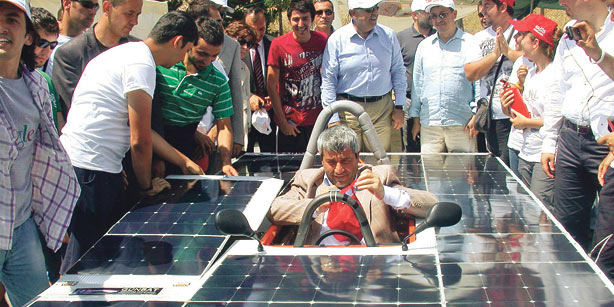
Science, Industry and Technology Minister Nihat Ergün test-drives a solar-powered car at a solar vehicle competition in the Turkish city of Izmir.

A strange array of vehicles were seen speeding around Izmir, Turkey last week, as the Scientific and Technological Research Council of Turkey (TÜBİTAK) hosted its first Alternative Energy Vehicle Races in the sunny Aegean coastal city. Thirty-eight teams entered the solar car races, while 20 teams brought vehicles to the hydrogen car competition.

The event inspired Nihat Ergün, of Turkey’s Ministry for Science, Industry and Technology, to declare that the government will up its investments in renewable vehicles in coming years.

Vague promises from the government

Though Ergün expressed enthusiasm for developing renewable energies at the TÜBİTAK races, the government’s material support for these technologies has been lackluster so far.

Ergün’s ministry recently published a Strategy Document for Turkey’s industrial sector between 2011 and 2014. While the paper sets some concrete goals for that time period, such as the development of Turkey’s first automotive brand, it stays vague on renewable energy targets despite frequently mentioning the need for a cleaner energy economy.

The document mentions old laws that have been passed to support renewable energy in Turkey, but does not point out that these laws have so far only resulted in subsidies that are too low to make solar and wind power competitive in the wider energy marketplace.

Recent reshufflings of the government ministries, though, could improve the prospects for renewable energy in Turkey. In June, Prime Minister Recep Tayyip Erdoğan announced that the former Ministry of Industry and Trade would lose “Trade” and add “Science and Technology” to its name.

As a result of this change, Ergün said in Izmir, his ministry will be able to focus on research and development projects more than it used to.

Promising activity from international bodies, private sector

While the government slowly begins to appreciate Turkey’s abundant renewable resources and technological potential, private companies and international organizations are already taking advantage of them.

The United Nations’ International Centre for Hydrogen Energy Technologies, for example, has already been holding competitions for hydrogen vehicles for several years now. Solar power is widely popular at the grassroots level, as evinced by the omnipresence of solar water heaters and small PV arrays on Turkish rooftops. And Turkish investor MetCap Developments recently contracted a renewable integrated combined cycle power plant from General Electric, the world’s first application of this unprecedentedly efficient power-producing technology.

The impressive turnout by university teams at the TÜBİTAK races suggests that Turkey’s next generation of scientists and engineers will be actively engaged in bringing their country into a cleaner energy future. Let’s hope the government follows their lead.

:: Today’s Zaman

Read more about renewable energy in Turkey:

GP Exclusive Interview: Turkey Beginning To Lay Infrastructure For Hydrogen Economy

World’s First Integrated Renewables Combined Cycle Plant To Be Built in Turkey

Europe’s Biggest Solar Farm To Be Built in Turkey

Image via Today’s Zaman

Julia Harte
Julia Hartehttp://www.greenprophet.com
Julia spent her childhood summers in a remote research station in the Rocky Mountains of Colorado, helping her father with a 25-year-old experiment in which he simulated global warming over a patch of alpine meadow. When not measuring plant species diversity or carbon flux in the soil, she could be found scampering around the forests and finding snowbanks to slide down. Now she is a freelance journalist living in Istanbul, where her passion for the environment intersects with her interest in Turkish politics and grassroots culture. She also writes about Turkish climate and energy policy for Solve Climate News.

Read More

TRENDING

Wave wind energy for Nvidia’s next AI energy boom?

As AI factories consume unprecedented amounts of electricity, NVIDIA is looking beyond chips and data centers to the ocean. The company recently spotlighted Israel's Eco Wave Power and its wave energy projects in Jaffa and Los Angeles, highlighting how AI, digital twins and renewable energy can work together to meet future power demands. The collaboration reflects a growing realization that the future of artificial intelligence may depend as much on clean energy infrastructure as it does on computing power.

Collecting kinetic energy from roads; REPS turns traffic into a power plant

REPS announced a $23.6M equity financing round to scale...

AI data centers are triggering panic, instead of cleantech opportunities

AI may unintentionally become the economic engine that finally modernizes America’s aging grid. California is experiencing a massive AI data center boom, ranking 3rd in the U.S. with 227 operating centers and 54 more in development as of April 2026, according to Stanford.

Korean researchers create battery from greenhouse gases

Professor Ji-Soo Jang, in collaboration with Professor Taekwang Yoon of Ajou University and Professor Hansel Kim of Chungbuk National University, has developed a novel energy device that generates electricity during the process of capturing greenhouse gases.

EU startup aiming to generate energy on moon villages

Stepping up to democratize the moon is an EU-funded company, Deep Space Energy, which has just raised more than $1 million USD as a seed fund to help it create energy generators on the moon.

Yerukim Forms a New Green Economy Where the Money is Really Green

The Yerukim members who pick up the recyclables get to keep the monetary reward, the public earns "green" bills that can be used in shops, and business owners get to be associated with environmentalism.

Choosing Riyadh over Dubai? What Investors Should Know

Saudi Arabia is deploying capital at unmatched scale to catalyze tourism and advanced industry while rewiring its power-and-water backbone. The investable frontier is widening—especially in renewables, grid storage, water efficiency/desal retrofits, and hospitality operating platforms. Prudent investors will insist on phased delivery, enforceable KPIs (energy, water, biodiversity), and RHQ/zone compliance—while pricing political-economy and reputational risks alongside growth upside.

Sell your cooking oil for biodiesel money

Want to make money on old french fry oil? Sell it.

Qatar Alternative Energy Summit Pairs Investors And Innovators

Alternative energy investors and innovators can meet n' greet in Doha, Qatar March 16 and 17.

Here’s How To Implement The Four Pillars Of Employee Engagement

If you throw a party for your work team and they are vegans, don't make it a barbecue. Know the sustainability values of your team to boost moral and retain good people.

Locals From Rishon Fight IKEA

Big Box stores are a pretty new concept in Israel, and thank God that not every Israeli city wants them in their backyard. A word from someone who has see the beautiful farmland around her hometown Newmarket, Ontario stripped and converted into vulgar strip malls of big box shops: they have no place in a healthy and sustainable town or city.

The Jewish National Fund Meets An Inconvenient Truth

According to the JNF, it has transformed thousands of acres of barren land into green forests in Israel. They state that each person emits about 23 tons of carbon per year, estimating that each tree planted can absorb one ton of carbon in its lifetime. That's a whole lot of trees you'd need to be planting. Could so many fit in Israel?

How to quiet noise from construction in your office

Streets need to be resurfaced in New York but the humming and grinding noise is unsettling. Noise is environmental pollution. 

Popular Categories