Make Moroccan Anise Flatbread

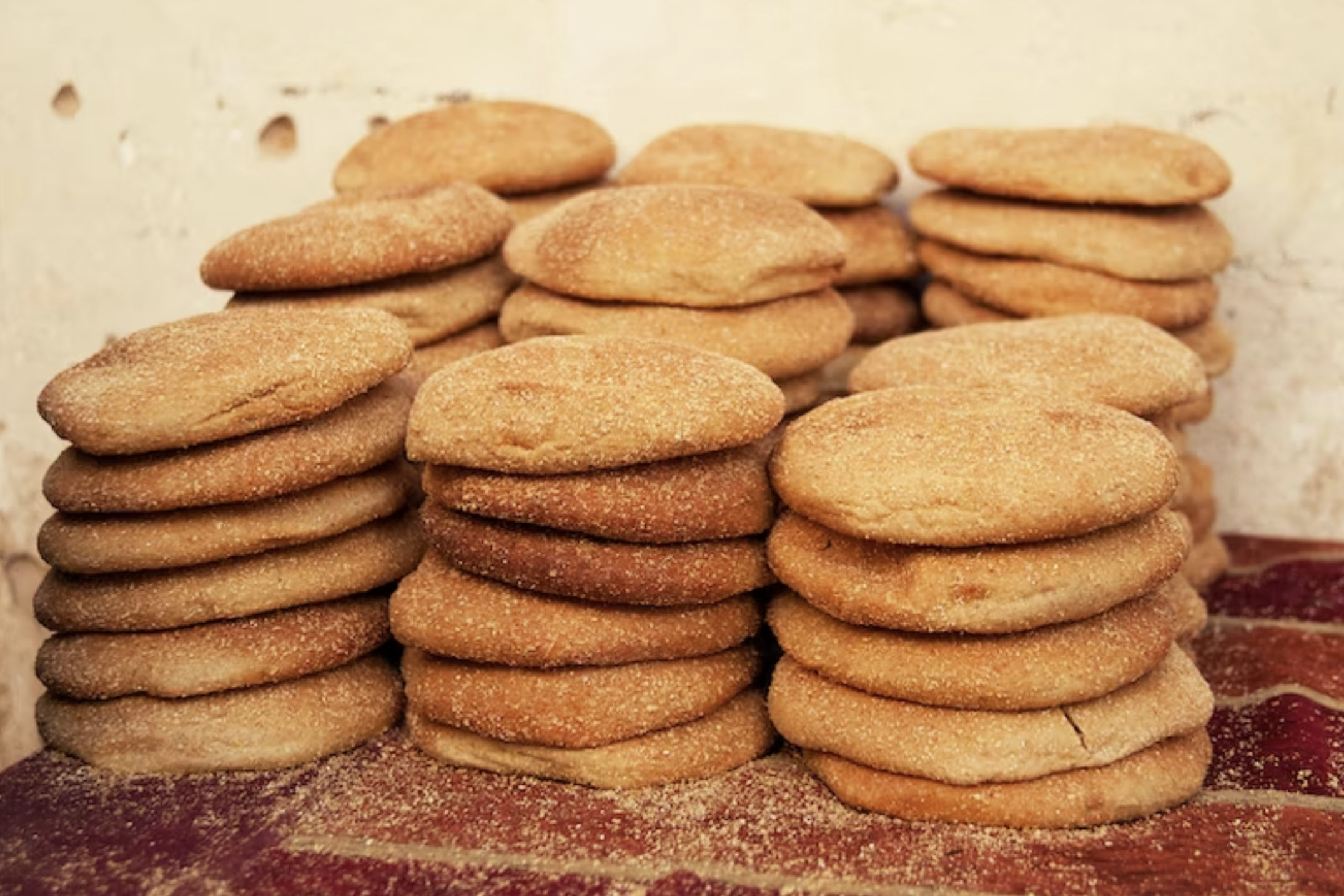
These warm, fragrant loaves bring Moroccan flavor to any meal.

Karin’s stay in a beautiful eco-lodging high up in the Moroccan mountains, and Tafline’s intrepid hike up and down them, inspired me to find particularly Moroccan recipe. And I find that this flatbread, perfumed with anise and sesame seeds, puts dreams of Morocco in my head with every mouthful. Tear chunks off the warm loaves and eat it like that for maximum exotic-dreams effect.

Moroccan Anise Bread Recipe

Ingredients:

1 tablespoon active dry yeast or 1 cube fresh yeast

1- 1/3 cup warm water

1 teaspoon sugar or honey

1 tablespoon vegetable oil

2 1/2 teaspoons anise seeds

2 teaspoon salt

4 cups unbleached all-purpose flour

1 egg white, beaten with 1 teaspoon water

3 tablespoons sesame seeds

Semolina or corn meal for sprinkling on baking sheet

Dissolve the yeast in 1/4 cup of the water. Add the sugar or honey and let stand until foamy, 5 to 10 minutes.

Add the remaining water, oil, anise, salt, and 2 cups of the flour.

Gradually stir in the remaining flour until the mixture holds together. On a lightly floured surface, knead the dough until smooth and elastic, about 10 minutes.

Place in a greased bowl, turning to coat.

Cover loosely with a towel or plastic wrap and let rise at room temperature until double in bulk, about 1-1/2 hours.

Punch down the dough and divide in half. Shape each piece into a ball, cover, and let rest for about 10 minutes.

Grease the baking sheet and sprinkle it with semolina or corn meal. Place the rounds on the prepared baking sheet and with your palms, flatten each into a 9-inch disk. Cover, and let rise 30-40 minutes.

Preheat the oven to 400 degrees F – 220 C.

Prick the dough around the sides with the tines of a fork. Brush the tops
of the loaves with the egg white and lightly sprinkle with the sesame seeds.

Bake until golden brown and hollow-sounding when tapped, about 30 minutes.

Transfer to a wire rack to cool.

More breads to make you dream on Green Prophet:

 

Miriam Kresh
Miriam Kreshhttps://www.greenprophet.com/
Miriam Kresh is an American ex-pat living in Israel. Her love of Middle Eastern food evolved from close friendships with enthusiastic Moroccan, Tunisian and Turkish home cooks. She owns too many cookbooks and is always planning the next meal. Miriam can be reached at miriam (at) greenprophet (dot) com.

Read More

TRENDING

Dior’s Summer 2027 show promises sustainability. Do we believe them?

Dior highlights recycled materials, regenerative agriculture, circularity initiatives, and digital traceability, but the luxury fashion business model still depends on constant consumption, global supply chains, fashion shows, and high-carbon production.

Is your shawarma wrapped in forever chemicals? The hidden microplastics in street feed

Shawarma is one of the world's most popular street foods, but the greatest health risk may not be the meat, pickles or tahini. Scientists are increasingly concerned about PFAS "forever chemicals" and microplastics that can migrate from food packaging into hot, greasy takeaway meals. As awareness grows about hidden toxins in everyday products, even your favorite shawarma wrap may be part of a much larger environmental and public health story.

Self-repairing contact lenses and desalination membranes that fix themselves?

Could the humble contact lens become a sustainability breakthrough? Researchers in Korea have developed a self-healing hydrogel lens that repairs scratches with just one hour of UV light exposure. Beyond reducing waste from disposable contacts, the technology could one day help extend the life of solar panels, water filtration systems, and other plastic-based products.

Should we be worried about ebola?

Touch the body and ancient African traditions are causing the Ebola virus to spread.

Idols of Ganesh in Canadian lakes are causing local environmental concerns

Immersing religious idols in Canada's lakes, rivers and coastal waters remains a contentious issue. While the practice is an important tradition for many Hindu communities during festivals such as Ganesh Chaturthi, environmental regulations in many jurisdictions prohibit the disposal of foreign materials into natural waterways, even when the objects are intended as religious offerings.

Yerukim Forms a New Green Economy Where the Money is Really Green

The Yerukim members who pick up the recyclables get to keep the monetary reward, the public earns "green" bills that can be used in shops, and business owners get to be associated with environmentalism.

Choosing Riyadh over Dubai? What Investors Should Know

Saudi Arabia is deploying capital at unmatched scale to catalyze tourism and advanced industry while rewiring its power-and-water backbone. The investable frontier is widening—especially in renewables, grid storage, water efficiency/desal retrofits, and hospitality operating platforms. Prudent investors will insist on phased delivery, enforceable KPIs (energy, water, biodiversity), and RHQ/zone compliance—while pricing political-economy and reputational risks alongside growth upside.

Sell your cooking oil for biodiesel money

Want to make money on old french fry oil? Sell it.

Qatar Alternative Energy Summit Pairs Investors And Innovators

Alternative energy investors and innovators can meet n' greet in Doha, Qatar March 16 and 17.

Here’s How To Implement The Four Pillars Of Employee Engagement

If you throw a party for your work team and they are vegans, don't make it a barbecue. Know the sustainability values of your team to boost moral and retain good people.

Locals From Rishon Fight IKEA

Big Box stores are a pretty new concept in Israel, and thank God that not every Israeli city wants them in their backyard. A word from someone who has see the beautiful farmland around her hometown Newmarket, Ontario stripped and converted into vulgar strip malls of big box shops: they have no place in a healthy and sustainable town or city.

The Jewish National Fund Meets An Inconvenient Truth

According to the JNF, it has transformed thousands of acres of barren land into green forests in Israel. They state that each person emits about 23 tons of carbon per year, estimating that each tree planted can absorb one ton of carbon in its lifetime. That's a whole lot of trees you'd need to be planting. Could so many fit in Israel?

How to quiet noise from construction in your office

Streets need to be resurfaced in New York but the humming and grinding noise is unsettling. Noise is environmental pollution. 

Popular Categories