
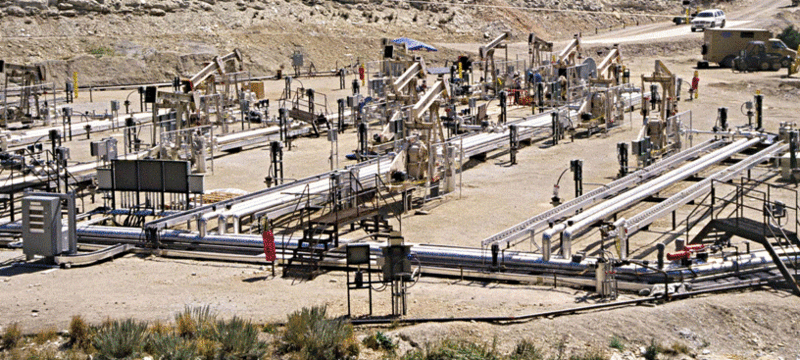

 An oil shale trial plant in Colorado. Does Israel want its Negev and Galilee regions torn up for “black gold”?
Until recently, Israel has been an energy poor country, with nearly all its energy needs having to be supplied by importing both petroleum – bought mainly on the international Spot Market – and coal. Previous attempts to find oil in Israel have only been marginally successful, with small amounts discovered outside the city of Ashdod, and on the shores of the Dead Sea. But following the discovery of large amounts of natural gas in offshore Mediterranean fields, such as the Tamar and Leviathan gas fields off the coast of Haifa, Israel has begun to become a potential world player in energy production, with ideas to export natural gas to Europe in an undersea pipeline, despite security and environmental implications. But these finds could be nothing, compared to vast amounts of oil shale waiting to be processed.
 Lawrence Solomon
All of this, including the natural gas finds, are small in comparison to estimates of as much as a half trillion barrels of oil in the form of oil shale, that has been estimated to be lying under parts of Israel’s Negev and Galilee regions; and just waiting for the proper technology to extract it.
Extracting liquid petroleum from rock-hard oil shale (which looks and feels like solid rock) is not an easy task, however.
The process involved is very expensive as well as not very environmentally friendly. This has been already found out in locations like Alberta Canada, where Israeli geothermal energy company Ormat Industries teamed up with Canadian company Opti Canada Inc. to extract oil from shale-like tar sands by using high pressure steam.
But despite the drawbacks, there are now research teams working on ways to be able to extract oil from these large Israel oil shale reserves as reported recently on Canada’s Sun News Service, environmentalist Lawrence Solomon told Sun’s reporter that Israel’s oil shale reserves “may be as much or more than all of those in Saudi Arabia”.
Some “big gun” energy investment players appear interested in the Israel oil shale venture, including media mogul Rupert Murdoch, former US Vice President Dick Cheny, and business planning strategist Barry Rothschild.
[youtube]http://www.youtube.com/watch?v=t8QVAAFfcRg[/youtube]
Solomon believes that oil can be produced from Israeli oil shale for a price of between US $35 and 40 per barrel. The idea, according to the SUN News video clip, is to break OPEC’s control of the world energy market, particularly the portion in the hands of Arab countries.
If this is true, and if Israeli geologists and energy production experts are successful in extracting this energy, OPEC’s global influence may be severely damaged, if not broken entirely.
Hearing this kind of prediction from a person like Solomon is a bit strange, however. His Energy Probe NGO has spoken out against causes of global warming (of which over use of fossil fuels has been blamed), extraction of oil from the Alberta Tar Sands, and use of nuclear energy.
For a small country like Israel, with limited geographical space compared to Canada, intense production of oil from oil shale could be very environmentally damaging. This has already been seen on a lesser extent by a pilot oil shale production project Mishor Rotem that is being shut down due to environmental concerns.
If oil shale production by Israel may be eventually profitable, and even turn Israel into a major energy exporter, what environment price will have to be paid in order to become a world energy player? Tearing up large portions of the Negev and the Galilee to extract this energy does not sound very environmentally plausible. And despite all this “black gold” , the Israeli public will not benefit as the government seems bent of adhering to the “Norwegian Plan” of levying high energy taxes despite the availability of oil .
Read more on Israeli energy issues, including oil shale:
Israel’s Leviathan Gas Finds Will Have Widespread Repercussions on World Power
Who’s Testing Environmental Impact as Israel Drills for Oil at the Dead Sea?
Is Israel’s Oil Shale Pie Big Enough to Shift World Politics?
Negev Oil Shale Plant to Shut Down and Switch to Natural Gas
Oil shale production photo via Wikipedia




Mr. Solomon, I am an Engineering student currently working in the Canadian Oil Sands for a company that has alot of shared intrest with OPTI (The Israeli oil company), I have had alot of exposure to the technology used in the oil sand and shale gas industries. I have also worked for one of the largest technology providers for the renewables industry. My degree is focused on sustainable energy and I have read countless books, reports and literature on the environmental costs of energy.
Energy Probe has been praised by us all for its oposition to OPG’s Nuclear expansion in the past (and hopefully the present).
But, while I agree with you on most of your statements on the advancements in SAGD technology and land requirment drawbacks of renewables (certainly not in Canada), I am shocked at your statement (made in the July 7th response) that “environmental impact of the project may be net positive” and your support of the anti-renewables movement.
Please, explain the logic of your claim to us. The readers of this website are well educated sir, and we would appreciate some background for this bold statement.
Israel would do better continuing to invest in electric vehicles. The country is in a warm region, has plenty of educated citizens, and is small enough to cross in a EV.
EVsRock
http://www.evsroll.com/Electric_Vehicle_Charging_Stations.html
And where can we go, Dude? Where you live?
These are all pipe dreams. Israel won’t even survive to see all these pipe dreams come through, which would take 10-20 years. The country is one vote away from total chaos. The society is becoming facist and right wing, the Arabs are gaining incredible powers and geo-strategic positioning, and the whole World is turning against Israel. Give it another 3-4 years, and an exodus of Jews will begin. Unless you are planning to invest these billions so Palestinians can secure their energy future, that sounds good. But you guys will be overwhlemed soon; time to pack up.
Thank you for covering this issue, which is even more critical to the interests of peace than it is to the economy of Israel and its neighbors.
My organization, Energy Probe, in the past has been a critic of oil sands projects, and has been responsible in part for their cancellation in Canada (Energy Probe has been Canada’s chief energy critic since its founding in 1970). But the technology has improved immensely over the decades and it is now one of the better energy options (all energy options carry environmental drawbacks). With Israeli technology added to the current state of the technology, and with the small physical footprint that the project will require, the environmental impact of the project may be net positive, not only in Israel but in other countries to which Israel will be able to export this technology. Renewable technologies can have major environmental impacts, among them the need for land. This land requirement has become a major environmental issue in Canada, despite our low population density, and has led to the largest grassroots anti-renewables protest movement in decades.
Plus a lot of OTHER media news sites I understand.
I think Rupert Murdoch owns SUN news.