Bosphorus To Become Center of Hydrogen Energy Production If Second Canal Is Built

The proposed canal has been slammed by Turkish environmentalists. But authorities at Turkey’s center for hydrogen energy technology see a silver lining: the canal could enable Turkey to become one of the world’s most important producers of hydrogen energy.

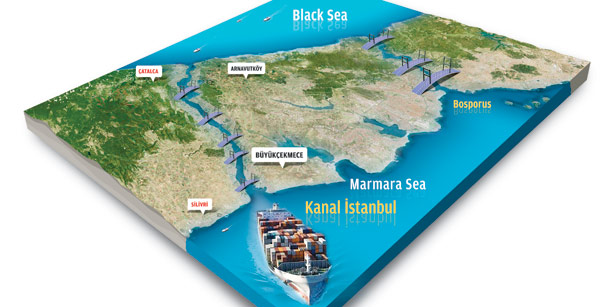
When Turkish Prime Minister Recep Tayyip Erdoğan announced his self-termed “crazy project” last month – a new canal connecting the Black Sea and Marmara Sea, a few kilometers west of the Bosphorus Strait – most environmentalists were aghast. The project would open up hitherto undeveloped areas around Istanbul to a rash of giant new constructions, including convention centers, exhibition halls, sports facilities, housing, and Turkey’s largest airport.

But the canal would also take over most of the ship traffic that currently fills the Bosphorus: about 150 ships per day, to be specific. And that would free up the strait for hydrogen energy projects that Turkey has been waiting years to realize.

The undersea flow of the Bosphorus could be harnessed to generate a huge amount of hydrogen energy, according to authorities from the International Center for Hydrogen Technologies (ICHET), which the United Nations Industrial Development Organization founded in Turkey in 2003.

The ICHET has tried to set up such projects in the past, but the heavy traffic through the strait was an insurmountable obstacle. If construction on the canal actually moves ahead, the ICHET will station a turbine on a submarine about midway up the Bosphorus, eight meters deep in the water. This initial generator would probably only generate 20 kilowatts of electricity, ICHET authorities told Turkish daily Today’s Zaman, but it would be a pilot project for future hydrogen energy endeavors in the strait.

By electrolyzing the seawater in the Bosphorus, the turbine would produce hydrogen, which would be stored under heavy pressure. That high-pressure hydrogen could then be used to fuel an internal combustion engine, which would generate electrical energy from mechanical energy, or could be used as raw fuel itself.

If the Bosphorus became available to the ICHET, it would mark the center’s biggest opportunity for hydrogen energy production since its founding. Little research and development of hydrogen energy has occurred so far, so its costs are still high. But with increased research and development, experts predict this renewable resource could become one of the most important ways for the world to wean itself from conventional fuels.

Turkey is well on its way to becoming a major player in this future industry. In February, the ICHET began work on Turkey’s first hydrogen filling station in Istanbul, and expects it to be ready for service in 2011. Concurrently, Turkey’s first hydrogen-fueled boat is being constructed in nearby shipyards. Foreign firms are  also eyeing the market for hydrogen-powered devices in Turkey; Mazda will begin selling hydrogen-powered cars  in Turkey in coming months.

Hydrogen energy could undoubtedly become one of the most exciting renewable energies in Turkey over the next century. Hopefully, it will attract more support from the government than the underappreciated solar sector, and entice the government away from sponsoring destructive hydropower projects in the country’s eastern regions.

:: Today’s Zaman

Read more about renewable energy in Turkey:

Hidden Costs of Constructing Wind Farms in Turkey Include Many New Roads

Hydropower Could Meet More of Turkey’s Energy Demand – But At What Cost?

Europe’s Biggest Solar Farm To Be Built in Turkey

Image via Today’s Zaman

Julia Harte
Julia Hartehttp://www.greenprophet.com
Julia spent her childhood summers in a remote research station in the Rocky Mountains of Colorado, helping her father with a 25-year-old experiment in which he simulated global warming over a patch of alpine meadow. When not measuring plant species diversity or carbon flux in the soil, she could be found scampering around the forests and finding snowbanks to slide down. Now she is a freelance journalist living in Istanbul, where her passion for the environment intersects with her interest in Turkish politics and grassroots culture. She also writes about Turkish climate and energy policy for Solve Climate News.

Read More

LEAVE A REPLY

Please enter your comment!
Please enter your name here

TRENDING

AI data centers are triggering panic, instead of cleantech opportunities

AI may unintentionally become the economic engine that finally modernizes America’s aging grid. California is experiencing a massive AI data center boom, ranking 3rd in the U.S. with 227 operating centers and 54 more in development as of April 2026, according to Stanford.

Abortion Pills, Plan B and Mifepristone and what the new US mail ban means

Abortion pills, often confused with Plan B (the morning-after pill), and historically referred to as RU486 (mifepristone), are part of a broader category of reproductive health medications that women have been using for decades. But they are not the same thing.

Korean researchers create battery from greenhouse gases

Professor Ji-Soo Jang, in collaboration with Professor Taekwang Yoon of Ajou University and Professor Hansel Kim of Chungbuk National University, has developed a novel energy device that generates electricity during the process of capturing greenhouse gases.

Should You Invest in the Private Market?

startustartup Unlike public stock exchanges, which offer daily trading, strict...

EU startup aiming to generate energy on moon villages

Stepping up to democratize the moon is an EU-funded company, Deep Space Energy, which has just raised more than $1 million USD as a seed fund to help it create energy generators on the moon.

How to quiet noise from construction in your office

Streets need to be resurfaced in New York but the humming and grinding noise is unsettling. Noise is environmental pollution. 

EarthX and a blueprint for sustainable investing

Trammell S. Crow, a Dallas-based businessman and father of four, is focusing his efforts on impact investing, and media that focuses on saving the planet through EarthX.

Mining Afghanistan’s Mineral Discoveries Similar to Avatar

Now that American forces in Afghanistan are commemorating the longest period of any war that America has been involved in, including the 1965-73 Vietnam War, the recent discoveries of large and extremely valuable mineral and metal deposits may finally bring to light a reason to continue the presence of US fighting forces in this war torn and backward country.

From Pilot Plant to Global Stage: How Aduro Clean Technologies’ 2026 Expansion Signals a Turning Point for Chemical Recycling Investors Like Yazan Al Homsi

The company's Next Generation Process (NGP) Pilot Plant in London, Ontario, has officially moved into initial operating campaigns, generating the kind of structured, repeatable data that separates laboratory promise from commercial viability.

Nobul’s Regan McGee on Shareholder Value: “Complacency Is the Silent Killer” 

Why the governance framework designed to protect shareholders so...

Should You Invest in the Private Market?

startustartup Unlike public stock exchanges, which offer daily trading, strict...

How to build a 100-year-company

Kongō Gumi is a Japanese construction company, purportedly founded in 578 A.D., making it the world's oldest documented company. What can we learn about building sustainable businesses from them?

How AI Helps SaaS Companies Reduce Repetitive Customer Support Work

SaaS products are designed for large numbers of users with different levels of experience, and also in renewable energy.

Popular Categories