
New Geo-Archaeological Study Reveals 2,500 Years of Mediterranean Sea Level Fluctuations

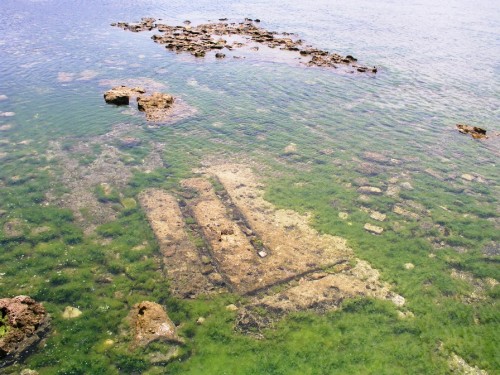
sea-level-rising-falling-2500-yearsThe Templar palace ruins in Akko (Acre), one of the sites where a geo-archaeological study was carried out. New research finds that short-term rising and falling of sea levels may not say much about global warming patterns.

Rising sea level, one of many climate change-related phenomena expected to occur in the coming years, is a major environmental concern for many Middle Eastern countries where coastlines are long and water resources are scarce.

However, a recent study headed by Dr Dorit Sivan, Head of the Department of Maritime Civilizations at the University of Haifa, shows that showed that sea level rise (and fall) is nothing new “under the sun” here in Israel.  According to the study, the sea level in Israel has been rising and falling over the past 2,500 years, with a one-meter difference between the highest and lowest levels, most of the time below the present-day level.

“Rises and falls in sea level over relatively short periods do not testify to a long-term trend. It is early yet to conclude from the short-term increases in sea level that this is a set course that will not take a change in direction,” explained Dr. Sivan.

Dr. Sivan and research assistant Ayelet Toker set out to examine Israel’s sea level over the past 2,500 years, based on data deduced from many coastal archaeological findings.  The pair examined Crusader-era excavations from the Antiquities Authority in Acre, which revealed that the sea level during the Crusader period – just 800 years ago – was some 50-90 centimeters lower than the present sea level.  An analysis of other archaeological findings from the same period at Caesarea and Atlit reinforced this conclusion.

When additional sites were examined from periods before and after the Crusader period, Dr. Sivan and Ms. Toker discovered there have been significant fluctuations in sea level: During the Hellenistic period, the sea level was about 1.6 meters lower than its present level; during the Roman era the level was almost similar to today’s; the level began to drop again during the ancient Muslim period, and continued dropping to reach the same level as it was during the Crusader period, but within about 500 years it rose again, and reached some 25 centimeters lower than today’s level at the beginning of the 18th century.

“Over the past century, we have witnessed the sea level in Israel fluctuating with almost 19 centimeters between the highest and lowest levels,” said Dr. Sivan.  “Over the past 50 years Israel’s mean sea level rise is 5.5 centimeters, but there have also been periods when it rose by 10 centimeters over 10 years. That said, even acute ups and downs over short periods do not testify to long-term trends. An observation of the sea levels over hundreds and thousands of years shows that what seems a phenomenon today is as a matter of fact ‘nothing new under the sun.’ ”

However, although rising sea level may not be new, it may still be incredibly destructive.  Impacts like flooding, underground water salinization, flooded effluents, and acceleratead coastal damage are all associated with sea level rise.  Israel and other nearby Mediterranean countries should therefore make every effort to prepare for and adapt to possible damage in the coming years.

:: University of Haifa

Photo Credit:  Amir Yurman, University of Haifa

More stories on sea level rise:
12 Million Egyptians to be Affected by Climate Change
The Conflicted Middle East to Worsen As Global Warming Causes Rising Sea Levels
Mega Urban Developments In Gulf Region A Natural Disaster Waiting to Happen

Rachel Bergstein
Rachel Bergsteinhttps://www.greenprophet.com/
When her vegan summer camp counselor explained to a fifteen-year-old Rachel how the dairy industry pollutes the groundwater in poor rural communities and causes global warming, there was no turning back. Her green fire lit, Rachel became increasingly passionate about the relationship between human societies and the natural environment, particularly about the systemic injustices associated with environmental degradation. After snagging a B.A. in Peace and Justice Studies at the University of Maryland, where she wrote an undergraduate thesis on water injustice in Israel/Palestine and South Africa, Rachel was awarded the New Israel Fund/Shatil’s Rabbi Richard J. Israel Social Justice Fellowship to come and spread the green gospel in Israel for the 2009-2010 academic year. She currently interns for Friends of the Earth Middle East in their Tel Aviv office. When Rachel is not having anxiety about her ecological footprint, carbon and otherwise, she can be found in hot pursuit of the best vegetarian food Tel Aviv has to offer. She also blogs about her experience as an NIF fellow and environmentalist in Israel at organichummus.wordpress.com. Rachel can be reached at rachelbergstein (at) gmail (dot) com.

Read More

7 COMMENTS

TRENDING

Billie Eilish’s Mom Takes the Stage at Hollywood Climate Summit — But Does Hollywood Still Care About Climate Change?

Hollywood once promised to help save the planet. Leonardo DiCaprio warned of climate catastrophe from awards stages. Celebrities flew to climate conferences. Studios pledged greener productions. Streaming platforms rushed to commission environmental documentaries. But in 2026, with the aftermath of wildfires, heatwaves and floods becoming routine, a question lingers: Does Hollywood still care about climate change?

Can Scientists Predict Coral Bleaching Before It Happens?

Now researchers at the Woods Hole Oceanographic Institution (WHOI) in the US say they have developed a way to predict coral bleaching five to six months before it occurs, potentially giving reef managers enough time to intervene and save vulnerable corals.

All 13 Tel Aviv Beaches Reawarded the Prestigious ‘Blue Flag’ for 2025

Reaffirming its leadership in sustainable coastal management, all 13 of Tel Aviv-Yafo’s public beaches have once again earned the prestigious Blue Flag certification for 2025. This honor, awarded by the International Blue Flag Committee and the Foundation for Environmental Education (FEE), recognizes beaches that meet exceptional standards in water quality, safety, accessibility, and environmental education.

Carbon Capture in 2025: Technologies, Markets, and Investment Trends

By 2028, the global CCUS market is projected to surpass $14 billion. Companies able to deliver scalable technology and tie it directly to revenue from high-integrity carbon credits are best positioned to benefit from the next wave of climate finance and regulation.

The Secrets of Longevity in Ikaria, Greece

Ikarians drink herbal teas every day, made from plants grown around their homes and in the wild

Locals From Rishon Fight IKEA

Big Box stores are a pretty new concept in Israel, and thank God that not every Israeli city wants them in their backyard. A word from someone who has see the beautiful farmland around her hometown Newmarket, Ontario stripped and converted into vulgar strip malls of big box shops: they have no place in a healthy and sustainable town or city.

The Jewish National Fund Meets An Inconvenient Truth

According to the JNF, it has transformed thousands of acres of barren land into green forests in Israel. They state that each person emits about 23 tons of carbon per year, estimating that each tree planted can absorb one ton of carbon in its lifetime. That's a whole lot of trees you'd need to be planting. Could so many fit in Israel?

How to quiet noise from construction in your office

Streets need to be resurfaced in New York but the humming and grinding noise is unsettling. Noise is environmental pollution. 

EarthX and a blueprint for sustainable investing

Trammell S. Crow, a Dallas-based businessman and father of four, is focusing his efforts on impact investing, and media that focuses on saving the planet through EarthX.

Mining Afghanistan’s Mineral Discoveries Similar to Avatar

Now that American forces in Afghanistan are commemorating the longest period of any war that America has been involved in, including the 1965-73 Vietnam War, the recent discoveries of large and extremely valuable mineral and metal deposits may finally bring to light a reason to continue the presence of US fighting forces in this war torn and backward country.

From Pilot Plant to Global Stage: How Aduro Clean Technologies’ 2026 Expansion Signals a Turning Point for Chemical Recycling Investors Like Yazan Al Homsi

The company's Next Generation Process (NGP) Pilot Plant in London, Ontario, has officially moved into initial operating campaigns, generating the kind of structured, repeatable data that separates laboratory promise from commercial viability.

Nobul’s Regan McGee on Shareholder Value: “Complacency Is the Silent Killer” 

Why the governance framework designed to protect shareholders so...

Should You Invest in the Private Market?

startustartup Unlike public stock exchanges, which offer daily trading, strict...

Popular Categories