

Earth. Energy. Everything next.

Bike Sharing Down to a Science

bike shareNew algorithms make bike sharing more efficient.

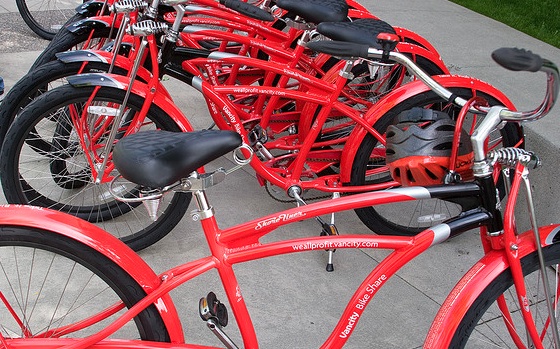
The environmentally-friendly concept of  bike-sharing is taking over European cities like Paris, and Tel Aviv is about to get its own too –– although that’s been in the works for several years. Bike sharing, if you haven’t experienced it allows a subscriber to “borrow” a bike from one of hundreds of locations in the city, use it, and return it to another location at the end of the journey.

It’s good for commuters and for running short errands. The idea is gaining speed and subscribers at the 400 locations around the world where it has been implemented, there have been growing pains — partly because the projects have been so successful. About seven percent of the time, users aren’t able to return a bike because the station at their journey’s destination is full. And sometimes stations experience bike shortages, causing frustration with the system. But Tel Aviv University researchers have  a solution to turn bike sharing into a science.

Dr. Tal Raviv and Prof. Michal Tzur are developing a mathematical model to lead to a software solution: “There is no system for more scientifically managing the availability of bikes, creating dissatisfaction among users in popular parts of the city.”

As an environmentalist, Raviv wants to see more cities adopt the bike-sharing system. In Paris alone, there are 1,700 pick-up and drop-off stations.  To help coordinating availability of bikes and drop off stations, their students have created a mathematical model to predict which bike stations should be refilled or emptied — and when that needs to happen.

In small towns with 100 stations, mere manpower can suffice, they say. But anything more and it’s really just a guessing game. A computer program will be more effective: “Our research involves devising methods and algorithms to solve the routing and scheduling problems of the trucks that move fleets, as well as other operational and design challenges within this system,” says Raviv.

What are the benefits of bike-sharing? Raviv says they are easy to point out:

cut down traffic congestion

alleviate parking shortages

reduce air pollution and health effects such as asthma and bronchitis

promote fitness

enable good complementary public transportation by allowing commuters to ride from and to train or bus stations

Because of the low cost of implementing bike-sharing programs, cities can benefit without significant financial outlay. And in some cities today, bicycles are also the fastest form of transport during rush hour.

The city of Tel Aviv is now in the process of deploying a bike sharing system to ease transport around the city, and improve the quality of life for its residents. Tel Aviv University research is contributing to this plan, and the results will be used in a pilot site in Israel.

Read more about urban cycling:
Cicleta Sprint Bicycle Messengers Take Over Tel Aviv
The Cycling Nightlife in Jerusalem
EasyBike Makes it Easy to be Green

Image via roland

::AFTAU
Read More

2 COMMENTS

TRENDING

Amman’s traffic crisis is about more than cars. It’s about how we think

I believe Jordan needs a cultural transformation alongside its infrastructure investments. We must begin by redefining social prestige. Why should ownership of an expensive car be considered a greater achievement than making an environmentally responsible transportation choice? Why should travelling by bus carry a social stigma?

Oil tankers are spilling and burning in the Middle East – where is the environmental outrage?

From the Red Sea to the Strait of Hormuz, ships have burned, tankers have leaked oil and cargo vessels have sunk since October 2023. A timeline of maritime disasters, environmental damage and cleanup efforts.

PeaceTech is the next CleanTech. And we’ve been building it for decades.

From the forests of Ontario to sea turtle conservation in Lebanon and water cooperation across the Middle East, Green Prophet founder Karin Kloosterman argues that CleanTech, EnviroTech and AgTech are already building the foundations of PeaceTech.

The ancient factory that never sat idle: what Tel Shiqmona can teach modern architects

A 2,700-year-old industrial site on Israel’s Carmel coast shows how ancient craftsmen reused the same spaces for different seasonal jobs — a lesson in flexible architecture that still matters today.

Was the Flydubai cockpit emergency an attempted terror attack — or a pilot in crisis?

What happened inside the cockpit of flydubai Flight FZ1073 on Wednesday morning is still under investigation, but the story has become considerably more disturbing since the first reports of a “fight between pilots.”

Why Bronwyn Finnegan Chose the Nonprofit Sector Over Politics or Corporate Life

Bronwyn Finnegan could have pursued a career in politics or corporate leadership. Instead, she chose the nonprofit sector, where she focuses on financial sustainability, governance and helping mission-driven organizations build the capacity to survive and grow.

Scientists make lead-free perovskite solar cells that can weather the elements

Scientists have developed a “raincoat” for lead-free tin perovskite solar cells, helping them withstand air, moisture and heat while maintaining high efficiency.

The Essential Guide To Sustainability in Project Management

Sustainability is an approach where businesses and individuals balance the environmental, social, and economic aspects of a project such that current and future stakeholders are not overburdened with the impacts of the project in future.

Yerukim Forms a New Green Economy Where the Money is Really Green

The Yerukim members who pick up the recyclables get to keep the monetary reward, the public earns "green" bills that can be used in shops, and business owners get to be associated with environmentalism.

Choosing Riyadh over Dubai? What Investors Should Know

Saudi Arabia is deploying capital at unmatched scale to catalyze tourism and advanced industry while rewiring its power-and-water backbone. The investable frontier is widening—especially in renewables, grid storage, water efficiency/desal retrofits, and hospitality operating platforms. Prudent investors will insist on phased delivery, enforceable KPIs (energy, water, biodiversity), and RHQ/zone compliance—while pricing political-economy and reputational risks alongside growth upside.

Sell your cooking oil for biodiesel money

Want to make money on old french fry oil? Sell it.

Qatar Alternative Energy Summit Pairs Investors And Innovators

Alternative energy investors and innovators can meet n' greet in Doha, Qatar March 16 and 17.

Here’s How To Implement The Four Pillars Of Employee Engagement

If you throw a party for your work team and they are vegans, don't make it a barbecue. Know the sustainability values of your team to boost moral and retain good people.

Popular Categories