Arab World and Med Region More Vulnerable to Climate Change

climate change arab worldIf Egypt’s Nile Delta is flooded by rising seas, half of its population will be at risk.

We’ve written about the topics dealing with the effects of climate change in the Middle East before on Green Prophet, and will undoubtedly write about it again. The sad truth is that the Middle East and much of the Mediterranean region, is becoming more vulnerable to the effects of climate change. Whether this involves severe water problems, often caused by government apathy; wheat and other grains dying from rising temperatures and less rainfall, or an increase in bed bug biting in  the UAE. The Arab World is becoming more vulnerable to the effects of climate change.

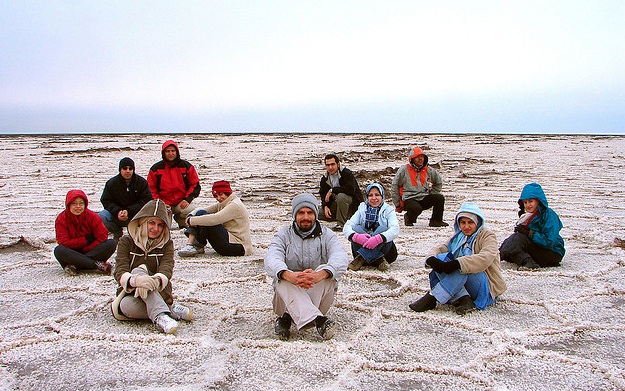
Dry lake bed in southern Cyprus

The seriousness of climate change in the Arab World was pointed out recently in an article in the news site ArabBusiness.com, in which it was noted that powerful dust storms in Iraq, freak floods wreaking havoc in Saudi Arabia and Yemen, and rising sea levels eroding Egypt’s coast are all sure signs that countries in the Middle East are some of the most vulnerable to the effects of climate change.

This is certainly nothing new as the Middle East has never been an area that has received ample rainfall. With one of the fastest growing populations in the world, especially in countries like Egypt, people living in the Arab World by the year 2015 will have to survive on less than 500 cubic meters of water a year each, against a world average exceeding 6,000 cubic meters per head, according to Mohamed El-Ashry, former head of the Global Environment Facility.

Five hundred cubic meters of water per person per annum is barely enough to survive on, much less maintain a decent quality of life. Although desalination is now widely used in Saudi Arabia, and in the Gulf States, especially in Dubai and Abu Dhabi, strict measures of water conservation and recycling, such as those now being considered in Abu Dhabi will now have to become the norm.

After all, if a small country like Israel, with a population of 7.5 million can reclaim 75% of its sewage waste water then why can’t Arab countries do the same? The ravages of climate change will not go away soon; and the sooner that Arab countries take more measures to conserve water, the better off they will be.

According to a UN Development Program (UNDP) research paper, as quoted in Arabianbusiness.com:

“For a region that is already vulnerable to many non-climate stresses, climate change and its potential physical and socio-economic impacts are likely to exacerbate this vulnerability, leading to large-scale instability.”

Hotter, drier weather already worsens water scarcity in the Middle East. And unless more effort is made by countries in this region, increased political instability and mass population migrations will soon become the norm in the Arab World.

::Almasryalyoum

Read more on Climate Change affecting the Middle East:

12 Million Egyptians to be affected by climate Change

Climate Change Killing the First Crops in the Cradle of Civilization

Is Middle East Taking Climate Change Seriously?

Arab World in Water Crises Reports Jordanian Journalist


Maurice Picow
Maurice Picowhttps://www.greenprophet.com/
Maurice Picow grew up in Oklahoma City, U.S.A., where he received a B.S. Degree in Business Administration. Following graduation, Maurice embarked on a career as a real estate broker before making the decision to move to Israel. After arriving in Israel, he came involved in the insurance agency business and later in the moving and international relocation fields. Maurice became interested in writing news and commentary articles in the late 1990’s, and now writes feature articles for the The Jerusalem Post as well as being a regular contributor to Green Prophet. He has also written a non-fiction study on Islam, a two volume adventure novel, and is completing a romance novel about a forbidden love affair. Writing topics of particular interest for Green Prophet are those dealing with global warming and climate change, as well as clean technology - particularly electric cars.

TRENDING

Saving Gourmet Wild Plants For The Future

Think of truffles, a gourmet wild food. The European...

Climate change traced in sea turtle shells

It's sea turtles which may in the end save islands in the Seychelles. They may also better help us understand climate change. Like rings on a tree, scientists have found a way to read sea turtle shells and how they are impacted by climate change tells a story. 

We’ve lived through the past 11 of the hottest years on record

Have we forgotten about global warming when the world...

Huge Fish Nursery Discovered Under Freezing Arctic Seas

In 2019, an underwater robot camera exploring the seabed...

Remilk makes cloned milk so cows don’t need to suffer and it’s hormone-free

This week, Israel’s precision-fermentation milk from Remilk is finally appearing on supermarket shelves. Staff members have been posting photos in Hebrew, smiling, tasting, and clearly enjoying the moment — not because it’s science fiction, but because it tastes like the real thing.

Nobul’s Regan McGee on Shareholder Value: “Complacency Is the Silent Killer” 

Why the governance framework designed to protect shareholders so...

Should You Invest in the Private Market?

startustartup Unlike public stock exchanges, which offer daily trading, strict...

How to build a 100-year-company

Kongō Gumi is a Japanese construction company, purportedly founded in 578 A.D., making it the world's oldest documented company. What can we learn about building sustainable businesses from them?

From Pilot Plant to Global Stage: How Aduro Clean Technologies’ 2026 Expansion Signals a Turning Point for Chemical Recycling Investors Like Yazan Al Homsi

The company's Next Generation Process (NGP) Pilot Plant in London, Ontario, has officially moved into initial operating campaigns, generating the kind of structured, repeatable data that separates laboratory promise from commercial viability.

How AI Helps SaaS Companies Reduce Repetitive Customer Support Work

SaaS products are designed for large numbers of users with different levels of experience, and also in renewable energy.

Pulling Water from the Air

Faced with water shortage in Amman, Laurie digs up...

Turning Your Energy Consultancy into an LLC: 4 Legal Steps for Founders in Texas

If you are starting a renewable energy business in Texas, learn how to start an LLC by the books.

Tracking the Impacts of a Hydroelectric Dam Along the Tigris River

For the next two months, I'll be taking a break from my usual Green Prophet posts to report on a transnational environmental issue: the Ilısu Dam currently under construction in Turkey, and the ways it will transform life along the Tigris River.

Related Articles

Popular Categories