Is the Middle East taking Climate Change Seriously?

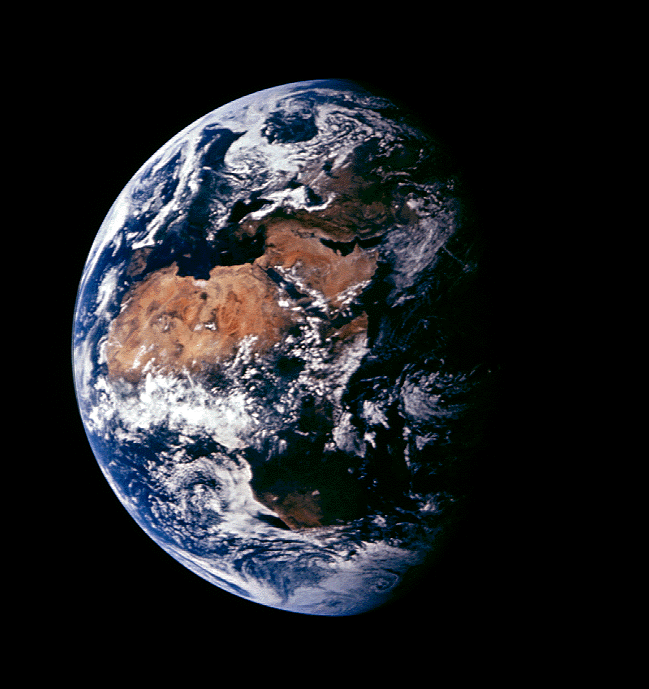
Despite facing issues such as water scarcity and pollution at poisonous levels, the Middle East is still sending mixed message about climate change. Image of Mideast and earth Courtesy of NASA.

There is a constant debate in green circles over whether the Middle East is really taking climate change seriously. Some days the Arab world seems busy installing solar panels, planting trees, planning green cities and the next they are expanding airports, driving species to extinction and spending billions on the defense rather than the environment. So what is really going on?

Well, the only honest answer is that its complicated. For one, there is the whole issue of the difference in attitudes between the numerous governments, businesses and the average person who is just trying to make a living. To me, it seems that against a backdrop of ignorance and lack of interest, there is real progress being made by innovative groups, individuals and government plans. But like in many countries, there is a lot of people who just don’t get it.

In a recent article published in Qantara, Joseph Mayton stated that the idea of conservation and environmental activism was ‘unknown and almost nonexistent’ in the average person living in the Middle East despite urgent issues such as water shortages and environmental pollution. He explained that “the environmental movement is often ridiculed and shunned by local media. In many ways, it is seen as foreign or Western, and it has yet to make a solid impact on the ground.”

Whilst this may not be easy reading, it does ring true to many people working the field. Issues such as environmental pollution and water shortage may have an impact of the daily lives of Arabs but they are not making the connection between them and climate change. Well not yet, anyway.

Air pollution is a huge problem facing Egyptians living in Cairo and yet many don’t make the link between pollution and protecting the environment. Image via ninahale.

Taking a quick look at businesses there is more to feel hopeful about but it’s far from great. According to the latest report by the Sustainability Advisory Group (SAG), an international alliance of sustainability strategists and specialists, businesses are still complacent about several critical issues affecting the region.

Whilst regional businesses increasingly view Corporate Social Responsibility (CSR) as something which can add value to their business reputation, sadly a relatively high number of business leaders continue to rate water conservation, climate change and waste as “un-important to their business.” Given the real threats that the region faces from climate change, these results are quite alarming.

Maria Sellanpaa, Founding Director of the Sustainability Advisor Group, told Green Prophet that she had witnessed fairly uneven progress on the issue of climate change in the Middle East. “It appears that in some countries there is considerable activity ‘on the ground’ to explore for instance alternative energy solutions but mostly at micro generation level. This is obviously encouraging but what we are not really witnessing yet is strong government support and action or regional collaborative efforts.”

Maria also added the link between desalinated water and carbon was not clear and new technologies urgently needed implemention to make water less carbon-intensive and  cheaper.  The CSR report is SAG’s second CSR report and the research covered UAE, Saudi Arabia, Bahrain, Oman, Qatar, Yemen, Egypt and Jordan.

This may all make for some depressing reading but it does illustrate my point that’s complicated. Because against the backdrop of limited interest, things are starting to change.

Green groups are forming all the time across the Middle East, the environment is climbing up governments and businesses’ agenda and there are some great projects already making a difference. Support is growing, so we just have to accept that change of the magnitude that climate change demands is going to take time.

:: Sustainability Advisory Group

Arwa Aburawa
Arwa Aburawahttp://www.greenprophet.com
Arwa is a Muslim freelance writer who is interested in everything climate change related and how Islam can inspire more people to care for their planet and take active steps to save it while we can. She is endlessly suspicious of all politicians and their ceaseless meetings, especially as they make normal people believe that they are not part of the solution when they are the ONLY solution. Her Indian auntie is her model eco-warrier, and when Arwa is not busy helping out in the neighborhood alleyway garden, swap shopping or attempting fusion vegetarian dishes- with mixed success, she’d like to add- she can be found sipping on foraged nettle tea.

Read More

TRENDING

Weston Higginbotham found dead in a Kyoto forest: is climate anxiety part of the story?

In some ways, Weston has become a symbol of a generation wrestling with environmental and technological anxiety. Friends and family described him as deeply concerned about environmental issues. Reports also noted that he questioned the growing role of artificial intelligence in daily life, even reportedly disagreeing with his mother about her use of AI.

Billie Eilish’s Mom Takes the Stage at Hollywood Climate Summit — But Does Hollywood Still Care About Climate Change?

Hollywood once promised to help save the planet. Leonardo DiCaprio warned of climate catastrophe from awards stages. Celebrities flew to climate conferences. Studios pledged greener productions. Streaming platforms rushed to commission environmental documentaries. But in 2026, with the aftermath of wildfires, heatwaves and floods becoming routine, a question lingers: Does Hollywood still care about climate change?

Can Scientists Predict Coral Bleaching Before It Happens?

Now researchers at the Woods Hole Oceanographic Institution (WHOI) in the US say they have developed a way to predict coral bleaching five to six months before it occurs, potentially giving reef managers enough time to intervene and save vulnerable corals.

Lyme Disease And The Great Outdoors

Planning on being outdoors a lot this summer? We...

10 Amazing Facts About the Sidr Tree

Most people in the West have never heard of the Sidr tree. That's strange when you think about it. This tough, thorny desert tree has fed people, bees, birds, and camels for thousands of years. It appears in Islamic tradition. Its honey sells for astonishing prices.

Locals From Rishon Fight IKEA

Big Box stores are a pretty new concept in Israel, and thank God that not every Israeli city wants them in their backyard. A word from someone who has see the beautiful farmland around her hometown Newmarket, Ontario stripped and converted into vulgar strip malls of big box shops: they have no place in a healthy and sustainable town or city.

The Jewish National Fund Meets An Inconvenient Truth

According to the JNF, it has transformed thousands of acres of barren land into green forests in Israel. They state that each person emits about 23 tons of carbon per year, estimating that each tree planted can absorb one ton of carbon in its lifetime. That's a whole lot of trees you'd need to be planting. Could so many fit in Israel?

How to quiet noise from construction in your office

Streets need to be resurfaced in New York but the humming and grinding noise is unsettling. Noise is environmental pollution. 

EarthX and a blueprint for sustainable investing

Trammell S. Crow, a Dallas-based businessman and father of four, is focusing his efforts on impact investing, and media that focuses on saving the planet through EarthX.

Mining Afghanistan’s Mineral Discoveries Similar to Avatar

Now that American forces in Afghanistan are commemorating the longest period of any war that America has been involved in, including the 1965-73 Vietnam War, the recent discoveries of large and extremely valuable mineral and metal deposits may finally bring to light a reason to continue the presence of US fighting forces in this war torn and backward country.

From Pilot Plant to Global Stage: How Aduro Clean Technologies’ 2026 Expansion Signals a Turning Point for Chemical Recycling Investors Like Yazan Al Homsi

The company's Next Generation Process (NGP) Pilot Plant in London, Ontario, has officially moved into initial operating campaigns, generating the kind of structured, repeatable data that separates laboratory promise from commercial viability.

Nobul’s Regan McGee on Shareholder Value: “Complacency Is the Silent Killer” 

Why the governance framework designed to protect shareholders so...

Should You Invest in the Private Market?

startustartup Unlike public stock exchanges, which offer daily trading, strict...

Popular Categories