Israel's Best and Brightest Debate Climate Policy

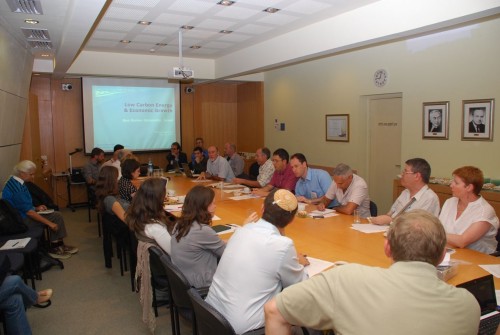
Workshop at Ben-Gurion University on Climate Change Mitigation PolicyWhat will Israel do if the Nile Delta becomes submerged from climate change? Brainstorming at the Climate Change Mitigation Policy Workshop today at Ben-Gurion University. (Image courtesy of Ophir Shoham)

In his opening remarks at the Climate Change Mitigation Policy Workshop at Ben-Gurion University today, Prof. Alon Tal, one of Israel’s most revered environmentalists, referred to the 20 or so people seated around the conference table as a “dream team” for environmental policy in Israel. Indeed, the workshop featured an all-star lineup of Israeli experts from academia, government, NGOs and the private sector.

The initial reference point for the workshop was the McKinsey report commissioned by the Ministry of Environmental Protection last year, entitled “Greenhouse Gas Abatement Potential in Israel.” Tal said the idea of convening this workshop came to him after realizing that the Israeli environmental community had yet to formulate a concerted response to this report.

The workshop began with presentations from three international experts: Bracken Hendricks, a Senior Fellow at the Center for American Progress in Washington; Dr. Malte Schneider, a Senior Researcher at ETH Zurich; and Joe Kruger, Policy Director at the National Commission on Energy Policy in Washington.

“There’s tremendous opportunity here. Israel could be a leader of global change and serve as a regional hub,” Hendricks asserted, noting that the Middle East and North Africa region is at the center of the climate debate. “Israel is at ground zero: If the Nile Delta is submerged [as a result of climate change], there will be millions of climate refugees.”

Hot showers and cold beers

Hendricks also stressed that climate advocates must make a strong case for the economic benefits of environmental policy: “It’s hard to mobilize people around atmospheric chemistry when people are getting pink slips. What we really care about is hot showers and cold beers.” The US government’s substantial investment in the green economy came as part of the economic recovery package and not as climate change spending, he explained.

Schneider, from ETH Zurich, said he was surprised by the uniqueness of Israel’s situation, including its extensive range of technology for both mitigating and adapting to climate change. He also noted that Israel places special emphasis on energy security and [for now, at least] functions as an “island,” with an isolated grid.

He offered this advice: “Get the first waves of renewables off the ground now,” while continuing to try to figure out the larger picture and formulate long-term policy.

The third international expert, Joe Kruger, noted that Israel’s share of greenhouse gas emissions is negligible on a global scale. Nonetheless, “the world needs Israel to step up and show leadership, to become an innovation center for the world,” he said.

Israel should integrate emissions reduction into its economic development plans, thus serving domestic needs at the same time, Kruger suggested. In particular, he singled out energy efficiency in buildings as an important place to start, and advocated instituting a carbon tax: “Carbon should be considered a cost.”

Calling a spade a spade

Next, it was time for the Israeli experts to present their views. In general, they were less circumspect than the foreign experts in criticizing the McKinsey report. (Dr. Dan Rabinowitz of Tel Aviv University would later explain to the guests that Israelis tend to “call a spade a spade” and that the visitors’ real opinion of the McKinsey report was evident, despite their more polite language: “You also think it sucks!”)

Yosef Abramowitz, president of Arava Power Co., rendered the most scathing indictment of the report, accusing McKinsey of “capitulating to the cynicism of Israeli politics.” Achieving ambitious targets for renewable energy in Israel is “completely doable” he passionately insisted, but complained that Israel’s political leadership has shown “no clarity or courage” in this area.

‘Kick ass’ at the Knesset

On Wednesday, the three foreign visitors will visit the Knesset and meet with the minister of national infrastructure, Uzi Landau. Abramowitz expressed hope that this “nexus of expertise and timing” would wield critical influence with policy makers in Jerusalem.

The cultural anthropologist Rabinowitz offered some advice for the foreign experts: “When you meet with Israeli politicians, remember that they’ll only listen to the first half of the sentence, so save any compliments for last, and first – kick ass.”

Read more about Israel and greenhouse gas emissions:

Are Israeli Emission Controls Hopeless?
Israel Can Do More Than Cleantech to Reduce Regional Carbon Footprint

Ira Moskowitz
Ira Moskowitzhttps://www.greenprophet.com/
When his kids were small, Ira would point to litter on the ground and tell them: “That makes me angry!” He still gets angry about pollution, waste and abusive treatment of our world, but is encouraged by the growing awareness of environmental issues and has been following the latest developments in cleantech with great interest. Ira grew up in the green hills of western Massachusetts and moved to Israel in the early 1980s after completing an MA in Middle Eastern Studies. He has worked as a software developer and journalist, and translates works of Hebrew fiction and non-fiction to English. Ira is trying to age gracefully, but refuses to surrender his youthful belief in the potential for change, including a collaborative future for the peoples of the Middle East. To contact Ira, email ira (at) greenprophet (dot) com.

Read More

TRENDING

Dan Zaslavsky’s energy tower dream is rising again in Iran and China

The Energy Tower idea never made the leap from drawings and engineering studies to full-scale construction. But nearly two decades after most people stopped talking about it, the concept is quietly evolving in two unexpected places: China and Iran. The concept let dreamers dream and doers do - figuring out more pleasing designs and engineering.

Weston Higginbotham found dead in a Kyoto forest: is climate anxiety part of the story?

In some ways, Weston has become a symbol of a generation wrestling with environmental and technological anxiety. Friends and family described him as deeply concerned about environmental issues. Reports also noted that he questioned the growing role of artificial intelligence in daily life, even reportedly disagreeing with his mother about her use of AI.

Billie Eilish’s Mom Takes the Stage at Hollywood Climate Summit — But Does Hollywood Still Care About Climate Change?

Hollywood once promised to help save the planet. Leonardo DiCaprio warned of climate catastrophe from awards stages. Celebrities flew to climate conferences. Studios pledged greener productions. Streaming platforms rushed to commission environmental documentaries. But in 2026, with the aftermath of wildfires, heatwaves and floods becoming routine, a question lingers: Does Hollywood still care about climate change?

Can Scientists Predict Coral Bleaching Before It Happens?

Now researchers at the Woods Hole Oceanographic Institution (WHOI) in the US say they have developed a way to predict coral bleaching five to six months before it occurs, potentially giving reef managers enough time to intervene and save vulnerable corals.

10 Amazing Facts About the Sidr Tree

Most people in the West have never heard of the Sidr tree. That's strange when you think about it. This tough, thorny desert tree has fed people, bees, birds, and camels for thousands of years. It appears in Islamic tradition. Its honey sells for astonishing prices.

Locals From Rishon Fight IKEA

Big Box stores are a pretty new concept in Israel, and thank God that not every Israeli city wants them in their backyard. A word from someone who has see the beautiful farmland around her hometown Newmarket, Ontario stripped and converted into vulgar strip malls of big box shops: they have no place in a healthy and sustainable town or city.

The Jewish National Fund Meets An Inconvenient Truth

According to the JNF, it has transformed thousands of acres of barren land into green forests in Israel. They state that each person emits about 23 tons of carbon per year, estimating that each tree planted can absorb one ton of carbon in its lifetime. That's a whole lot of trees you'd need to be planting. Could so many fit in Israel?

How to quiet noise from construction in your office

Streets need to be resurfaced in New York but the humming and grinding noise is unsettling. Noise is environmental pollution. 

EarthX and a blueprint for sustainable investing

Trammell S. Crow, a Dallas-based businessman and father of four, is focusing his efforts on impact investing, and media that focuses on saving the planet through EarthX.

Mining Afghanistan’s Mineral Discoveries Similar to Avatar

Now that American forces in Afghanistan are commemorating the longest period of any war that America has been involved in, including the 1965-73 Vietnam War, the recent discoveries of large and extremely valuable mineral and metal deposits may finally bring to light a reason to continue the presence of US fighting forces in this war torn and backward country.

From Pilot Plant to Global Stage: How Aduro Clean Technologies’ 2026 Expansion Signals a Turning Point for Chemical Recycling Investors Like Yazan Al Homsi

The company's Next Generation Process (NGP) Pilot Plant in London, Ontario, has officially moved into initial operating campaigns, generating the kind of structured, repeatable data that separates laboratory promise from commercial viability.

Nobul’s Regan McGee on Shareholder Value: “Complacency Is the Silent Killer” 

Why the governance framework designed to protect shareholders so...

Should You Invest in the Private Market?

startustartup Unlike public stock exchanges, which offer daily trading, strict...

Popular Categories