


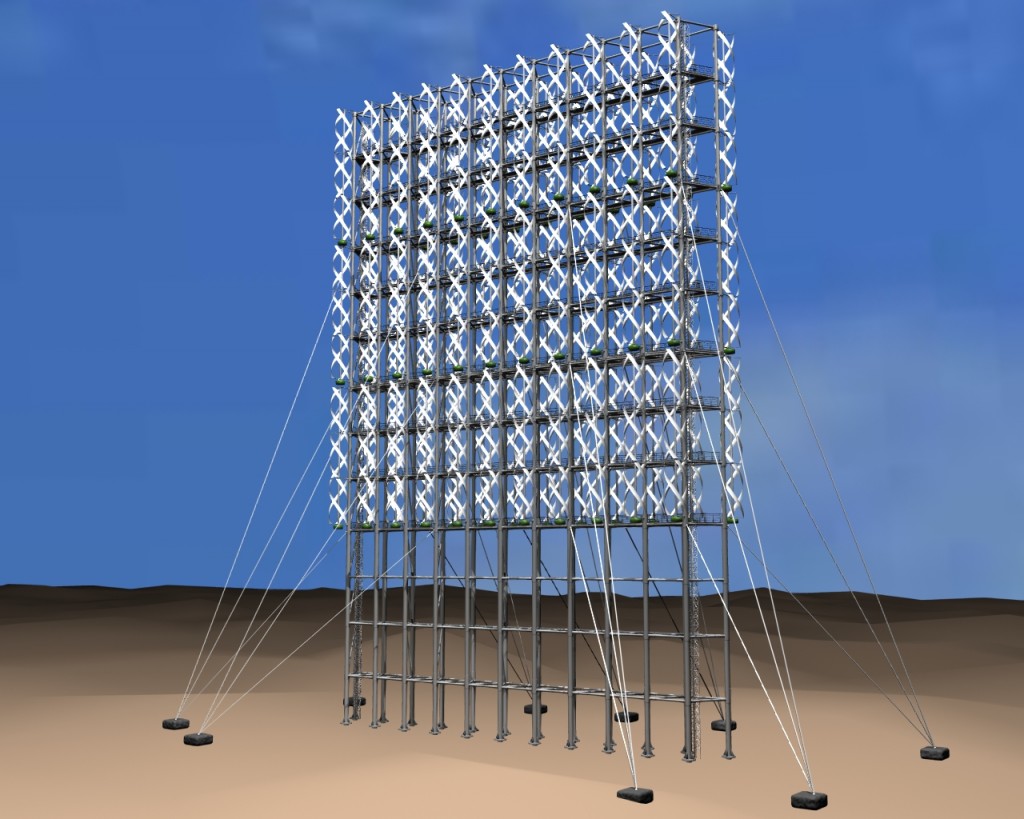
 A stackable, scalable wind-turbine solution taps into a lucrative $40 billion market. Move your turbines where the wind blows, without heavy environmental impact.
When we think of wind turbines, we tend to picture the standard massive turbine fans the size of airplane wings created by companies like Vestas. While they’re an important carbon-free component to supplying countries with renewable energy solutions, there are those – including environmentalists – who find the massive turbines unsightly and somewhat controversial. Sometimes, new roads have to be laid to secure the mega-blades into the ground near windy shores. And the unsightly wind stations devalue property and real estate.
Meanwhile, an Israeli company is proving that there’s more than one way to catch the wind. Looking to the French mathematician, Gaspard Gustave de Coriolis, the team at the company that bears his name has developed a medium-sized scalable wind technology that can grow with one’s energy needs, investment potential and the changing winds of time.
Based on a single unit that rotates three blades vertically, like a barber’s pole, Coriolis Wind’s solution which we’ve reported on earlier, is scalable – each unit of 50 kilowatts can be stacked together with others to generate as much as one megawatt of power, enough energy to run an industrial park. The product is currently in the prototype stage.
With a name derived from the Coriolis effect – the deflective effect of the earth’s rotation on all free-moving objects, including oceans, the atmosphere and wind – the company’s solution lies in extremely lightweight vertical turbine blades, each only about six and a half feet long. Developed from a lightweight plastic material, the molded turbines are linked together in a “pod” of three, to form a module. Modules can be connected together to scale, as more power is needed.
Tapping into a $40 billion market
Coriolis sees itself as ultimately offering a new paradigm to tap into the medium-scale wind power solutions market, estimated at about $40 billion. Its approach is to move away from the massive blades and over to small- to medium-sized units that have less effect on the environment and their surroundings.
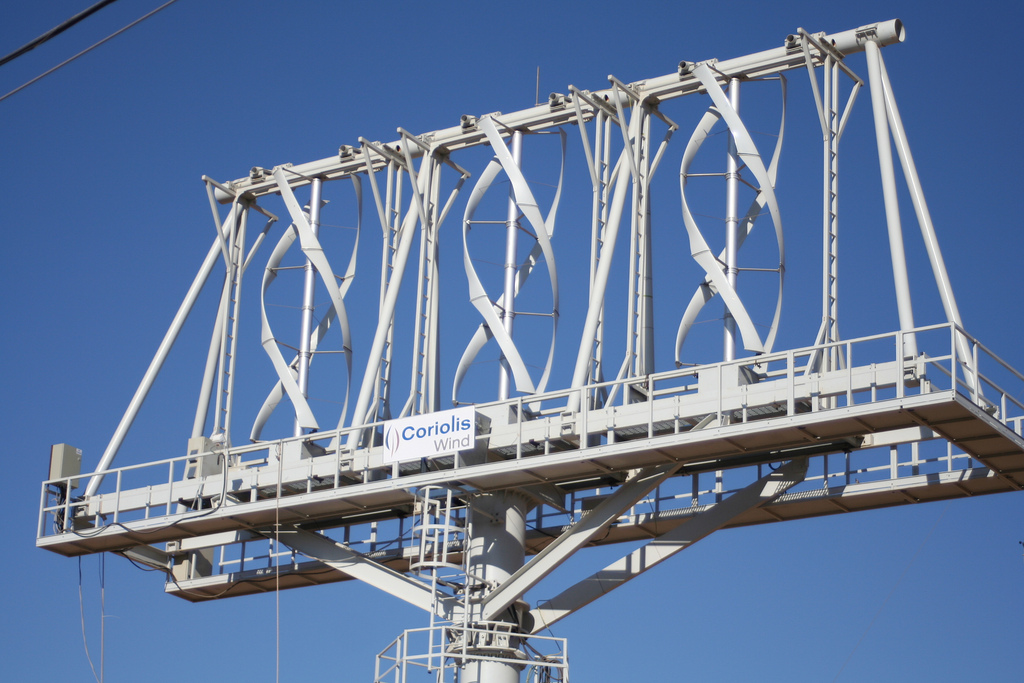
“You know it’s very subjective,” Coriolis CEO Rafi Gidron tells ISRAEL21c. “We believe that the environmental impact of our system is not as disturbing as the big turbines.
“Ours is designed for a distributed wind environment in industrial parks, commercial parks and small communities in the wind environment,” he explains. With Coriolis, you won’t see “big wind farms with dozens of turbines, but a smaller installation,” he adds.
Coriolis is focusing on the niche where the big wind turbines are not the appropriate solution. The company can reduce the overhead costs incurred by cranes, and doesn’t require any special type of delivery transport for installation like the larger turbine fans do.
“Our system is designed so it doesn’t require training, it can easily be maintained and can be transported by small standard trucks,” he says, stressing that the units’ prices will be competitive with the industry standards.
Born in a cowshed
Some companies, Gidron continues, will be able to park the system behind the electricity meter and sell the power back to the grid at retail prices. At other locations the units can be tailored to meet the energy needs at any given time, and can scale up as a company or factory grows. And theoretically, the turbines can also be moved if wind intensity should change or if a company relocates.
The company of 13, founded in 2008, has an ambitious plan to be a leader in wind energy, supplying power to large buildings, schools and industrial parks all over the world.
The company’s pilot site is located at the Israeli agricultural village of Kfar Yarok, where its office and test lab are housed inside a cowshed. “That’s where the sh** literally hits the fan,” says Gidron (pun intended).
With a $10 million investment Coriolis will build its beta site in the US, along with a strategic partner – a major American energy company that has not yet been named. The site is expected to be ready by 2011.
Coriolis was founded by Precede, a group of four entrepreneurs who also founded the Pythagoras and Solar Power solar energy companies. All the founders now hold full-time positions at Coriolis and offer their support as board members to the other two companies since launched.
(This story was first published on ISRAEL21c – www.israel21c.org)
More on the potential of wind power for the Middle East:
Turkey Blowing and Going on Wind Power
Does Wind Energy Endanger Migrating Birds?
Harvest Rainwater and Build Turbines With Vertigo Dance Company
Dubai’s Wind-Powered Rotating Skyscraper is Building in Motion



[…] Israel’s Wind Power Sector Compete with Solar? Turkey Blowing and Going on Wind Energy Coriolis Scales Up for the Wind AKPC_IDS += […]
Scalable, stackable, moveable wind turbine solution with little enviro impact: http://www.greenprophet.com/2010/02/01/16755/coriolis-wind/
Coriolis Scales Up for the Wind http://ff.im/-faNSD
News:: Coriolis Scales Up for the Wind http://www.greenprophet.com/2010/02/01/16755/coriolis-wind/