
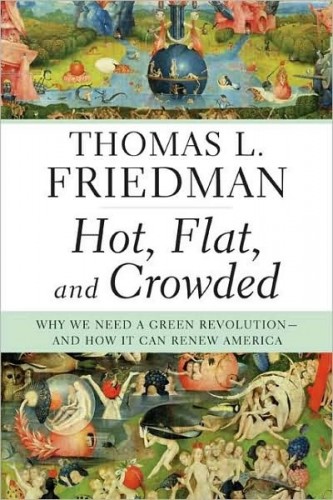

 Hot, Flat and Crowded shows people how to embrace clean energy and green technology industries.
The Genus of Genius: Someone once told me that there are three types of genius in the world. The first type of genius flows from those among us that birth brilliant and original ideas. The second type of genius belongs to those who can recognize the first type of genius. The third type of genius stems from those individuals who possess the ability to translate and transmit the first type.
Thomas L. Friedman’s book, Hot, Flat and Crowded (Why We Need A Green Revolution – And How It Can Renew America) indicates that the author likely falls into the third genus of genius. It isn’t the prose that impresses and the content isn’t that original either.
What Friedman does best is present disparate ideas from the worlds for business, science, homeland security and macro-economics into one coherent argument for the green revolution. Most of the ideas posited by Friedman to support his overarching thesis shouldn’t be foreign to even the armchair environmentalist. But it’s precisely the armchair environmentalist that has Friedman so (justifiably) worried.
According to Friedman:
“The final and most important sign that we are succeeding will be that the term ‘green’ blessedly disappears. There will be no such thing as a green building, a green car, a green appliance, a green window, or even green energy…Green will be the new standard. It will be the new normal – nothing else will be available, nothing else will be possible.”
Friedman levels strong criticism at what he perceives as the growing cosmetic concern about the environment and the energy crisis. He writes, “It is not about Earth Day concerts. It is not about special green issues of magazines. It is not about 205 easy ways to go green…too often and in too many ways, “green” has become a license to feel good without doing good, to raise awareness without actually changing our behavior.”
The Hot, Flat and Crowded Thesis
The book is divided into two parts. The first half focuses on the challenges facing the world today, including energy poverty, climate change, and loss of biodiversity, coupled challenges specifically facing the West including petro-dictatorship (e.g. Iran, Venezuela and yes, Russia) and America’s tarnished issue abroad. Although Friedman alludes to the opportunity that the world’s leading countries have by solving these problems, most of the first 200 pages focus on the formidable challenges the planet is facing.
According to Friedman:
“The world also has a problem: It is getting hot, flat and crowded. That is global warming, the stunning rise of the middle classes all over the world, and rapid population growth have converged in a way that could make our planet dangerously unstable. In particular, the convergence of hot, flat and crowded is tightening energy supplies, intensifying the extinction of plants and animals, deepening energy poverty, and strengthening petro-dictatorship, and accelerating climate change. How we address these interwoven global trends will determine a lot about the quality of life on earth in the twenty-first century.”
Hot, Flat and Crowded‘s thesis breaks up the world into electricity haves and have-nots. The argument is similar to Tom Athanasiou’s, in his groundbreaking book, Divided Planet: the ecology of rich and poor.
Both authors make a compelling argument that as middle class luxuries like hairdryers and iPods make their way into the developing world, the tax on natural resources will reach dangerous levels that are completely unsustainable.
The difference between Athanasiou’s book and Friedman’s is that Divided Planet was published 14 years ago in 1996. In other words, all of Athinisou’s assumptions have become indisputable facts by the publishing date of Hot, Flat and Crowded.
America’s Role in the Climate-Energy Era
Friedman posits that we are now entering a new era in history, the Energy-Climate Era. The second half of the book aims at how the planet can address these challenges.
As the subtitle indicates, Friedman sees America’s role as critical in solving the world’s environmental problems. He sees a direct connection between solving those problems and winning the war on terror. At one point in the introduction, Friedman recommends dropping code red in place of “Code Green” from the Department of Homeland Security’s current warning system. His elaboration on the obvious connection between global terrorism and the USA’s dependence on crude oil, the one fossil fuel that literally funds their fiercest enemies resonates here.
Friedman suggests that America has the opportunity to lead the world once again by embracing the challenges and making it a goal to do to energy what we did with IT, transform the world with new ideas that lead to new business models all focusing on efficiency, conservation and renewable energy. See, nothing earth-shattering here. In relation to America’s role in the Energy-Climate Era, Friedman says that US leadership is key both domestically and in foreign affairs:
“In a world that is Hot, Flat and Crowded, it is essential that the next president also be a CEO – chief energy officer – who finds a democratic way to establish authority over this American energy beast that is shouting and pulling in so many directions, and refocus it on the single priority of innovating and generating clean power, energy efficiency and conservation through a smart system.”
Friedman suggests that the US absorb itself with renewable energy sources. He compares “fuels from hell” – coal, oil and natural gas with “fuels from heaven” – wind, hydro-electric, tidal, biomass and solar power. According to Friedman, “These [fuels form heaven] all come from above ground, are endlessly renewable, and produce no harmful emissions.”
Hot, Flat and Crowded is the perfect starter kit to someone unfamiliar, but curious about climate change, the energy crisis, the alarming rate at which endangered species become extinct and what we (and the leaders we vote for) can do about these problems.
One glaring omission from this book was the mandate for multinational corporations to get involved in leading the fight on the world’s environmental challenges. In a world where Apple and Google have more money and influence around the world than most countries, innovation and leadership can just as easily begin at the checkout line as it can from the voting booth.
There aren’t that many ideas in the book that were unfamiliar, but Friedman’s writing style and obvious passion for the subject matter make the book very accessible and engaging for the reader.
::Hot, Flat and Crowded (on Amazon)



[…] “Energy from heaven or energy from hell.” – Friedman […]
[…] with Hot, Flat and Crowded, a great eco starter book, and continuing with French adventures and some cooking tips, our list […]
[…] more about green reading:: Sustainable Reading: The CEO of Eco-Libris Speaks Friedman’s “Hot, Flat and Crowded” – The Perfect “Green” Starter… Book Review of Precycle! by Paul Peacock: So You Can Do Better Than Recycling AKPC_IDS += […]
[…] A good primer for the cleantech space is Thomas Friedman’s book “Hot, Flat and Crowded.” […]
Good review. Tom Friedman was in Taiwan yesterday at invite of Roc President Ma, and TLF told the lecture of Taiwanese government officials in the Presidential Office meeting hall:”I’m gonna tell you a secret. Don’t let anybody else know,” Friedmansaid. “There are too many Americans in the world today.”It is a blessing that so many people in the world can live likeAmericans, Friedman said, but “the good Lord did not design our planetfor this many Americans.”see FULL STORY AND LINK TO TAIPEI TIMES HEREhttp://northwardho.blogspot.com/2010/01/i-see-b…
Good review. Tom Friedman was in Taiwan yesterday at invite of Roc President Ma, and TLF told the lecture of Taiwanese government officials in the Presidential Office meeting hall:”I’m gonna tell you a secret. Don’t let anybody else know,” Friedmansaid. “There are too many Americans in the world today.”It is a blessing that so many people in the world can live likeAmericans, Friedman said, but “the good Lord did not design our planetfor this many Americans.”see FULL STORY AND LINK TO TAIPEI TIMES HEREhttp://northwardho.blogspot.com/2010/01/i-see-b…
RT @GreenProphet Friedman’s “Hot, Flat and Crowded” – The Perfect “Green” Starter Book http://bit.ly/5GQ1o6
Friedman's “Hot, Flat and Crowded” – The Perfect “Green” Starter … http://bit.ly/60RO0k
RT @kloostermania: “Hot, Flat and Crowded” – The Perfect “Green” Starter Book http://www.greenprophet.com/2010/01/11/16033/friedman-hot- …
Friedman's “Hot, Flat and Crowded” – The Perfect “Green” Starter … http://bit.ly/614An5
Friedman's “Hot, Flat and Crowded” – The Perfect “Green” Starter … http://bit.ly/82uTKB
Great review, I'll probably give this a read. I haven't been a big fan of Friedman's in the past. His arguments seem at times anecdotal. He doesn't have the scientific rigor of authors that he is trying to mimic like the freakonomics people or Malcolm Gladwell. He also seems self serving in pushing the “flat” meme. Interesting how he transitioned from a middle east correspondent to a commentator on economics, I think he is trying to get a nobel prize like the other nytimes columnist Paul Krugman.
Friedman's “Hot, Flat and Crowded” – The Perfect “Green” Starter … http://bit.ly/74fENJ
Friedman's “Hot, Flat and Crowded” – The Perfect “Green” Starter …: Hot, Flat and Crowded shows people ho.. http://bit.ly/7IGaZZ
agree- good bk @DavidAnthony21V RT @GreenProphet Friedman’s “Hot, Flat and Crowded” – The Perfect “Green” Starter Book http://bit.ly/7dWuZh
“Hot, Flat and Crowded” – The Perfect “Green” Starter Book http://www.greenprophet.com/2010/01/11/16033/friedman-hot-flat-crowded/
News:: Friedman's "Hot, Flat and Crowded" – The Perfect "Green" Starter Book http://bit.ly/5xO86g