
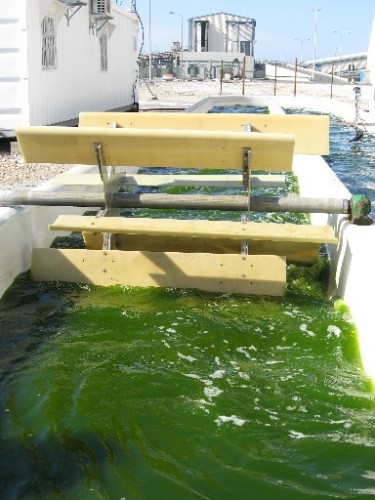

 A Seambiotic algae farm grows biofuel
Seambiotic’s been teaming up with NASA to to create a biofuel suitable for sending astronauts into space (?), and now this company is once again making news in a new venture with the China Goudian utility company to grow micro algae for use as a biodiesel fuel to power electrical power stations all over China.
Founded in 2003, Seambiotic develops and produces marine microalgae for the nutraceuticals and biofuel industries by using flue gas from electric power plants.
Seambiotic’s success in utilizing an organic substance that is found in abundance in the world’s oceans and in fresh water sources as well, may one day solve much of the world’s energy needs as well as provide food products for the earth’s continuing increasing population.
The new venture with one of China’s largest utility companies, which operates more than 100 power stations, will build its first commercial farm on 12 hectares (30 acres) in Penglai, a city in Shandong Province.
The $10 million farm will utilize carbon dioxide being expelled from the power station in Penglai. It is expected to be operational some time in 2010. On Seambiotic’s website, the growth of microalgae requires an abundance of solar radiation in a wide range of temperatures. The algae is best grown in shallow ponds where both light and temperature play a part in the algae’s growth, they say, which is then “fed” by an abundance of carbon dioxide. In this case, by using the flue gases from coal-burning power stations, which are abundant in China.
By utilizing the carbon dioxide that otherwise would escape into the atmosphere and contribute to global warming, these “greenhouse gases” are channeled into the algae cultivation ponds to stimulate algae growth.
Algae as both a food source and as a bio fuel has been the subject of many projects all over the world, utilizing one of the earth’s most abundant plants that has been supplying much of our oxygen as well as being food for marine life as part of their food chain.
Being able to utilize this natural wonder product to provide food products for both animals and human beings, as well as an environmentally cleaner bio fuel, may one day reduce or even eliminate the need for using oil and coal as a fuel source, as well as reduce the problems of global warming. This good news in advance of the Copenhagen climate change talks which begin this week.




[…] Interest in using algae as a biofuel has resulted in a number of projects in various parts of the world, including a joint venture with Israel’s Seambiotic and China’s giant Goudan Utility Company. […]
[…] Converting algae into bio fuel has been written about on previous occasions for Green Prophet: Israel and China are planning to work together on a joint bio fuel project. An Israeli Isaac Berzin brought the idea back to life while working for NASA. Another article […]
To learn about the fast-track commercialization of the algae production industry you may want to check out the National Algae Association, the trade association.
Coastal Harvest™ – Algae Into Biofuel a “Greener” Story In $10 Million Joint Israeli & Chinese Project [GreenProphet] http://bit.ly/5wN8Ew
[…] in Israel, including joint projects with NASA to fuel spaceships sending astronauts into space; and with the Chinese by utilizing “flue gasses” from power plants. And of course the country is home to the […]
RT @fuelgae Algae Into Biofuel a “Greener” Story In $10 Million Joint Israeli and Chinese Project- http://bit.ly/7yajjb
Algae Into Biofuel a “Greener” Story In $10 Million Joint Israeli and Chinese Project- http://bit.ly/7yajjb: Al… http://bit.ly/7honlY
Algae Into Biofuel a “Greener” Story In $10 Million Joint Israeli and Chinese Project- http://bit.ly/7yajjb
RT @storm_rice: 割と地味な印象の藻類ベンチャーのSeambioticがNASAと組んだり、中国の企業と組んだりしているらしい。中国の石炭火力の排ガスで藻類を培養するとのこと。 http://bit.ly/7yajjb –
割と地味な印象の藻類ベンチャーのSeambioticがNASAと組んだり、中国の企業と組んだりしているらしい。中国の石炭火力の排ガスで藻類を培養するとのこと。 http://bit.ly/7yajjb –
Green Prophet » Algae Into Biofuel a 1CGreener 1D Story In Joint … http://bit.ly/7lbqEE: Green Prophet » Algae… http://bit.ly/5eIIRk
Biofuel suitable for sending astronauts into space? http://www.greenprophet.com/2009/12/06/14174/seambiotic-algae-china/
Green Prophet » Algae Into Biofuel a 1CGreener 1D Story In Joint … http://bit.ly/7lbqEE