


Green Prophet first met Gal Luft, an Israeli-American lobbyist and alternative energy educator in Washington for the Set America Free Coalition, when Karin covered a profile of Luft on ISRAEL21c. Today, Luft talks about the launch of India’s Tata Nano, the cheapest car in the world and one that could change the entire industry, he says.
But first, a little more on Luft: he advises American senators and presidents on how America can end its dangerous dance with foreign oil. Growing up in Haifa, Israel where he was born, and later South Africa, Luft became all too aware of how oil is used as a weapon for war.
Newsweek Magazine has called Luft a “tireless and independent advocate of energy security,” while Esquire Magazine bestowed upon him the title of one of America’s Best and Brightest, in 2007. He is the most hated man in several U.S. cities, including Detroit.
Here are his thoughts on the new Tata Nano:
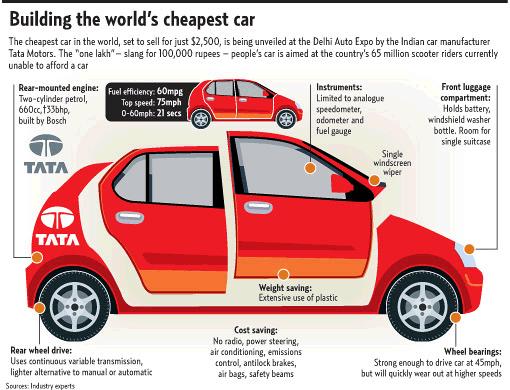
It’s 2 feet shorter than a Mini Cooper, presents an almost cartoonish appearance and weighs less than the four passengers it seats.
But for the 350-million-plus middle class of India, the just-launched Tata Nano, the world’s cheapest car at $2,000, is a cause for exhilaration. And for the first 100,000 lucky customers drawn via lottery, it’s a dream come true.
A century after Henry Ford put America on wheels with the Model T, the affordable Tata Nano is doing the same to the less privileged of the world. What is now dismissed by many as a “toy car” could soon reveal itself to be the mouse that roared, one of the most transformational consumer products of the century.
Roughly 100,000 Indians lose their lives on the road every year, seven times the rate of the developed world. In a country where it is not uncommon to see entire families overflowing a rickshaw or women in saris sitting side-saddle on a bike with small children on their laps, moving one’s family from an unsafe bike into a plastic capsule is a sensible $2,000 investment.
Safety and affordability were what Ratan Tata, chairman of the Tata Group, envisioned for the Nano. The low sticker price means a 65 percent increase in the number of Indian families who can now afford a car.
But India is not the only hub of poverty, and what works for its middle class could appeal to those in Bangladesh, Pakistan, Sri Lanka, Guatemala, Congo and scores of other countries, including China, where the middle class is projected to hit 700 million by 2020.
Because of this huge potential market, and even though the Nano emits 25 percent less carbon dioxide per mile than a standard automobile, environmentalists are terrified by the micro-car. Nobel Prize winner Rajendra Pachauri, head of the Intergovernmental Panel on Climate Change, said he was “having nightmares” about the Nano and its potential to pollute.
See the Tata Nano test drive video:
But these concerns could be alleviated should the tens of millions of new micro-cars that will roll onto the planet’s roads be able to run on something other than gasoline. There are many approaches here, from compressed air to batteries.
All of them would increase the car’s price and weight, making it less attractive to the poor. The only exception is the flex-fuel technology, which would allow micro-cars to run on any combination of gasoline and alcohol, as do most cars in Brazil today.

Flex-fuel technology would bump the price of the Nano by less than $100. But it would allow Indians to grow their fuel rather than import it. Nearly half of India’s land is arable, and it is already the world’s second largest producer of sugar cane: by far the best crop for ethanol production.
Micro-cars with flex-fuel engines fed by domestically grown fuel would reduce poor countries’ trade deficits, strengthen their energy security, create agricultural jobs and even reduce carbon dioxide emissions.
Micro-cars can be engines of prosperity in more ways then one. But only if they offer the world’s poor more than the false hope of indefinite cheap gasoline.
Cutting Edge energy desk writer Gal Luft is executive director of the Institute for the Analysis of Global Security and co-founder of the Set America Free Coalition. He is a co-author of two forthcoming books: “Energy Security Challenges for the 21st Century” and “Turning Oil into Salt: How Breaking the Oil Monopoly Can Make Us Prosper Again.”
(This article was reprinted with permission from the Cutting Edge News)



It is the cheapest car of the world but not the cheapest to run. How great it is, if it is fitted with CNG filled light Aluminium cylinder tightly wraped with carbon fiber, now easily available!
[…] since India’s Tata Motors Company came out with its Nano micro mini car in 2009, and we featured it here on Green Prophet, people are still wondering if this tiny little bug shaped car is something that people outside […]
Bloody nice idea, Cheap, Great little car. Where can I get one? Perfect for work and a small family
that is simply amazing…
cool, this car is good in the city…
I cant’ make out the motive of those making a big deal about TATA Nano. India needs a small affordable car & Nano is an answer to that. Why can’t these environmentalists including Rajendra Pachauri use their time & energy to comment on the gas guzzlers people have been driving in the US- from those huge SUV’s to V8 trucks they use daily as a commuter vehicle? Not speak of those huge boats & RV’s they run just for entertainment. Let us look at the countries who consumed most petroleum products in the last decade & contributed to pollution. I am sure it is not India, but they don’t like Indians to meet their needs now. It is like I want to keep all the toys for myself. How more selfish can we get? Frankly we readers are getting tired of those double-standard critics. Why can’t they just shut up
India’s Tata Nano Could Change the Mobility of Millions http://tinyurl.com/c4cvmw
India’s Tata Nano Could Change the Mobility of Millions http://tinyurl.com/d766qn