

 Israeli Researcher Finds Earth Cracks May Contribute to Global Warming
“Fractures breathe, and this process has direct relevance to the question of global warming,” says Dr. Noam Weisbrod –– With the ever increasing shortage in the world’s water resources and dire warning of Israel’s own ongoing drought, research to reduce contamination of existing water resources while developing new potable sources has become a pressing concern, here, as in the rest of the world.
For example, due to massive deterioration of groundwater quality, the Israeli coastal plain aquifer now provides less than 50 percent of its output 20 years ago.
Thus the need to halt or reverse the degradation of the country’s groundwater is crucially important.
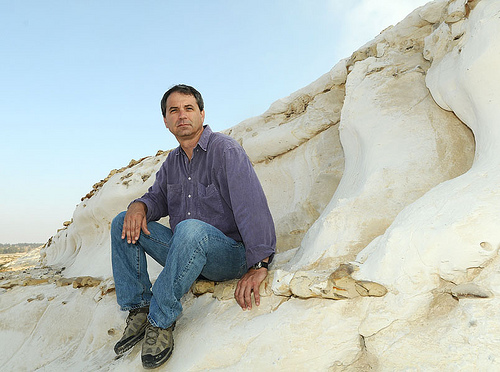
Hydrologist Dr. Noam Weisbrod’s research is providing the basic knowledge that can help in solving this crisis by understanding how pollutants reach the subsurface and how they behave underground.
Weisbrod, a member of the Zuckerberg Institute for Water Research of the Jacob Blaustein Institutes for Desert Research at Ben Gurion University’s Sede Boqer campus, is investigating the transport of various contaminants into the groundwater from land-surface, through the soil to the aquifer, and within the aquifer to vital production wells for fresh water.
Weisbrod, together with his fellow researchers and students, has been studying how pollutants travel to reach the groundwater below industrial sites at various locales around the country.
“Of special concern is the leaching of contaminants from military-related industries, such as chromium, missile fuel residues, explosives and volatile organic compounds, which have been released at the surface for decades,” he says with concern.
At the largest waste reclamation project in Israel, the Shafdan, Weisbrod is working on exploring the migration of treated wastewater from filtration ponds through deep sandy layers.
The local chalk formation in the Negev desert is a very different kind of surface compared to the sandy soils of the coastal aquifer. “Hydrologists once thought chalk was a natural barrier protecting the groundwater under what is now the Ramat Hovav industrial complex, located south of Beer-Sheva, but they were wrong,” he continues.
“The chalk formation may be impermeable in most areas, but it is fractured: the maze of cracks and fissures create a kind of by-pass from the surface to the water table, allowing pollutants and salts to migrate through the cracks crossing the chalk rock and reach groundwater at surprisingly high velocities,” he explains.
Weisbrod’s first face-to-face confrontation with such aquifer pollution took place during his graduate studies at the Hebrew University of Jerusalem in the early 1990s when worrying signs of groundwater degradation under the hazardous waste depository at Ramat Hovav began appearing.
He became a member of the scientific team looking into why this was happening, studying the role of the fractures as carriers of pollutants to the deep subsurface.
Weisbrod found the multidisciplinary challenges in this field exciting. It involved the interface between chemistry, physics, flow behavior and material properties, against the politically charged backdrop of social, commercial and governmental inputs. All these aspects came into play during his postdoctoral studies at the Department of Bioengineering at Oregon State University, where he worked at a government nuclear waste site in Washington state.
There, he studied transport processes in the local sandy soil, which had been contaminated by highly radioactive wastes that had leaked out of the site’s huge storage tanks.
Having spent years studying how pollutants move down through natural soil and rock fractures, Weisbrod, now a resident of Sede Boqer with his wife and two small children, has recently focused his research on what is coming up through these fissures.
“Gases, particularly water vapor,” he explains, “are being released from deep underground through the earth’s fractures into the atmosphere. Until now, scientists have neglected this critical aspect of fracture physics,” he says.
Fractures have been intensively studied for their role in aquifer recharge or aquifer contamination during periods of liquid infiltration. In general, they have been considered inactive when there is no precipitation.
In arid and semi-arid environments, this is the case more than 90 percent of the time. But here’s a surprising fact: “Fractures breathe,” declares Weisbrod, “and this process has direct relevance to the question of global warming. The role of geological fissures in global water cycles has been entirely neglected in the design of modern climate models,” he notes.
Weisbrod and his group have shown that in dry arid regions, such as the Negev desert, there is a nightly escape of water vapor from fractures. They’ve proven that, in fact, water vapors are being released at a much greater rateduring the night than during the day, through fractures. During the day, the air deep inside the fracture is cooler than the warm air at its opening. This is a stable condition.
At night, the air cools down and unstable conditions develop, which is when convective movement takes place: the now cooler atmospheric air invades the fracture and the relatively warmer and lighter humid inner air goes out.
“We’ve demonstrated and quantified this process both in the field and in a specially designed climate controlled laboratory,” says Weisbrod. “We believe this mechanism plays an important role in the gas exchange rate between the earth and the atmosphere and may also be important in our understanding of the energy balance across the earth’s surface.”
In addition to water vapor, movement of gases through fractures affects the exchange of many other “greenhouse” gases, including carbon dioxide and methane. “Even small changes in such gases are thought to have large repercussions on global climatic function,” he continues.
Since there are untold numbers of cracks, shafts, caves and other cavities on the earth’s surface, if climatologists were given accurate data on earth-atmosphere gas exchange rates via these cavities throughout the world,” contends Weisbrod, “they could design better models predicting climate change and CO2 concentrations. And this is a completely untouched area of geoscience.”
By demonstrating how gases move up and out of natural fissures due to temperature differences, Weisbrod believes his research has opened a small window into a novel mechanism that may have serious implications for better prediction and understanding of global climate change and the global water cycle.
This story was provided courtesy of Ben Gurion University.


Yup!this must be a revelation taht we should get alarm with.In fact as early as now we should get ready of wht’s gonna happen but atleast know what you can do to stop it.
What an exciting revelation – and outstanding contribution to our evolving grasp of global warming dynamics.
I’d like to mention a likely under considered factor that may play into this new awareness and act to broaden it.
In the American West and increasingly across areas of the North-East, unconventional natural gas mining is complicating geologic conditions through a myriad of impacts such as: hydraulic fracturing, high-pressure drilling encounters, and de-pressurization of gas and groundwater.
As this practice is conducted under dense (10 acre) down-hole density, there is a much greater likelihood of non-predictive production modeling and formation failure – which, in turn, certainly changes predictive modeling for the formation’s contributions to green house gases.
Here, where drilling is particularly intense (60 wells within a mile of one another), methane and its attendant constituents express to the surface.
Additionally, in an effort to prevent further formation degradation during natural gas production in highly pressurized areas, excess pressure on the bradenheads of wells will be openly vented to the atmosphere, contributing undisclosed volumes of methane into the air (here there are at least 9 such wells at any given time). So this practice provides an unquantified expressway for methane gas emission that should be considered in the greenhouse gas equation.
More on hydraulic fracturing and other natural gas related geologic interactions can be viewed at my website: http://www.journeyoftheforsaken.com
Thanks for this wonderful article.