

“We are not gaining knowledge with every generation. We are losing it. A dark and gathering sameness is upon the world.”
– Terry Glavin – ‘The Lost & Left Behind: stories from the age of extinction’ 2007
This is one of those very few books that sit right in the hand – a few pages in, and the strength of the writing coupled with the clear message of the book, grip a reader, and the synergy of the authors words coursing through the reader has begun. In this case, Glavin, a Canadian journalist, blogger, author and professor of creative writing, has hit on the most urgent topic – extinctions: of species, habitats, languages, tribes, beliefs, stories …. that really should fire up our bellies and get us all responding.
The author has travelled the world, consulted scientists and talked to locals, read up on histories and teased out statistics, and herein presents a grim analysis of the situation. Each chapter structure is broken down into species headings: a tiger, a bird, a fish etc, but then within each chapter, a world around that species is contained and examined, and chiefly, how the human world has historically interacted with that species, and whether our actions have directly or indirectly caused that species to reduce in numbers, or like the famous dodo, simply disappear.
“Among all the earth’s species, human beings are especially good at allowing their reach to expand beyond their immediate horizons. The old ‘feedback loops’ that tend to restrain over-harvesting of local renewable resources – technological limits, and market limits …. are breaking down, all over the world.”
Glavin delves deep into languages and mythological stories that have become extinct, or too vague and unspecific to remember. Many examples float out of these pages – the dying Nanai language in the village of Sikachi Alyan, the stories of the giant Taimen salmon, being over-fished to extinction in the Amur river of Siberia, and more.
The author makes an interesting connection between the tenacity of the Faroese language, a combination of Norse and Gaelic spoken by islanders on Faroe, and Hebrew, both defying the odds of dying languages. He doesn’t explore the issue further, of language carried by a wandering people, and surviving in separate pockets, to be later united. As a former resident of Eire, I particularly resonated with the connection to the landscape and stories of old Ireland, in the chapter, ‘The Valley of the Black Pig’, and the poetic vision expressed here: “the dead breathe their stories out of the ground.”
I must take the author to task on one incorrect point he makes – the great Naturalist and writer John Muir, was Scottish, not American. The chapter, ‘Drifting into the Maelstrom’ (themed around the whale … see our recent post here) is a bit of a historical drift, weaving in and out of a catalogue of the International Whaling Committee’s actions and in-actions, coupled with Glavin’s own anthropological journeying, and an ambiguous exploration of the pro’s and cons of whaling. He sets sail into the issues involved, and weaves it around a real life maelstrom in the waters around the Norwegian area of the Lofoten.
Other chapters cry for the worldwide loss of apple varieties (and cheerfully introduce defiant orchard owners and seed savers who struggle to preserve some of the old tastes and flavours), and the loss of language, currently estimated to be at the rate of 1 per fortnight, with an estimated range of 5,000 languages spoken at the start of the 21st Century; to an anticipated 200 remaining within 2 centuries.
An interesting fact, crammed in to a dense chapter set in the Himalayan region of Nagaland, ‘The Singing Tree of Chungliyimti’, and something I will explore further, is that 800 members of the Mizo tribe were recognised as one of the ‘lost tribes’ of Israel, and made aliyah here in 2003. This is one of the many facts Glavin peppers his writing with, and uses to reinforce the idea that not all is lost; not everything will die and become extinct.
There is a kind of optimism to be gleaned reading through the glum catalogue of losses in this astute and compassionate book. If we learn from our bloody, fearful and destructive history, and use these lessons coupled with developing science and technologies, we can halt the extinction of the diversity of life, in all its richness, vivid beauty and splendour, as Terry Glavin (amongst others) tries to steer this teetering ship of humanity away from colonization, deforestation, and destruction:
“We have figured out ways to colonize every ecological niche on earth. We will survive. So there’s hope.”
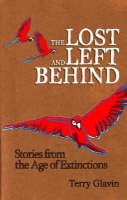
‘The Lost & Left Behind: stories from the Age of Extinction’ by Terry Glavin
2007 published by Saqi Books, London www.saqibooks.com