Use heroin? Fund Terror

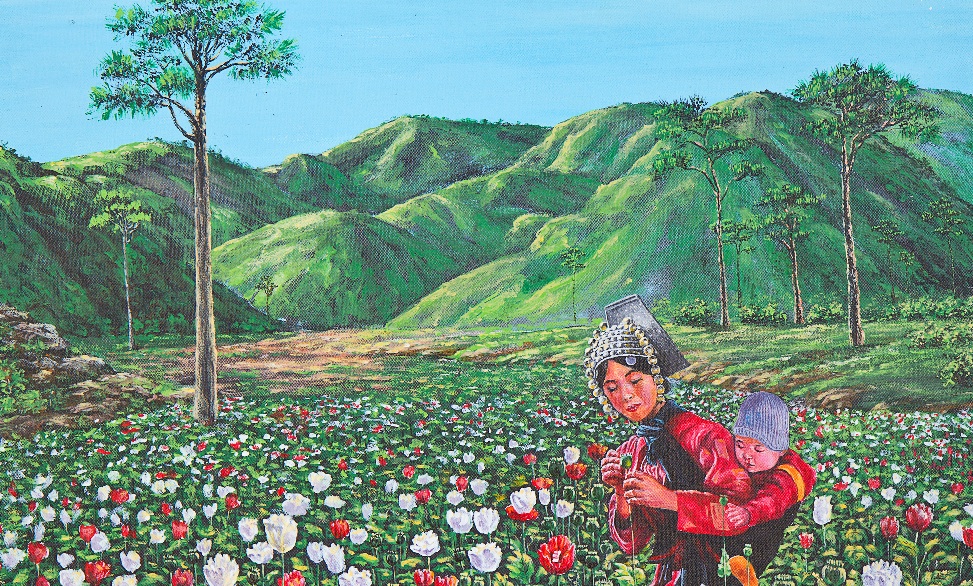
opium field woman with baby poppies, poppy

There are many ways to fund terror, and one way is by consuming opium or heroin: Opium production in Afghanistan is seeing record increases for the third year straight, reports the United Nations.

This is because foreign military have started leaving the country and as they do drop Afghani farmers back into the hands of the Taliban.

Poppy production started going down starting in 2008 when there were eradication (burning opium crops) and incentive efforts to get Afghani farmers to switch to other kinds of crops.

But with the Taliban insurgents returning to the provinces they are now supporting opium farmers’ return to the valuable cash crop.

And when we say support, we mean with arms and guns. The Taliban actively fight government officials who try to eliminate poppy fields.

Prices this year range from $350 to $440 a pound.

Despite the religious prohibition, opium and heroin are not just a problem in the west. The drugs are also used by Afghanis, and opium is also heavily consumed by Iranians. This leads to a broad range of societal problems which we are sure readers are aware of.

For the Afghani farmers in the southern Kandahar and Helmand provinces, alternative crops to poppies which form the derivative of opium, do not compare. Farming wheat leaves them hungry, while opium creates a multi-billion dollar business, and the Taliban of course get their cut.

Someone who can help the Afghani farmers find a more productive and sustainable crop might very well earn the Nobel Prize. Maybe help them switch to medicinal marijuana?

Afghanistan is currently the world’s largest producer of opium, and it supplies about 75 percent of the global market.

Karin Kloosterman
Karin Kloostermanhttp://www.greenprophet.com
Karin Kloosterman is an award-winning journalist, innovation strategist, and founder of Green Prophet, one of the Middle East’s pioneering sustainability platforms. She has ranked in the Top 10 of Verizon innovation competitions, participated in NASA-linked challenges, and spoken worldwide on climate, food security, and future resilience. With an IoT technology patent, features in Canada’s National Post, and leadership inside teams building next-generation agricultural and planetary systems — including Mars-farming concepts — Karin operates at the intersection of storytelling, science, and systems change. She doesn’t report on the future – she helps design it. Reach out directly to [email protected]

Read More

5 COMMENTS
  1. Protected by Taliban?

    “In July 2000, Taliban leader Mullah Mohammed Omar, collaborating with the United Nations to eradicate heroin production in Afghanistan, declared that growing poppies was un-Islamic, resulting in one of the world’s most successful anti-drug campaigns. The Taliban enforced a ban on poppy farming via threats, forced eradication, and public punishment of transgressors. The result was a 99% reduction in the area of opium poppy farming in Taliban-controlled areas, roughly three quarters of the world’s supply of heroin at the time.”

    (http://en.wikipedia.org/wiki/Opium_production_in_Afghanistan)

  2. There are errors in the article. Afghanistan produces 93% of world’ opium as per United Nations and not 75% which is a number pulled out of a hat. Afghanistan in addition to opium also produces 90% of world’s heroin and is also the largest producer of cannabis in the world.

    This is not all. British press had been reporting how British troops used to protect opium crops when they were stationed there. So saying that western armies were trying to eradicate opium cultivation is a joke. Under NATO watch Afghan drug cultivation reached its historical pinnacle.

TRENDING

Dubai sets up smart feeding stations for abandoned cats

Dubai Municipality has set up 12 AI-powered "Ehsan Stations" to safely and officially feed strays. The city also officially supports Trap-Neuter-Return (TNR) programs. 

Eco organization offices destroyed by Iran missile

Tel Aviv's eco organization, the Heschel Center, was impacted by an Iranian missile.

How does one start prepping?

Faced with an extreme winter storm this year, Americans wonder how to be prepared for catastrophe. Miriam has lived through wars in the Middle East - so she's prepared on giving you a guide to prepping.

Iran’s holiest city about to run dry as terror chosen over water management

Iran’s second-largest city, Mashhad, is facing an acute water emergency after dam reservoirs feeding the city fell below three percent capacity, according to Iranian state and local media. Officials warn that without rainfall or improved inflows from neighboring Afghanistan, the city’s supply could soon collapse.

Afghanistan’s earthquake and mud-brick homes. Can they rebuild safer and more sustainably?

A 6.0-magnitude earthquake in eastern Afghanistan killed over 800 people as mud-brick homes collapsed in rain-soaked landslides. Here’s why traditional earthen houses failed, how human-driven slope damage worsened the disaster, and how sustainable, earthquake-resistant construction can save lives.

Yerukim Forms a New Green Economy Where the Money is Really Green

The Yerukim members who pick up the recyclables get to keep the monetary reward, the public earns "green" bills that can be used in shops, and business owners get to be associated with environmentalism.

Choosing Riyadh over Dubai? What Investors Should Know

Saudi Arabia is deploying capital at unmatched scale to catalyze tourism and advanced industry while rewiring its power-and-water backbone. The investable frontier is widening—especially in renewables, grid storage, water efficiency/desal retrofits, and hospitality operating platforms. Prudent investors will insist on phased delivery, enforceable KPIs (energy, water, biodiversity), and RHQ/zone compliance—while pricing political-economy and reputational risks alongside growth upside.

Sell your cooking oil for biodiesel money

Want to make money on old french fry oil? Sell it.

Qatar Alternative Energy Summit Pairs Investors And Innovators

Alternative energy investors and innovators can meet n' greet in Doha, Qatar March 16 and 17.

Here’s How To Implement The Four Pillars Of Employee Engagement

If you throw a party for your work team and they are vegans, don't make it a barbecue. Know the sustainability values of your team to boost moral and retain good people.

Locals From Rishon Fight IKEA

Big Box stores are a pretty new concept in Israel, and thank God that not every Israeli city wants them in their backyard. A word from someone who has see the beautiful farmland around her hometown Newmarket, Ontario stripped and converted into vulgar strip malls of big box shops: they have no place in a healthy and sustainable town or city.

The Jewish National Fund Meets An Inconvenient Truth

According to the JNF, it has transformed thousands of acres of barren land into green forests in Israel. They state that each person emits about 23 tons of carbon per year, estimating that each tree planted can absorb one ton of carbon in its lifetime. That's a whole lot of trees you'd need to be planting. Could so many fit in Israel?

How to quiet noise from construction in your office

Streets need to be resurfaced in New York but the humming and grinding noise is unsettling. Noise is environmental pollution. 

Popular Categories