Giant Squid Kraken Sea Monster Caught on Video

The journal Nature reports that a team of ocean researchers have captured the world’s first video of a giant squid (Architeuthis dux) in its natural environment. The video was captured 700 meters (2300 feet) beneath the Pacific near the Ogasawara archipelago,  about 1000 kilometers south of Tokyo Japan. The mission was funded by Japan’s NHK broadcasting commission and the US-based Discovery Channel, both of which will air programs about the giant squid encounter later this month.

Widder’s camera relied on a dim light in the red, near-infrared range. And you can see the results for yourself here:

[youtube]http://www.youtube.com/watch?v=uLRY1cNxL1I[/youtube]

Sailors have known about giant squid for centuries. But ancient whalers and fishermen didn’t carry video equipment and so their fish stories were filed with tales of dragons, mermaids and other sea monsters. The Nordic tales of a sea monster named Kraken may have been based upon rare sightings of the giant squid.

It doesn’t help our believability that these tales were often exaggerated. The Kraken was said to reside in the deep ocean and attract many fish to itself. It was said to only briefly rise to the surface. So far this sounds very much like a giant squid, but the Kraken was also said to be so large that it was sometimes mistaken for an island. Its mouth was described to gape as large as the entrance to a fjord.

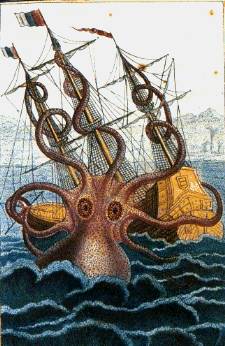
Well, fish stories are known for their exaggerations. The giant squid is estimated to grow as large as 15 meters (50 feet) in length, not quite the size of a fjord but something sure to frighten the daylights out of sailor. In his poem, The Kraken (1830), Alfred Tennyson writes:colossal octopus by pierre denys de montfort kraken giant squid
Below the thunders of the upper deep;

Far far beneath in the abysmal sea,

His ancient, dreamless, uninvaded sleep

The Kraken sleepeth: faintest sunlights flee

About his shadowy sides; above him swell

Huge sponges of millennial growth and height;

And far away into the sickly light…

In 20,000 Leagues Under the Sea, Jules Verne writes:

“I stared in my turn and couldn’t keep back a movement of revulsion. Before my eyes there quivered a horrible monster worthy of a place among the most farfetched teratological legends. It was a squid of colossal dimensions, fully eight meters long. It was traveling backward with tremendous speed in the same direction as the Nautilus. It gazed with enormous, staring eyes that were tinted sea green.

Its eight arms (or more accurately, feet) were rooted in its head, which has earned these animals the name cephalopod; its arms stretched a distance twice the length of its body and were writhing like the serpentine hair of the Furies. You could plainly see its 250 suckers, arranged over the inner sides of its tentacles and shaped like semispheric capsules. Sometimes these suckers fastened onto the lounge window by creating vacuums against it. The monster’s mouth–a beak made of horn and shaped like that of a parrot–opened and closed vertically. Its tongue, also of horn substance and armed with several rows of sharp teeth, would flicker out from between these genuine shears. What a freak of nature!”

Like the monster which attacked Captain Nemo’s submarine and the mythical Kraken, the giant squid spends much of its life in the silent darkness of the deep ocean. This is one reason so few have seen it alive. Occasionally a dead one would wash ashore but because this creature is adapted to cold high pressure water of the deep ocean, it quickly decayed on the surface as Tennyson’s poem ends:

Then once by man and angels to be seen,
In roaring he shall rise and on the surface die

Other clues to the giant squid’s existence are the scars its suckered tentacles leave on sperm whales. These squids are thought to be the only predator large enough to take on a beast of this size.

The first photograph of a giant squid in its native environment was taken by Tsunemi Kubodera of the National Science Museum in Tokyo and Kyoichi Mori of the Ogasawara Whale Watching Association in this same region of the Pacific ocean in the autumn of 2004.

The video taken by this more recent expedition relied on a camera system invented by Edith Widder, founder of the Ocean Research and Conservation Association in Fort Pierce, Florida. Widder believes that the key to this mission’s success was the focus on the squid’s keen sense of sight. Giant squids are accustomed to the darkness of the deep ocean, their eyes, the size of dinner plates, are sensitive to the dim light of bioluminescent prey, so bright camera lights would disturb it and possibly frighten it away.

Brian Nitz
Brian Nitzhttp://www.greenprophet.com
Brian remembers when a single tear dredged up a nation's guilt. The tear belonged to an Italian-American actor known as Iron-Eyes Cody, the guilt was displaced from centuries of Native American mistreatment and redirected into a new environmental awareness. A 10-year-old Brian wondered, 'What are they... No, what are we doing to this country?' From a family of engineers, farmers and tinkerers Brian's father was a physics teacher. He remembers the day his father drove up to watch a coal power plant's new scrubbers turn smoke from dirty grey-back to steamy white. Surely technology would solve every problem. But then he noticed that breathing was difficult when the wind blew a certain way. While sailing, he often saw a yellow-brown line on the horizon. The stars were beginning to disappear. Gas mileage peaked when Reagan was still president. Solar panels installed in the 1970s were torn from roofs as they were no longer cost-effective to maintain. Racism, public policy and low oil prices transformed suburban life and cities began to sprawl out and absorb farmland. Brian only began to understand the root causes of "doughnut cities" when he moved to Ireland in 2001 and watched history repeat itself. Brian doesn't think environmentalism is 'rocket science', but understanding how to apply it within a society requires wisdom and education. In his travels through Europe, North America, Asia and the Middle East, Brian has learned that great ideas come from everywhere and that sharing mistakes is just as important as sharing ideas.

Read More

2 COMMENTS

TRENDING

Weston Higginbotham’s Funeral Set for June 17 as Family and Friends Honor Environmentalist

The family of environmentalist and eco-engineer in training, James "Weston" Higginbotham will gather with friends, classmates, and supporters on June 17 in Birmingham, Alabama, to celebrate the life of the Auburn University student whose death in a Kyoto forest in Japan touched people around the world.

Before Funeral, Auburn University Creates Environmental Scholarship in Memory of Weston Higginbotham

The James "Weston" Higginbotham Endowed Scholarship will support Auburn students pursuing ecological engineering, ensuring that the work Weston cared about so deeply continues long after his passing.

Weston Higginbotham’s Family Declines to Release Cause of Death in Kyoto Forest

The family of Weston Higginbotham,an Auburn University student whose disappearance and death in the mountains near Kyoto, Japan, drew international attention, has declined to publicly release the cause of his death.

Weston Higginbotham found dead in a Kyoto forest: is climate anxiety part of the story?

In some ways, Weston has become a symbol of a generation wrestling with environmental and technological anxiety. Friends and family described him as deeply concerned about environmental issues. Reports also noted that he questioned the growing role of artificial intelligence in daily life, even reportedly disagreeing with his mother about her use of AI.

Japan’s packaging turns black and white from Iran oil shortage

Japan is a country that builds 100-year companies; while...

Yerukim Forms a New Green Economy Where the Money is Really Green

The Yerukim members who pick up the recyclables get to keep the monetary reward, the public earns "green" bills that can be used in shops, and business owners get to be associated with environmentalism.

Choosing Riyadh over Dubai? What Investors Should Know

Saudi Arabia is deploying capital at unmatched scale to catalyze tourism and advanced industry while rewiring its power-and-water backbone. The investable frontier is widening—especially in renewables, grid storage, water efficiency/desal retrofits, and hospitality operating platforms. Prudent investors will insist on phased delivery, enforceable KPIs (energy, water, biodiversity), and RHQ/zone compliance—while pricing political-economy and reputational risks alongside growth upside.

Sell your cooking oil for biodiesel money

Want to make money on old french fry oil? Sell it.

Qatar Alternative Energy Summit Pairs Investors And Innovators

Alternative energy investors and innovators can meet n' greet in Doha, Qatar March 16 and 17.

Here’s How To Implement The Four Pillars Of Employee Engagement

If you throw a party for your work team and they are vegans, don't make it a barbecue. Know the sustainability values of your team to boost moral and retain good people.

Locals From Rishon Fight IKEA

Big Box stores are a pretty new concept in Israel, and thank God that not every Israeli city wants them in their backyard. A word from someone who has see the beautiful farmland around her hometown Newmarket, Ontario stripped and converted into vulgar strip malls of big box shops: they have no place in a healthy and sustainable town or city.

The Jewish National Fund Meets An Inconvenient Truth

According to the JNF, it has transformed thousands of acres of barren land into green forests in Israel. They state that each person emits about 23 tons of carbon per year, estimating that each tree planted can absorb one ton of carbon in its lifetime. That's a whole lot of trees you'd need to be planting. Could so many fit in Israel?

How to quiet noise from construction in your office

Streets need to be resurfaced in New York but the humming and grinding noise is unsettling. Noise is environmental pollution. 

Popular Categories