

Israel’s Best-Loved Vegetables Carry Heavy Pesticide Loads

israeli-produce-pesticides

Are Israelis eating a mouthful of pesticides for breakfast?

If there’s one food group that Israelis love, it’s vegetables. In fact, all over the Middle East, vegetables are treated with love and presented at table in infinite artful ways. And people are picky about their produce, carefully inspecting each tomato and cucumber before consenting to buy.

But health hazards lurk on the well-loved produce. According to Haaretz, 11% of produce tested by the Israel Health Ministry showed unacceptably high levels of pesticide residues. Of over 5000 samples taken from 108 kinds of foods, 56% had traces of different pesticides.

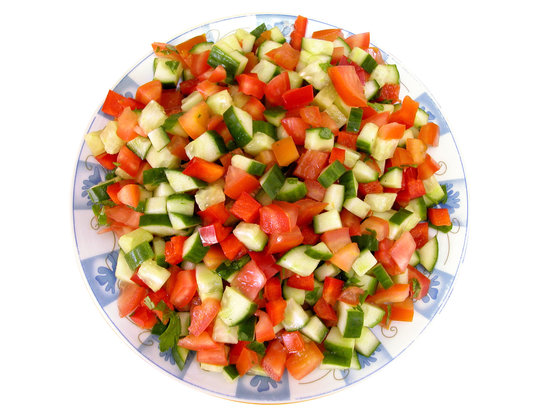
A scary tomato yielded 50 kinds of residues, while a cucumber showed 30 types. 46 kinds of pesticides were found on parsley. Those are the main ingredients of the famous Israeli salad. Are Israelis indeed eating pesticides with every bite of salad? Studies like the one showing how pregnant Jerusalemite women have higher pesticide levels in their bodies than pregnant New Yorkers  support this suspicion.

Even so, the Health Ministry stated that the pesticide residues on produce don’t represent a public health risk. Their argument is that the quantity of pesticides on raw samples doesn’t represent the quality of the same food when it’s peeled and cooked. Then there was the study from Stanford University that concluded that organic food isn’t really healthier.

The Israel Union for Environmental Defense (and common sense) reply that health risks to sensitive populations like children, people with allergies, and the elderly are not yet known, nor what the accumulative effects may be.

At least, there is awareness of the issue in Israel, and testing occurs regularly. Fish and eggs are said to have minimal excess pesticide residues; poultry none. No excess, that is – just “acceptable” levels . Israelis won’t find pesticide-free foods unless they have connections with organic farms. Still, it’s a move forward.  The samples of this study were collected from 2006-2010. A later study from 2008-2011 resulted in the banning of three organophosphates and limiting Simazine, another herbicide.

One wonders what pesticide levels might be present in the produce of other Middle Eastern countries, where regulations are not up-to-date and enforcement is slack, or as in Egypt, where the former agriculture minister allowed the importation of carcinogenic pesticides.

I’m looking forward to the appearance of the first “bio-strawberries.” New in the markets last year, these berries are far sweeter and more flavorful than the usual commercial ones. It’s worth the little trouble of more washing to rid them of grit, for the authentic flavor and health benefit of fruit grown organically.

Read more about pesticides in the Middle East:

::Haaretz

Image of Arab salad via Shutterstock.
Miriam Kresh
Miriam Kreshhttps://www.greenprophet.com/
Miriam Kresh is an American ex-pat living in Israel. Her love of Middle Eastern food evolved from close friendships with enthusiastic Moroccan, Tunisian and Turkish home cooks. She owns too many cookbooks and is always planning the next meal. Miriam can be reached at miriam (at) greenprophet (dot) com.

Read More

1 COMMENT
  1. Only organically grown vegetables are safe to eat. All nations should make that the requirement for all their food producers, which means truck gardens instead of mega-farms.

LEAVE A REPLY

Please enter your comment!
Please enter your name here

TRENDING

Baby teeth read like tree rings paint a picture of toxins in early life

A new study from the Icahn School of Medicine at Mount Sinai in New York offers a striking insight into how the environments we are born into can quietly shape our brains years later. By analyzing naturally shed baby teeth, the ones tucked under pillows for the tooth fairy, researchers have reconstructed a detailed timeline of exposure to environmental metals during pregnancy and early infancy.

Poop in the East River shows the city’s rat problem and what people like to eat

New York ecology and health can be monitored by a jug of water a week.

Saving Gourmet Wild Plants For The Future

Think of truffles, a gourmet wild food. The European...

Fresh Fava Bean Soup, A Vegan Springtime Recipe

Somehow vegetables with short seasons excite the imagination and appetite more sharply than produce that’s available all year around. Good Middle Eastern cooks have many recipes for delicate fava beans, and this turmeric-fragrant soup is one.

The Next New Cosmetic: Human Fat Known as Alloclae

In this Ozempic age, a person may diet themselves...

How to quiet noise from construction in your office

Streets need to be resurfaced in New York but the humming and grinding noise is unsettling. Noise is environmental pollution. 

EarthX and a blueprint for sustainable investing

Trammell S. Crow, a Dallas-based businessman and father of four, is focusing his efforts on impact investing, and media that focuses on saving the planet through EarthX.

Mining Afghanistan’s Mineral Discoveries Similar to Avatar

Now that American forces in Afghanistan are commemorating the longest period of any war that America has been involved in, including the 1965-73 Vietnam War, the recent discoveries of large and extremely valuable mineral and metal deposits may finally bring to light a reason to continue the presence of US fighting forces in this war torn and backward country.

From Pilot Plant to Global Stage: How Aduro Clean Technologies’ 2026 Expansion Signals a Turning Point for Chemical Recycling Investors Like Yazan Al Homsi

The company's Next Generation Process (NGP) Pilot Plant in London, Ontario, has officially moved into initial operating campaigns, generating the kind of structured, repeatable data that separates laboratory promise from commercial viability.

Nobul’s Regan McGee on Shareholder Value: “Complacency Is the Silent Killer” 

Why the governance framework designed to protect shareholders so...

Should You Invest in the Private Market?

startustartup Unlike public stock exchanges, which offer daily trading, strict...

How to build a 100-year-company

Kongō Gumi is a Japanese construction company, purportedly founded in 578 A.D., making it the world's oldest documented company. What can we learn about building sustainable businesses from them?

How AI Helps SaaS Companies Reduce Repetitive Customer Support Work

SaaS products are designed for large numbers of users with different levels of experience, and also in renewable energy.

Popular Categories