

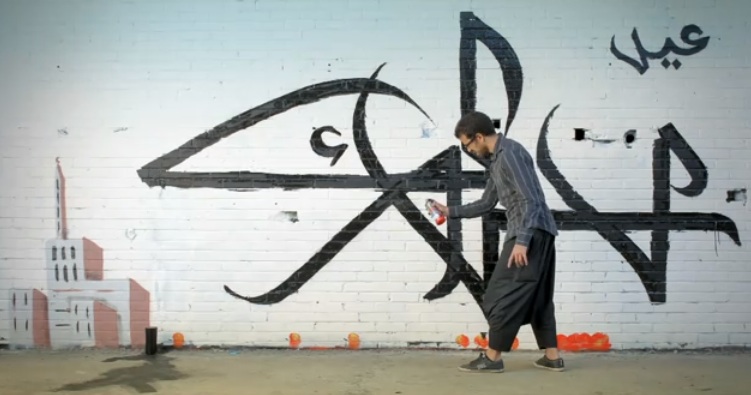
 eL Seed, a Tunisian artist who combines Arabic calligraphy and street painting, is making an imprint on the world street art scene.
I can’t remember how I found him. One of those idle internet ramblings where a sound or image grabs you by the hair and pulls you smack up to the monitor to find out more. I love when that happens. And it happened with eL Seed.
I’m a graffiti fan. Filthy subway cars in ‘70’s Manhattan made more tolerable by paint-sprayed shells. Crumbling underbellies of bridges and tunnels, colorfully tagged, sound out visual wake-up calls. People observe, and comment. I love public art. The kind spelled in lower case. Yarn-bombing, sidewalk chalk painting, Lego micro-installations, and graffiti.
[youtube]http://www.youtube.com/watch?v=-jer8RStSXQ[/youtube]
It’s not so easy in Jordan to find things to read in English. Of course these exist, but my unscientific observation is that most English-speaking Jordanians prefer their info delivered in Arabic. I hop on a bus, brush aside so meone’s newspaper, and get zapped by exotic fonts.
Arabic script is gorgeous: bold swirls and delicate loops and fat, juicy dots that look ready to burst. Could be an ad for toothpaste, but to my eye it’s art. The only upside to being Arabic-illiterate is that I see script as pure graphics. Arabic-speaking friends think I’m nuts. I clip newsprint and make collages. My daughter rolls her eyes, then joins me with scissors and glue. I think everyone can appreciate the beauty of Arabic calligraphy. Enter my soulmate, eL Seed.
Born in France to Tunisian parents, his work is a quest for identity. He dabbled in graffiti as a hobbyist, but didn’t take the art form seriously until twelve years ago. eL Seed’s style developed in tandem with a re-immersion into his family’s roots and language. Although street art can be controversial, he chose the form because of its public view; it’s immediate and accessible. It doesn’t require climate control, special lighting, or security guards. And it pulls people in who might not normally enter a museum.
Mixing the ancient art of Arabic calligraphy with modern spray paint techniques, he calls his work “calligraffiti”. Early works commented on French politics with an emphasis on immigrant acceptance. He now works to promote wider Arab culture, breaking down common stereotypes and misconceptions.
While creating pieces in the street, he hears onlookers comment, “What’s this guy writing? Is it a call for jihad?” Says the artist with a smile, “It’s an Arabic saying, just keep it cool!” He says other street artists are surprised to see a Muslim-Arab artist born and raised in the West painting in Arabic.
Arabic script grew as a means of transmitting the messages of the Qur’an. The holy book, in turn, played a major part in the evolution of Arabic language. “Calligraphy is a venerated form of Islamic art,” says eL Seed: “Middle East youth say calligraphy’s an old-school art form for old people. Through graffiti, I feel I’m carrying cultural traditions into modern reality while keeping my heritage alive.”
Arab revolutions instigate parallel development in art. Serious artists – “taggers” – have emerged in the United Arab Emirates, Israel and Iran. Tags can be spotted on bullet-punched walls in Bahrain, in ancient Palestinian alleyways, on Jordanian trucks cruising from Aqaba to Damascus. Iranian artist A1one, considered the “Persian Bansky”, uses Tehran walls as his canvas.
The Israeli West Bank barrier is a favored site for political graffiti with its provocative symbolism drawing artists from around the world. Images are photographed and shared through art blogs and social media. The form becomes legitimized. In the West, graffiti is vandalism. In the Middle East, using street art to comment on social and political issues can be a much more dangerous crime.
Arabic script is surfing a hipster wave seen in Western cities in highbrow galleries and on lowbrow tee-shirts. Due to the efforts of artists like eL Seed, who also works on traditional canvas, examples can be seen in Los Angeles, Beirut, Gaza and Montréal.
A year after the Tunisian revolution, the city of Kairouan ignited an artistic “revolution” with a mural on a 40m x 7m wall  positioned just beyond the turrets of the old Medina, a site of cultural innovation since the first Islamic Empires.
Cultural group El Khaldounia mobilized the project, inviting eL Seed to design and oversee the works. Local authorities, community leaders and townspeople worked together to complete the project, the first of its kind in Tunisia.
He recently took part in the annual Sharjah Islamic Festival. At the Museum of Islamic Art in Doha, he conducted a week-long series of workshops with local school kids.
He’s toured North America, sharing his artistic vision and demonstrating how Arabic graffiti can voice personal and national ideas. He encourages people from different backgrounds to connect with Arabic calligraphy by using a medium familiar to all in the West: graffiti.
The name eL Seed is inspired from the Arabic word, al Sayed, which means the man, the master. Enjoy watching this seed grow.
More on Urban Art in the Middle East:
The Bedouins Convert Ill-Begotten Mansion into a Skate Park


Arianne –
Back to you on your coverage of this artist: terrific coverage. He is as joyous as his work, a delight to swap info with. I hope our small efforts bring him much wider recogition.
What’s the story behind the Kindle Project? Great stuff – love the piece on the Kurdistan photographer, also the story on seeds (no connection to the artist of course!).
Perhaps you might be incited to write something for The Green Prophet? If so – check the “contact us” tab on the home page and get in touch with our editor Karin. Best of luck with The Kindle Project – Laurie
A wonderful piece! We feel a lot of the same things as you do about street art and about eL Seed. Thank you for this insightful feature! Here’s ours: http://www.kindleproject.org/blog/2011/11/17/feature-el-seed/