

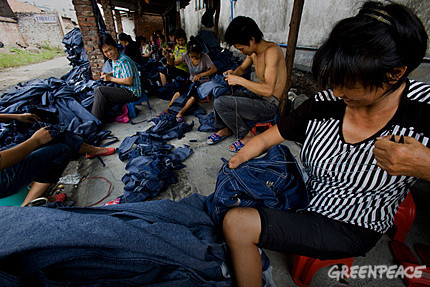
 The “jean capital of the world” exacts a dark environmental and public health price – too steep for wholesome gift-giving.
When the last Hanukkah candle is extinguished, we will shift our attention to Christmas. Since the wise men laid down their wares at baby Jesus’ feet in Bethlehem, Christians (and atheists and agnostics and many in between) have demonstrated their love and consideration for friends and family through gifts. Theoretically.
In reality, this tradition has evolved into a cacophony of registers blowing smoke from burning cash. So people in the green world have been calling for more meaningful giving: fair trade items, homemade art, or experiences versus things because only a gift that has been created with a wholesome spirit, from the cradle to the grave, can be truly loving. Which is why we think blue jeans may just be the most unloving gift of all.
 Post Gold Rush fever, in 1872, a poor tailor named David Jacob approached Levi Strauss, by then a prominent member of San Francisco’s Jewish community.
He had designed a sturdy pair of pants but could not afford to get them patented. Levi shared the patent and turned those pants into the most famous article of clothing on the planet: jeans.
But the Bavarian merchant was a good guy who insisted that his employees call him Levi, not Mr. Strauss. He was so well respected, in fact, that the city of San Francisco declared the day of his funeral a business holiday so that his admirers could attend. The business has remained in the family, but if Levi’s ghost could speak, what would he say about the state of jean production today?
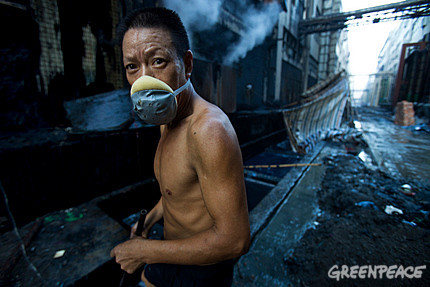
According to Greenpeace, Xintang, China is the “jeans capital of the world.” 40% of jeans sold in the United States are produced here in factories large and small. Everyone in the family helps – from small children who snip threads after school to their mothers and fathers.
Arguably, the industry provides jobs for people who might otherwise not have one. But residents of Xintang pay a hefty toll with the destruction of their habitat and health.
 The process to create those sexy whitewashed denims requires several chemically intensive washes, while fabric printing and dyeing requires help from our friends cadmium, lead, and mercury.
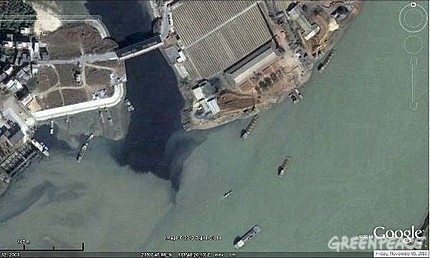
In tests conducted in water and sediments surrounding the factories, Greenpeace discovered traces of cadmium, chromium, mercury, lead, and copper in 17 out of 21 samples. One sample contained 128 times China’s legal level of cadmium.
That means that 260 million pairs of pants distributed each year contain traces of potentially harmful chemicals. And because of poor environmental regulations, the wastewater from factories is washed into Xintang’s local river, which in turns spills darkly into the Pearl River Delta.
“Everyone says that people who work in dyeing and washing have reproductive and fertility problems. My cousin once worked in a dyeing plant. He died of pleurisy,” Lin Zhixin, a migrant worker from Sichuan, told Greenpeace.
Spending money on products that cause this kind of destruction directly sanctions the process by which they are created. Why not spend your money on gifts created locally and in environmental and social harmony?
Your loved one will no doubt feel the warmth and factory owners may be inspired to clean up their act if their bottom line depends on it.
After we published this story, the Levi Strauss communications division contacted us with this statement:
At Levi Strauss & Co., we deeply care about how we make our products and the impact they have on the environment. Our company does not work with any factories in Xintang or Gurao, China, the towns featured in the Greenpeace report.
:: Greenpeace
Friendlier eco-fashion:



Wow, this article is fastidious, my younger sister is
analyzing such things, thus I am going to tell her.
Feel free to surf to my blog post :: air jordan 2 nightshade
I don’t see the problem here. They are paid for the work they do…
If you want to call it paid compared to a western salary; besides, are you not concerned about what is being leaked into the water?
Are there any “greener” substitutes for jeans ?
Sure… bamboo pants, perhaps. Maybe organic cotton, and anything used of course.
For a nice place to buy interesting homemade items, look at this group in FB: http://www.facebook.com/pages/Jerusalem-Israel/Domari-Society-of-Gypsies-in-Jerusalem/88644223296
I’ve tried contacting them and they don’t respond. Not recommended to buy from the Domari Gypsies.