
Tel Aviv Bids for Artificial Island International Airport At Sea

tel aviv artificial island airport
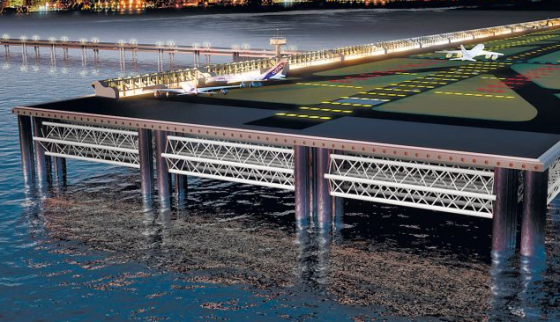
Fly into Israel? Land at sea first on this 250 acre platform runway proposed for international flights.

There has been talk for a couple of years already that Tel Aviv’s international airport will move to the sea, literally. A proposal has been submitted to create an artificial island off the city’s coast to replace the Ben Gurion Airport, one that services local, domestic and international flights. A couple months ago I interviewed a geologist helping to develop feasibility studies for such a structure. And according to media reports it looks like the crazy plan is going ahead despite environmental risks to the fragile Mediterranean Sea, and security risks of sabotage.

A new committee from the Ministry of Science and Technology in Israel developed a feasibility report for this artificial airport island to be built off the coast of the Tel Aviv suburb Rishon LeZion. Goodovitch Architects have drafted some sketches (above) of how the airport could look.

Among the parties involved in the far-flung idea is Elie Schalit, 92, a chairman and founder of the Colbert Group, which builds giant cruise ships. He was the man who built the first ships for Ted Arison and his Carnival Cruise Lines.

According to Haaretz the plan for the airport would include a large artificial island on top of poles, 15 meters above sea level. Located two kilometers out in the Mediterranean Sea, the 250 acre landing surface would connect to terminals and cargo docks onshore. Passengers would be shuttled to and from the runways by a fast train or by buses traveling along a long pier. The project cost is an estimated NIS 50 billion, about $12 billion USD, and would take more than a decade to build.

Land grab for the rich, at the Sea’s expense?

“Former Tel Aviv municipal engineer Israel Goodovitch, the driving force behind the idea, is not concerned by the inevitable doubts. He makes use of his connections and acquaintances, and rushes through every door, loaded down with data and models of the plan that will he claims, make it possible to shut down Ben-Gurion International Airport altogether and transform its site into lands worth their weight in gold for residential construction in the center of the country.”

Doesn’t anyone see a conflict of interest in that the city engineer is also drafting plans for the airport under his private name?

With the growth of Israel outpacing its space, real estate developers no doubt have their eye on the land surrounding the Ben Gurion Airport in central Israel about 20 minutes from Tel Aviv. The conveniently located airport has become a drag for nearby residents who suffer from airplane emissions and exhaust. Goes to show why you shouldn’t buy your home near an airport and then complain later.

At any rate, this massive artificial island will far exceed the size and scope of the artificial islands in the Persian Gulf – ones that have have severe ramifications for coastal erosion and sea life. Since it will be built on poles, perhaps the environmental effects will be less pronounced than they are in the gulf?

I have to say that after flying in the air for 10 or 12 hours getting to Israel, or any location for that matter, I am happy to land on, well, land. I am not so sure about how I feel landing on an artificial island, especially in a land that has seen its fair share of earthquakes and tsunamis. And terror attacks.

My overall feeling is that this new airport scheme is a bad idea. Want to usurp the valuable land on the not-long ago revamped Tel Aviv airport? Then move it to a periphery and have travellers move about on high speed trains. Or move the people to the periphery. Where to live is all about perceptions. Create a great city and the people will move there. No need to engineer new land at sea.

Karin Kloosterman
Karin Kloostermanhttp://www.greenprophet.com
Karin Kloosterman is an award-winning journalist, innovation strategist, and founder of Green Prophet, one of the Middle East’s pioneering sustainability platforms. She has ranked in the Top 10 of Verizon innovation competitions, participated in NASA-linked challenges, and spoken worldwide on climate, food security, and future resilience. With an IoT technology patent, features in Canada’s National Post, and leadership inside teams building next-generation agricultural and planetary systems — including Mars-farming concepts — Karin operates at the intersection of storytelling, science, and systems change. She doesn’t report on the future – she helps design it. Reach out directly to [email protected]

Read More

2 COMMENTS
  1. Re: Tsuamis, sort of. From Wikipedia: ‘Studies of seabed deposits at Caesarea have shown that a tsunami struck the area sometime between the 1st and 2nd centuries CE.[28] Although it is unknown if this tsunami simply damaged or completely destroyed the harbor, it is known that by the 6th century the harbor was unusable.” So maybe there was a mild tsunami, although 1900 years ago… Point taken. Thanks for letting me know about that.

TRENDING

Dan Zaslavsky’s energy tower dream is rising again in Iran and China

The Energy Tower idea never made the leap from drawings and engineering studies to full-scale construction. But nearly two decades after most people stopped talking about it, the concept is quietly evolving in two unexpected places: China and Iran. The concept let dreamers dream and doers do - figuring out more pleasing designs and engineering.

A visit to Amirim, Israel’s first all-vegetarian village in the Galilee

Just 15 kilometers from Tzfat there is a moshav that was founded in the late 50s that was ideologically influenced by organic, vegetarian and vegan principles. My hostess at Ohn-Bar, the tzimmer where I stayed, explained that the people of Amirim were among the pioneers of Israel’s strong vegetarian movement.

Israeli Hydrogen Startup H2Pro Are Trying to Solve Clean Energy’s Hardest Problem

The company has attracted backing from major investors including Breakthrough Energy Ventures, the climate fund founded by Bill Gates, along with industrial partners such as Sumitomo, ArcelorMittal, and Temasek, a multi-billion dollar company that owns Singapore airlines. H2Pro has raised more than $100 million USD and is moving from pilot projects toward commercial-scale deployments.

5 great wearable luggage solutions to hack low cost airlines

Wearable luggage so you can hack low cost air travel

Operational Integrity and Safety-Oriented Aviation Management in Contemporary Private Aviation: The Hera Flight Framework

The modern private aviation industry has undergone substantial structural...

Locals From Rishon Fight IKEA

Big Box stores are a pretty new concept in Israel, and thank God that not every Israeli city wants them in their backyard. A word from someone who has see the beautiful farmland around her hometown Newmarket, Ontario stripped and converted into vulgar strip malls of big box shops: they have no place in a healthy and sustainable town or city.

The Jewish National Fund Meets An Inconvenient Truth

According to the JNF, it has transformed thousands of acres of barren land into green forests in Israel. They state that each person emits about 23 tons of carbon per year, estimating that each tree planted can absorb one ton of carbon in its lifetime. That's a whole lot of trees you'd need to be planting. Could so many fit in Israel?

How to quiet noise from construction in your office

Streets need to be resurfaced in New York but the humming and grinding noise is unsettling. Noise is environmental pollution. 

EarthX and a blueprint for sustainable investing

Trammell S. Crow, a Dallas-based businessman and father of four, is focusing his efforts on impact investing, and media that focuses on saving the planet through EarthX.

Mining Afghanistan’s Mineral Discoveries Similar to Avatar

Now that American forces in Afghanistan are commemorating the longest period of any war that America has been involved in, including the 1965-73 Vietnam War, the recent discoveries of large and extremely valuable mineral and metal deposits may finally bring to light a reason to continue the presence of US fighting forces in this war torn and backward country.

From Pilot Plant to Global Stage: How Aduro Clean Technologies’ 2026 Expansion Signals a Turning Point for Chemical Recycling Investors Like Yazan Al Homsi

The company's Next Generation Process (NGP) Pilot Plant in London, Ontario, has officially moved into initial operating campaigns, generating the kind of structured, repeatable data that separates laboratory promise from commercial viability.

Nobul’s Regan McGee on Shareholder Value: “Complacency Is the Silent Killer” 

Why the governance framework designed to protect shareholders so...

Should You Invest in the Private Market?

startustartup Unlike public stock exchanges, which offer daily trading, strict...

Popular Categories