



From vertical farming to rooftop gardening, here are 7 of the best agricultural companies and projects put in practice in the Middle East.
There’s no getting around it: the world is becoming a much less secure place in which to live. Economies are tanking, geo-political systems are in turmoil, weather events such as wintertime drought are becoming more frequent and serious, and already dangerous planetary warming is being exacerbated by phenomenon such as giant plumes of gurgling methane discovered in the great white north.
All of these factors have an impact on the ability of ordinary people to find healthy food at decent prices.
So we have gathered a few big ideas that are being harnessed in the Middle East region to address these challenges and increase our resilience amidst one of the most uncertain times that humanity has faced.
Read on for the not-to-miss list.

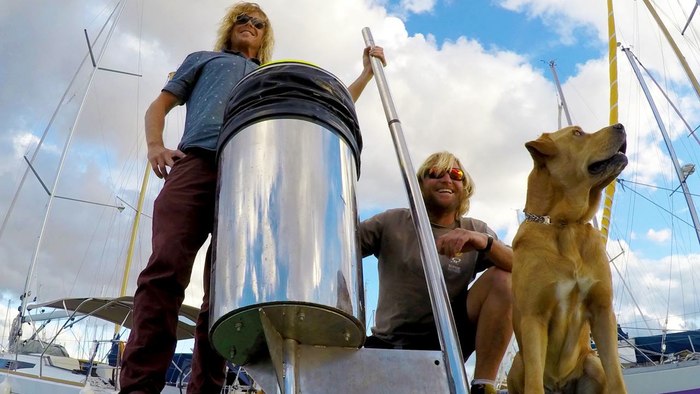
Eddy (see website here) is a low-cost device packed with powerful sensors that makes it easy for anyone, anywhere to access the benefits of hyper-local food. It is built with artificial intelligence to listen to plants and understand exactly what they need when they are growing in your spare bedroom or rooftop garden or farm. Pick up Eddy, add it to your garden, add seed types, nutrient types, connect with people nearby and Eddy will guide you through to perfection.

The company is in the hot area of urban agriculture and like Aerofarms (#2 on our list) Eddy can be used in any sized hydroponic garden or vertical farm. It sits in the water reservoir, and by connecting you to community and data, you are able to grow any kind of food in the world. Using hydroponics. The company is offering a 50% discount to the first 1000 people who sign up to order the product when it ships in the coming months. Sign up here to secure your product and discount. Hydroponics is great for the Middle East, as it’s up to 90% water efficient.
 Green Prophet writer Susan Kraemer wrote that AeroFarms could herald one of the most important developments in food harvesting since humans switched from hunting and gathering to farming. Based in New Jersey, Aeroponics using a method of hydroponics to grow hyper-local food.
These clever stacked farms that can be used virtually anywhere – including inside buildings in the heart of any city – use aeroponic farming technology instead of soil and sunshine to grow food. Saudi Arabia has already embraced the technology that specifically addresses estimates that 80% of the world’s burgeoning population will be living in cities by 2050.
Since this company has come online, a hot new food tech startup flux, has taken hydroponics one step further, by adding a layer of artificial intelligence to understand the language of plants.
3. Yemenite Rainwater Harvesting
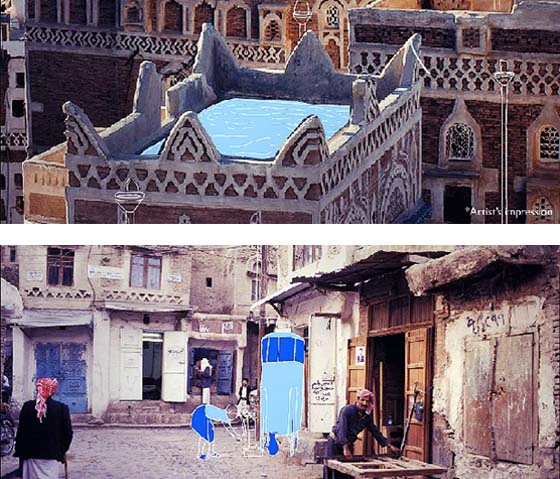 It’s not tech by today’s standards, but it’s traditional innovation. Food grows where water flows, so harvesting rainwater in nearly dry cities such as Sana’a in Yemen is absolutely pivotal to any kind of agricultural success.
Which is why Sabrina Faber’s award-winning rainwater capture system is so clever. Adding to its ingenuity is its sheer simplicity: the rainwater harvesting system will be incorporated into rooftops and is modelled after traditional capture designs Faber has seen out in Yemen’s countryside.
4. Gaza’s Green Roofs of Herbs and Vegetables
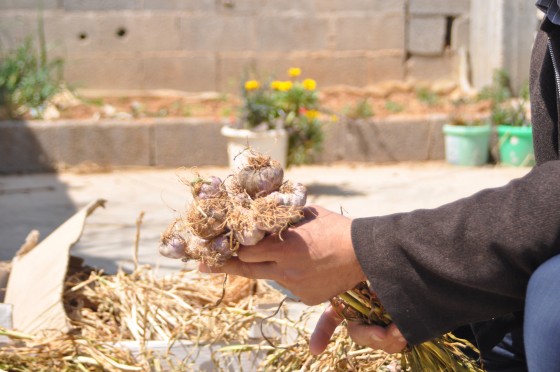 “They” say that necessity is the mother of invention, and this is turning out to be particularly true when it comes to food. Many residents in Gaza have experienced have embraced one of the largest growing urban agricultural solutions. They are building their own hydroponics solutions.
Having no land and stunted access to to food, many people in this politically-charged strip of land are growing cabbage, eggplants, and endochriyya [a plant used for making soup] in the winter, as well as chili, garlic, and onions in summer, and they are doing all of this on their flat rooftops that receive plenty of sunlight. Several rooftop farming initiatives have popped up in Cairo and Beirut as well.
5. Liveinslums Microgardens in Cairo
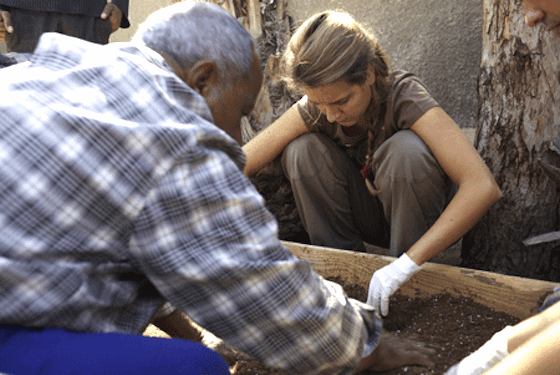 A Non-Governmental Organization (NGO), Liveinslums has worked with local architects and designers to help residents in Cairo’s neglected City of the Dead grow microjardins – mini, soilless, and transportable subsistence gardens that also fertilize the sand.
In addition to being incredibly portable, the microjardins are easy to construct.
Liveinslums provide seeds, turf and perlite, which act as a substitute to soil, vitamin solutions that are added to water, and plastic, wood, and other recycled materials out of which these mini gardens are made. Initiatives like this demonstrate that with the right amount of tender loving care, food can be grown anywhere!
6. Feeding Abu Dhabi With Water From Air
 Despite having some of the world’s most largest and grandest desalination plants, the Gulf countries are quite possibly the most vulnerable when it comes to water, and they are rising to the challenge with some of the most sophisticated water capture innovations.
With an average humidity level of 61% , the Abu Dhabi Farmers’ Services Center (FSC) has spearheaded G-earth – a technology that extracts condensation from the air to provide water for Abu Dhabi greenhouses.
7. SEKEM – Egyptian Organic Farm
 Organic farming may not be new, but Egypt’s largest is so successful that we can’t ignore its potential to not only save people from food shortages, but also to restore the country’s soil to sustainable levels.
Established by Dr. Ibrahim Abouleish in 1977, SEKEM is an organic farming community that integrates social, economic and environmental development just outside Cairo. Run by Dr. Abouleish’s son Helmy, this incredible enterprise that champions the best in sustainable farming techniques has grown from 70 hectares to several thousand!


Vertical farming is a concept that is perfect for the Middle East. Having lived in Dubai, I know just how much of a challenge the food situation can be. All my praise goes to the UAE leadership for makimg these challenges a national and regional priority.
I have worked over the past year on a vertical farm comcept that is affordable to both build and operate, produces massive amounts of food, and can grow almost ANYTHING, as opposed to most systems today that are limited to shallow root vegetables such as lettuce. I am building this farm here in Canada later on this year, and would love to create some form of partnership in the UAE to do this project down there.
I think it could be a massive advancement in food production worldwide.
If you would like more information or would like to have more information ou can contact me at [email protected]
Khaled Majouji
President
In.Genius Group
Yes, we agree, and I hope there is time to make the necessary changes before all the ice caps melt.
I agree with Laylin you must keep doing the measures and analysis to make them more better in improvements of agriculture. Thanks for your suggestions.
Tafline,
I suggest 1. 100% safe recycling of all human-generated waste products and materials, and 2. Peacefully reducing the human population with family planning education in which every woman is guaranteed the legally protected right to decide if and when to conceive and give birth to her children. Very few women want 4, 5, 6, 7, 8, 9, 10 children, more want none at all, but the vast majority want no more than 1, 2 or 3. That way the human population would return to a natural balance with the Earth’s ability to feed us and supply what we need and want. Then, because populations were no longer growing and competing for territory, World peace would prevail everywhere.
JTR, these are good suggestions and I believe that most people would agree with you. But that doesn’t mean that you stop taking other measures as well. If we hope to heal the planet, we are going to have to do everything possible: family planning, recycling, increase efficiency of resource use, diversify our energy portfolio, etc.
Karin,
Overpopulation is mostly the result of male supremacy in which a husband demands a large family to prove his superiority and to extend his influence. New gardening techniques are helful, but each women needs the legally protected right to decide if and when to conceive and birth her children. Very few want a large family, more want none at all, but the vast majority want no more than 1, 2 or 3 . That way the human population would return to a natural balance with the environment, conflicts caused by overpopulation would stop, pollution could be cleaned up and life on Earth could go on for several thousnad years.
I think these new solutions are good for the earth, and will allow people to live a more sustainable way, increasing prosperity for people. Happier, more prosperous people have less children because fewer die.
JTR, we certainly don’t dispute the notion that we our cultural values need to change and we need to slow down the growth of consumption, but what do you suggest? Just stop thinking about sensible solutions just because they are going to fix all the world’s problems?
So, do those new gardening techniques make it possible for the population to keep on growing and growing and growing and growing and growing? Most people are good, but too much of any good thing turns it bad.