Grandfather’s chemical exposure influences grand-daughter’s sexual health

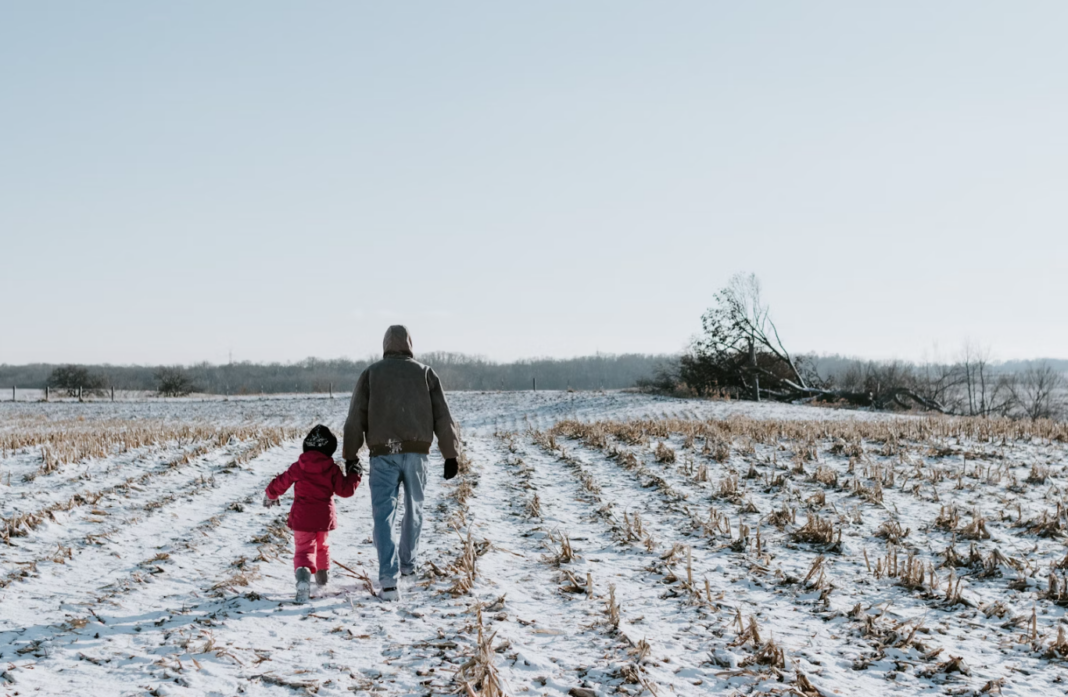
Grandpa and girl on a farmer field plowed in the winter
Grandfathers and the reproductive health of their granddaughters

“While we found that both the mother’s and father’s exposures were linked to when their daughters and granddaughters began puberty, the father’s influence was surprisingly strong.”

It’s often told that a grandmother’s environment and lifestyle effects her unborn grandchildren, because a grandmother’s daughter carries all her children’s eggs inside her tummy too. Grandparents also have an effect on mitochondrial health, pointing to a new study on grandfathers.

A grandfather’s exposure to endocrine-disrupting chemicals, perhaps at work or on the farm, may impact the age when his granddaughter starts her first period, according to a study being presented Sunday at ENDO 2025, the Endocrine Society’s annual meeting in San Francisco, Calif.

“Girls are starting puberty earlier than ever before, which can raise their risk for health problems later in life,” said lead researcher Xin Hu, PhD, of Emory University’s Rollins School of Public Health in Atlanta, Ga. “We wanted to explore why this might be happening by looking at how environmental exposures from grandparents can influence when girls get their first period.”

Endocrine-disrupting chemicals (EDCs) are substances in the environment (air, soil, or water supply), food sources, personal care products, and manufactured products that interfere with the normal function of the body’s endocrine system. Since EDCs come from many different sources, people are exposed in several ways, including air, food and water. EDCs also can enter the body through the skin. Microplastics are also a possible source.

The researchers used data from the Child Health and Development Studies (CHDS), a long-term study that began in the 1960s. They measured thousands of small molecules in blood samples taken from 249 couples in the 1960s. The researchers linked the couples’ chemical and metabolic profiles to the timing of puberty in their daughters and granddaughters.

The researchers studied the age at which their daughters (247 girls) and granddaughters (139 girls) started their periods. They found that while the median age of having a first period was stable between the grandmothers and their daughters, it dropped a full year from the daughters to the granddaughters, whose median year of birth was 1990.

They discovered that certain chemicals in both the mother’s and father’s blood were linked to when their descendants began puberty, with stronger effects seen in the granddaughters’ than in the daughters’ generation. Some chemicals such as phenoxyethanol, a common preservative in personal care products and foods, were linked to earlier puberty, especially when both parents had similar exposures.

“While we found that both the mother’s and father’s exposures were linked to when their daughters and granddaughters began puberty, the father’s influence was surprisingly strong,” Hu said. “Paternal exposure to environmental chemicals may play an unrecognized but critical role in shaping offspring endocrine health.”

She said this is the first population-based study to show that a father’s environment can affect reproductive development in both his daughter and granddaughter. “These findings highlight that prevention is possible if we identify mechanisms to protect future daughters and granddaughters, which cannot be effective if we do not consider the male line,” she said.

“Our results highlight the role of endocrine-disrupting chemicals during the vulnerable period of conception and pregnancy,” said senior author Barbara Cohn, PhD, MPH, of the Public Health Institute in Berkeley, Calif. “This research emphasizes the lasting impact of environmental exposures on reproductive health across generations.”


Karin Kloosterman
Karin Kloostermanhttp://www.greenprophet.com
Karin Kloosterman is an award-winning journalist, innovation strategist, and founder of Green Prophet, one of the Middle East’s pioneering sustainability platforms. She has ranked in the Top 10 of Verizon innovation competitions, participated in NASA-linked challenges, and spoken worldwide on climate, food security, and future resilience. With an IoT technology patent, features in Canada’s National Post, and leadership inside teams building next-generation agricultural and planetary systems — including Mars-farming concepts — Karin operates at the intersection of storytelling, science, and systems change. She doesn’t report on the future – she helps design it. Reach out directly to [email protected]

Hot this week

How does one start prepping?

Faced with an extreme winter storm this year, Americans wonder how to be prepared for catastrophe. Miriam has lived through wars in the Middle East - so she's prepared on giving you a guide to prepping.

Fishermen sue tire manufacturers on behalf of the salmon

A federal trial in San Francisco has brought US tire manufacturers, fishing groups, and environmental scientists into court over a chemical most drivers have never heard of — but which scientists say may be silently reshaping aquatic ecosystems.

Listening to Water: Tarek Atoui’s Next Work for Tate Modern

Born in Beirut, Lebanon in 1980 and now living in Paris, Atoui has spent years building instruments that don’t sit comfortably in concert halls. Many of them involve water, glass, and ceramics — materials that react to sound instead of simply producing it.

Leading Through a Dual-Energy Transition: Balancing Decarbonisation with Energy Security

Experience in one area of the energy industry isn't enough to guarantee readiness across all the others. That's where a structured program like an MBA in energy can come in. Today's advanced curricula explore energy economics, finance, policy, and strategic management alongside the technical subjects. And when pursuing an energy MBA online, professionals can skill up and retrain without having to step out of the labor market -- an important perk at a time when skilled professionals are already in short supply.

From Green Energy to Healthy Societies: Why old systems thinking is becoming relevant again

Across the Middle East and North Africa, large investments are being made in green hydrogen, renewable energy, water infrastructure and sustainability. Most of these efforts are discussed in the context of climate change, decarbonization and economic diversification. That framing is important, but it may not capture their full value.

Topics

How does one start prepping?

Faced with an extreme winter storm this year, Americans wonder how to be prepared for catastrophe. Miriam has lived through wars in the Middle East - so she's prepared on giving you a guide to prepping.

Fishermen sue tire manufacturers on behalf of the salmon

A federal trial in San Francisco has brought US tire manufacturers, fishing groups, and environmental scientists into court over a chemical most drivers have never heard of — but which scientists say may be silently reshaping aquatic ecosystems.

Listening to Water: Tarek Atoui’s Next Work for Tate Modern

Born in Beirut, Lebanon in 1980 and now living in Paris, Atoui has spent years building instruments that don’t sit comfortably in concert halls. Many of them involve water, glass, and ceramics — materials that react to sound instead of simply producing it.

Leading Through a Dual-Energy Transition: Balancing Decarbonisation with Energy Security

Experience in one area of the energy industry isn't enough to guarantee readiness across all the others. That's where a structured program like an MBA in energy can come in. Today's advanced curricula explore energy economics, finance, policy, and strategic management alongside the technical subjects. And when pursuing an energy MBA online, professionals can skill up and retrain without having to step out of the labor market -- an important perk at a time when skilled professionals are already in short supply.

From Green Energy to Healthy Societies: Why old systems thinking is becoming relevant again

Across the Middle East and North Africa, large investments are being made in green hydrogen, renewable energy, water infrastructure and sustainability. Most of these efforts are discussed in the context of climate change, decarbonization and economic diversification. That framing is important, but it may not capture their full value.

We saw peace – an interreligious encounter deep in our eyes

They came from Israel, Palestine, Jordan, Iraq, Yemen, Morocco, Tunisia, Lebanon, Egypt… There are Sunni Muslims, Shiite Muslims, Jews (Orthodox and Reform), Orthodox Christians, Coptic Christians, Protestant Christians, Druze, Baha'is, a Scientologist.

Can biochar reduce ‘Forever Chemicals’ in food if it’s used in farms?

Biochar is produced by heating organic material in a low-oxygen environment so it does not burn. This process, known as pyrolysis, transforms plant matter into a stable, carbon-rich material.

In The Dark Review – An Immersive Music Experience in Total Darkness at St Andrew Holborn

In complete darkness, inside the holy space of St Andrew Holborn, listening begins to feel like a form of prayer. With no light and no distraction, sound fills the church and holds the room. For an hour, attention itself becomes the shared act.

Related Articles

Popular Categories