Microplastics from brushing your teeth and wearing plastic aligners?

Plastic toothbrush used by dentists

Plastics are all around us. Despite Greenpeace diehards wanting to ban them, along with the oil industry that fuels ships, plastics have transformed our lives allowing us to fly in airplanes, preserve and store water, and produce clothes and everyday products cheaply and effectively. But there is a cost as plastics don’t biodegrade, most plastics are not recycled, and they can enter the food chain and our bodies in teeny, invisible bits known as microplastics. Scientists find microplastics in water, in dust, in bits that chip off of plastic bottles we drink from –– and now the obvious –– from brushing our own teeth. (Slide down if you are looking for the study on plastic oral retainers).

Microplastics, according to the NIH in the US, can affect the human body by stimulating the release of endocrine disruptors. Microplastics can carry other toxic chemicals such as heavy metals and organic pollutants during adsorption, which can adversely affect the human body.

In a new study by dental researchers in India, and published in the journal Environmental Pollution, researchers looked at the impact of using plastic toothbrushes and microplastics. Brushing one’s teeth is abrasive, no doubt, and plastics must most certainly be chipping off from toothbrushes. Is it time for natural bristles and the miswak stick, used in Africa and in Arab countries as a natural toothbrush?

The miswak is a teeth-cleaning twig made from the Salvadora persica tree. It shows antibacterial activity which may help control the formation and activity of dental plaque.

miswak toothbrush
Brush your teeth with the stick from a tree? It’s called a miswak. Find them for sale in African markets.

The Indian researchers from the Meenakshi Ammal Dental College and Hospital explain that the “environmental input of microplastics from personal care products has received significant attention; however, less focus has been paid to oral healthcare products.”

They looked at microplastics in commercially available oral healthcare products such as toothbrushes, toothpastes, toothpowder, mouthwash, dental floss, and mouth freshener spray that have a pan-India distribution.

All products showed microplastic contamination, where toothbrushes showed the maximum particles (30 to 120 particles/brush) and mouth freshener sprays (0.2-3.5 particles/ml) had the least abundance, they report.

Fragments, fibres, beads, and films were the various shapes of microplastics observed, where fragments (60%) were dominant. Various colors such as pink, green, blue, yellow, black, and colorless fragments were observed, where colorless (40%) particles were dominant.

Microplastics were categorized into three sizes: <0.1 mm (63%), 0.1-0.3 mm (35%), and >0.3 mm (2%).

Four major types of polymers, such as polyethylene (52%), polyamide (30%), polyethylene terephthalate (15%), and polybutylene terephthalate (3%), were identified.

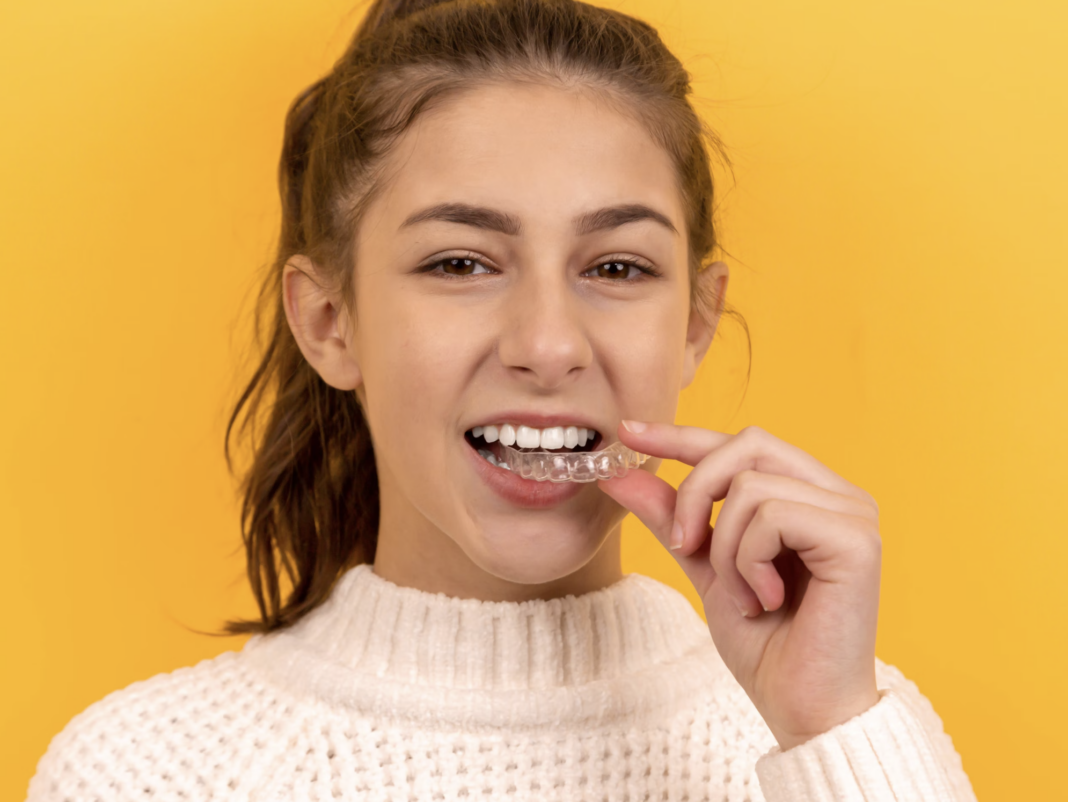
The researchers call for deeper investigation into microplastics and oral health. Which got me thinking after my daughter wore plastic Invisalign liners for a year to correct a minor overnite:

Are there microplastics shedding off of plastic aligners?

Microplastics in plastic aligners
Microplastics and orthodontic plastic aligners. Any risk?

A study in 2023 that simulated the mouth environment in the lab found yes, that microplastics were being separated from clear orthodontic aligners. They looked at the leading brands of plastic aligners and compared them: “This in vitro study highlighted for the first time the detachment of microplastics from clear aligners due to mechanical friction. This evidence may represent a great concern in the clinical practice since it could impact human general health,” the researchers wrote.

They looked at orthodontic clear aligners from different manufacturers: Alleo (AL); FlexiLigner (FL); F22 Aligner (F22); Invisalign (INV); Lineo (LIN); Arc Angel (ARC), and Ortobel Aligner (OR). For each group, two aligners were immersed in artificial saliva for 7 days and stirred for 5 h/day, simulating the physiological teeth mechanical friction.

After 7 days, the artificial saliva was filtered; then, filters were analyzed by Raman Microspectroscopy (RMS) and Scanning Electron Microscopy (SEM), respectively to chemically identify the polymeric matrix and to measure the number and size of the detected microplastics.

The results: aligners AL, FL, LIN, ARC, and OR were composed by polyethylene terephthalate, while F22 and INV ones by polyurethane. SEM analysis showed that the highest number of MPs was found in Arc Angel and the lowest in Invisalign (p < 0.05).

Avoid microplastics. Keywords: Annual microplastics exposure; Daily microplastics emission; Microplastics; Mitigation measures; Oral healthcare products; Polymer hazard index.
Avoid micrplastics and buy a wooden, natural fiber toothbrush

Related: Do your cosmetics contain cancer-causing asbestos? 

These studies forecast the community health risks linked to microplastics in oral healthcare products. Using a wooden toothbrush with natural bristles may help.

Is it time to go back to metal braces? We can’t say. We will wait for more research but you might want to take this research into your own hands and –– mouth.

microplastics in dentures?

Keywords: Annual microplastics exposure; Daily microplastics emission; Microplastics; Mitigation measures; Oral healthcare products; Polymer hazard index.


Karin Kloosterman
Karin Kloostermanhttp://www.greenprophet.com
Karin Kloosterman is an award-winning journalist, innovation strategist, and founder of Green Prophet, one of the Middle East’s pioneering sustainability platforms. She has ranked in the Top 10 of Verizon innovation competitions, participated in NASA-linked challenges, and spoken worldwide on climate, food security, and future resilience. With an IoT technology patent, features in Canada’s National Post, and leadership inside teams building next-generation agricultural and planetary systems — including Mars-farming concepts — Karin operates at the intersection of storytelling, science, and systems change. She doesn’t report on the future – she helps design it. Reach out directly to [email protected]

Read More

TRENDING

Do you have microplastics in your sperm?

Biohacker finds a way to remove microplastics from his sperm

Billie Eilish’s Mom Takes the Stage at Hollywood Climate Summit — But Does Hollywood Still Care About Climate Change?

Hollywood once promised to help save the planet. Leonardo DiCaprio warned of climate catastrophe from awards stages. Celebrities flew to climate conferences. Studios pledged greener productions. Streaming platforms rushed to commission environmental documentaries. But in 2026, with the aftermath of wildfires, heatwaves and floods becoming routine, a question lingers: Does Hollywood still care about climate change?

What is holistic dentistry?

A recent study of graduating dental hygiene students in the United States suggests there is a knowledge gap. Researchers found that 42% of respondent students were unfamiliar with holistic dentistry, while 60% did not feel comfortable discussing it with patients. Yet nearly half believed the topic deserved greater attention in dental hygiene education.

Baby fruit pouches ejecting microplastics into every serving

For generations, feeding a baby meant pureeing what you...

Baby teeth read like tree rings paint a picture of toxins in early life

A new study from the Icahn School of Medicine at Mount Sinai in New York offers a striking insight into how the environments we are born into can quietly shape our brains years later. By analyzing naturally shed baby teeth, the ones tucked under pillows for the tooth fairy, researchers have reconstructed a detailed timeline of exposure to environmental metals during pregnancy and early infancy.

Yerukim Forms a New Green Economy Where the Money is Really Green

The Yerukim members who pick up the recyclables get to keep the monetary reward, the public earns "green" bills that can be used in shops, and business owners get to be associated with environmentalism.

Choosing Riyadh over Dubai? What Investors Should Know

Saudi Arabia is deploying capital at unmatched scale to catalyze tourism and advanced industry while rewiring its power-and-water backbone. The investable frontier is widening—especially in renewables, grid storage, water efficiency/desal retrofits, and hospitality operating platforms. Prudent investors will insist on phased delivery, enforceable KPIs (energy, water, biodiversity), and RHQ/zone compliance—while pricing political-economy and reputational risks alongside growth upside.

Sell your cooking oil for biodiesel money

Want to make money on old french fry oil? Sell it.

Qatar Alternative Energy Summit Pairs Investors And Innovators

Alternative energy investors and innovators can meet n' greet in Doha, Qatar March 16 and 17.

Here’s How To Implement The Four Pillars Of Employee Engagement

If you throw a party for your work team and they are vegans, don't make it a barbecue. Know the sustainability values of your team to boost moral and retain good people.

Locals From Rishon Fight IKEA

Big Box stores are a pretty new concept in Israel, and thank God that not every Israeli city wants them in their backyard. A word from someone who has see the beautiful farmland around her hometown Newmarket, Ontario stripped and converted into vulgar strip malls of big box shops: they have no place in a healthy and sustainable town or city.

The Jewish National Fund Meets An Inconvenient Truth

According to the JNF, it has transformed thousands of acres of barren land into green forests in Israel. They state that each person emits about 23 tons of carbon per year, estimating that each tree planted can absorb one ton of carbon in its lifetime. That's a whole lot of trees you'd need to be planting. Could so many fit in Israel?

How to quiet noise from construction in your office

Streets need to be resurfaced in New York but the humming and grinding noise is unsettling. Noise is environmental pollution. 

Popular Categories