
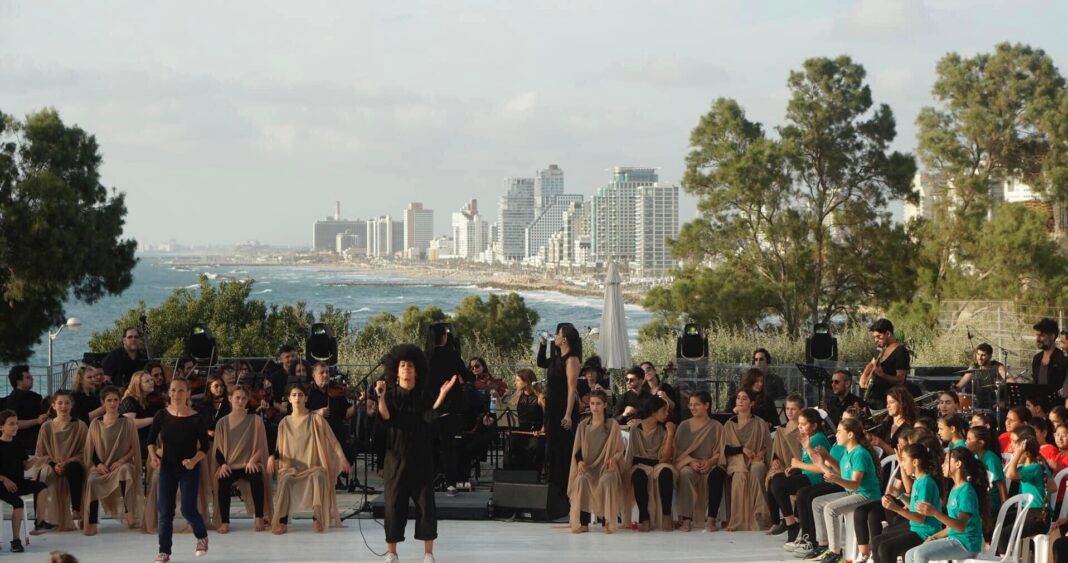
The young women who danced with Fairuz in Jaffa

Fairuz Festival Jaffa
The Fairuz Festival Jaffa showed the world that in times of trouble, we always have dance

A rumor started on a Facebook group in Jaffa that the beloved Lebanese singer Fairuz would be performing. Fairuz is the Ella Fitzgerald of the Arab world and without doubt the biggest musical icon of the Arab world. She is popularly known as “the soul of Lebanon” and has achieved fame despite being a modern, secular woman in an ultra-conservative world lived in by most of her biggest fans. 

The 87-year-old singer did not perform that day in May, but in her spirit a dozen girls, Jewish and Arabic, with origins from the Holy Land and as far and wide as Canada and Ireland shared a common dance floor for change –– and led a dance with Faizuz’s music at a new local dance festival that took place in the Old City of Jaffa overlooking the Mediterranean Sea and Tel Aviv. They had been working on the piece since January.

The dance troupe, led by Dalia Chaimsky dance director of the Jewish Arab Center in Israel, embraced a crew of 100 other girls and boys from Arab-speaking schools in the Jaffa area. The idea was to create a safe space for meeting face-to-face in a city that is culturally and religiously divided between rich and poor, secular and traditional, or Jewish, Muslim and Christian. 

Fairuz, dance, Israel, Jaffa
A group of girls from Jaffa share the hope for peace by creating a dance troupe that brings together schools with the music of Fairuz.

The dance troupe of young women aged 12 to 14 elegantly embraced their role as dance mentors to the other children, as a Middle Eastern orchestra, The Jerusalem Orchestra East West played an entrancing piece made famous by Fairuz. Hand movements and pulses of dancers crowded the stage, but everyone, along with their families in the audience were excited about the moment that the cellphones were off and the children could express themselves. Having 113 children on stage was a bit chaotic but the excitement and deeper meaning palpable.

It’s been a trying time for bringing people with varying backgrounds together in Jaffa, an ancient port city of mixed Muslim, Jewish and Christian heritage that sits side-by-side with the ultra modern Tel Aviv to the north. There were rockets falling in the area a couple of months earlier and while Yulia a lazy seal stretched herself along a Jaffa shore uniting Jaffainians for a moment, the sense in the community was one of distrust, loss of hope and pain.

(Related: remember when Syrian kids danced through pain and the rubble?)

As a resident of Jaffa and a mother of 3 young boys there, Chaimsky had a personal and professional mission to unite people through culture and dance in her beloved city.

She tells Green Prophet: “After being part of the Jewish Arab Center for 6 years it was important for me to develop the dance culture for the kids in Jaffa, especially the ones in our center. But it’s also important that the dance culture would be developed in Jaffa so that people will see what we are doing and recognizing that art and dance is not only for fun but can connect communities.” 

“Dance,” she adds, “can develop kids’ minds, their general knowledge, but also other aspects about their bodies, in music, and in choreography,” says the daughter of Lithuanian doctors who immigrated to Israel as a child. Chaimsky was a professional dancer before she took on the role of supervising the dance department at the Jewish Arab Center. Other disciplines found there include hip-hop, modern dance and ballet.

“The main thing we came out with the Fairuz Project was the 100-plus kids collaborating together from the Jaffa schools Kulna Yahad, Ajial and Al Alhua in Jaffa. We entered the schools with our dance teachers and did a dance project for kids who are non-dancers in their everyday life. It was important for me to choose music connected to the traditional Arabic culture in Jaffa and the Middle East,” Chaimsky explores.

The Fairuz Dance Troupe from the Jewish Arab Center, left is their dance instructor Stav

“The emphasis was on Arabic traditional music so the Arabic kids will be proud of their culture and sound and so that it will be heard in the public area for the Jewish kids to know and hear another culture and tradition that’s not from home.

“The main thing is that we are learning about this culture through movement and that everyone can connect. It was for three months in the school, one hour per week, and in the end we set everything together to one dance and the city worked hard so we’d have a great orchestra to play, the Jerusalem Orchestra East and West.”

Watch the Best of Fairuz

https://www.youtube.com/watch?v=qaBYV-9g63o

It isn’t easy for Chaimsky, as a modern secular Jewish woman, to see young Arab women hidden from the public eye once they start puberty: “It’s important to say that in Jaffa by the age of 12 the girls stop dancing because of their traditions so it was important for me to emphasize Dance as something much more meaningful for life and which can connect the community.  

“The fact that it comes out of Jaffa is a political statement,” she notes. “We are Jewish and Arab kids dancing together. We have different things to connect us now, not just the troubles, and yes we also have the good things. And you can see it onstage and you can see it in a very big festival like the one we had.

“But the main goal was to develop dance in the culture of Jaffa, within the kids,” Chaimsky, once a dancer, always a dancer, concludes.

The Fairuz Festival was in cooperation with and supported by the City of Tel Aviv-Jaffa, the Jewish Arab Center, The Mandel Center, the Old City of Jaffa, and the Pisgah Theatre in the Old City of Jaffa.

Karin Kloosterman
Karin Kloostermanhttp://www.greenprophet.com
Karin Kloosterman is an award-winning journalist, innovation strategist, and founder of Green Prophet, one of the Middle East’s pioneering sustainability platforms. She has ranked in the Top 10 of Verizon innovation competitions, participated in NASA-linked challenges, and spoken worldwide on climate, food security, and future resilience. With an IoT technology patent, features in Canada’s National Post, and leadership inside teams building next-generation agricultural and planetary systems — including Mars-farming concepts — Karin operates at the intersection of storytelling, science, and systems change. She doesn’t report on the future – she helps design it. Reach out directly to [email protected]

Read More

TRENDING

90% of Americans worry about microplastics

Microplastics are showing up everywhere—from dollar store toys and synthetic clothing to bottled water, toothbrushes and even human sperm. A new Ocean Conservancy survey finds that nearly 9 in 10 Americans are concerned about the health impacts of microplastics, while support is growing for tougher regulations. As scientists uncover plastic particles in the heart, placenta and reproductive organs, the question is no longer whether microplastics are affecting our lives, but how much damage they are already doing.

Understanding Food Production: Karl Studer on the Urban-Rural Knowledge Gap

Karl Studer occupies an unusual position in American business. As President of Quanta Services, he oversees electrical infrastructure operations across the United States, Canada, and Australia, managing thousands of employees and multibillion-dollar projects.

Tigris River oil spill highlights Iraq’s environmental oversight and our addiction to oil

A fresh oil spill in the Tigris River, filmed by an Iraqi university student, has reignited concern over Iraq's polluted waterways. From ancient Mesopotamia to modern Basra, the country's dependence on oil has come at a steep environmental and human cost, with activists warning that unchecked contamination is putting ecosystems and public health at risk.

Doctor-Led Direct Hair Transplant: What Surgeon Involvement Means for Outcomes

Hair restoration technology continues to evolve, but the surgeon behind the procedure remains the most important factor. Doctor-led hair transplants emphasize careful diagnosis, conservative donor management, natural hairline design, and long-term planning rather than simply maximizing graft counts. By treating donor hair as a limited resource and tailoring each procedure to the patient's future hair loss, experienced surgeons can reduce the need for corrective surgery while delivering more natural, sustainable results.

Data centers in Space? Sophia Space and Apex plan on busing them in

Can data centers really be built in space? Pasadena-based Sophia Space is partnering with Apex to test the idea by launching modular AI computing systems into low Earth orbit in 2027. Using radiation-hardened compute TILEs cooled by passive radiative systems and mounted on scalable satellite buses, the companies aim to prove that edge computing can operate reliably in space. While challenges remain, the project represents an important step toward distributed orbital computing networks that could support everything from climate monitoring and pollution tracking to autonomous spacecraft navigation in an increasingly crowded orbital environment.

Yerukim Forms a New Green Economy Where the Money is Really Green

The Yerukim members who pick up the recyclables get to keep the monetary reward, the public earns "green" bills that can be used in shops, and business owners get to be associated with environmentalism.

Choosing Riyadh over Dubai? What Investors Should Know

Saudi Arabia is deploying capital at unmatched scale to catalyze tourism and advanced industry while rewiring its power-and-water backbone. The investable frontier is widening—especially in renewables, grid storage, water efficiency/desal retrofits, and hospitality operating platforms. Prudent investors will insist on phased delivery, enforceable KPIs (energy, water, biodiversity), and RHQ/zone compliance—while pricing political-economy and reputational risks alongside growth upside.

Sell your cooking oil for biodiesel money

Want to make money on old french fry oil? Sell it.

Qatar Alternative Energy Summit Pairs Investors And Innovators

Alternative energy investors and innovators can meet n' greet in Doha, Qatar March 16 and 17.

Here’s How To Implement The Four Pillars Of Employee Engagement

If you throw a party for your work team and they are vegans, don't make it a barbecue. Know the sustainability values of your team to boost moral and retain good people.

Locals From Rishon Fight IKEA

Big Box stores are a pretty new concept in Israel, and thank God that not every Israeli city wants them in their backyard. A word from someone who has see the beautiful farmland around her hometown Newmarket, Ontario stripped and converted into vulgar strip malls of big box shops: they have no place in a healthy and sustainable town or city.

The Jewish National Fund Meets An Inconvenient Truth

According to the JNF, it has transformed thousands of acres of barren land into green forests in Israel. They state that each person emits about 23 tons of carbon per year, estimating that each tree planted can absorb one ton of carbon in its lifetime. That's a whole lot of trees you'd need to be planting. Could so many fit in Israel?

How to quiet noise from construction in your office

Streets need to be resurfaced in New York but the humming and grinding noise is unsettling. Noise is environmental pollution. 

Popular Categories