
Is deflation really a good thing

deflating a hot air balloon
Deflating a hot air balloon or an economy. 


Even if deflation appears to have a positive effect on household budgets for consumers, it is more dangerous for the economy than inflation. Deflation is the opposite of inflation and means a fall in prices. If there is no more price increase, one speaks of stagnation.

Deflation can become a dangerous downward spiral for an economy. To combat deflation, central banks lend cheap money to banks. These should stimulate investments by granting cheap loans, which in turn should create jobs and thereby strengthen purchasing power and increase demand.

Definition of deflation

What is deflation? When there is deflation, the prices of goods in the market fall. So, the value of money is increasing – people can buy more with their money. However, what sounds good at first has serious disadvantages. In fact, with inflation, money loses purchasing power.

Let’s understand the causes of deflation before we talk more about its serious consequences.

Causes of deflation

Deflation can occur when a central bank reduces the money supply too much as part of its monetary policy. Another reason can be that companies produce too many goods and there is an oversupply on the market.

Deflation is often favored and accelerated by reduced spending by private households and companies. In difficult economic times, people prefer to save. You don’t know if the future won’t get even worse. Companies are also cutting back on their investments.

Deflationary spiral

The monetary policy of the central banks is based on the optimization of the so-called magic square. This regulates the interaction between:

  • Full employment,
  • Price stability,
  • Balanced foreign trade
  • Steady economic growth.

It is the development and interaction of these factors that lead to deflation. When economic growth falls, the employment rate tends to fall as well. Rising unemployment leads to a drop in demand for goods. However, since companies have to sell, they are initially forced not to raise prices, which, together with rising unemployment, leads to falling wages. If demand continues to fall, stockpiles are formed. In order to reduce this, a price reduction must take place. The downward spiral has thus begun.

Consequences of deflation

Inflation results from rising demand and drives economic growth through higher production figures. During deflation, productivity falls, and there is no economic growth. Only foreign trade still offers a solution in this situation. Since prices in one economic zone drop significantly during deflation, companies may be able to deliver cheaper than their competitors in other economic zones with higher price levels.

Approaches to fighting deflation

When deflation occurs, there is a lack of demand, which usually results from high unemployment. So, the first step would be to create new jobs. These arise when companies have funds to make investments. For this purpose, the banks have to grant loans on more favorable terms.

The central banks can take the step of increasing the liquidity (free reserves) of the banks. In theory, banks can provide a credit on more favorable terms once they receive sufficient cash reserves from central banks. This gives companies the opportunity to create new jobs through investments. More jobs increase the purchasing power of the population and lead to increased domestic demand, which in turn means an increase in the production of consumer goods due to increased demand. This will stimulate economic growth again.

The banks have a key role in handling this situation since the central banks themselves are not allowed to lend to the economy. However, this cycle cannot be broken if private credit institutions remain reluctant to lend money.

Is inflation better than deflation?
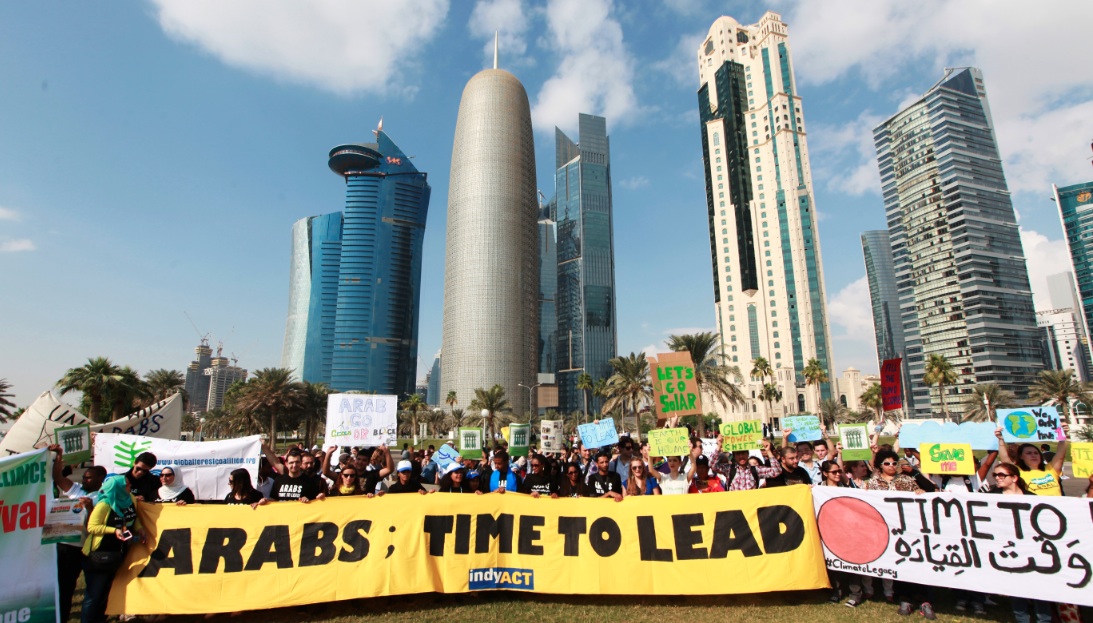
qatar climate change qatar cop18
Qataris and climate change

Central banks consider an annual inflation rate of two percent to be healthy. A moderate price increase signals that there is a steady economic growth. Rising personnel costs, as one of the drivers of rising prices, demonstrate a certain degree of employment, which in turn means demand. Japan suffered from the effects of deflation in the 1990s, and today confirms that this was the most difficult period in the Japanese economy. The recovery period lasted longer than the period of deflation itself.

Some environmentalists talk about negative growth or deflating economies to stop climate change and carbon emissions but if people can’t afford basic necessities such as heating a deflating economy might be worse than an inflating one. Companies respond to falling prices by slowing down their production, which leads to layoffs and salary reductions.


Bhok Thompson
Bhok Thompsonhttp://www.greenprophet.com
Bhok Thompson is an “eco-tinkerer” who thrives at the intersection of sustainability, business, and cutting-edge technology. With a background in mechanical engineering and a deep fascination with renewable energy, Bhok has dedicated his career to developing innovative solutions that bridge environmental consciousness with profitability. A frequent contributor to Green Prophet, Bhok writes about futuristic green tech, urban sustainability, and the latest trends in eco-friendly startups. His passion for engineering meets his love for business as he mentors young entrepreneurs looking to create scalable, impact-driven companies. Beyond his work, Bhok is an avid collector of vintage mechanical watches, believing they represent an era of precision and craftsmanship that modern technology often overlooks. Reach out: [email protected]

Read More

TRENDING

Understanding Food Production: Karl Studer on the Urban-Rural Knowledge Gap

Karl Studer occupies an unusual position in American business. As President of Quanta Services, he oversees electrical infrastructure operations across the United States, Canada, and Australia, managing thousands of employees and multibillion-dollar projects.

Tigris River oil spill highlights Iraq’s environmental oversight and our addiction to oil

A fresh oil spill in the Tigris River, filmed by an Iraqi university student, has reignited concern over Iraq's polluted waterways. From ancient Mesopotamia to modern Basra, the country's dependence on oil has come at a steep environmental and human cost, with activists warning that unchecked contamination is putting ecosystems and public health at risk.

Doctor-Led Direct Hair Transplant: What Surgeon Involvement Means for Outcomes

Hair restoration technology continues to evolve, but the surgeon behind the procedure remains the most important factor. Doctor-led hair transplants emphasize careful diagnosis, conservative donor management, natural hairline design, and long-term planning rather than simply maximizing graft counts. By treating donor hair as a limited resource and tailoring each procedure to the patient's future hair loss, experienced surgeons can reduce the need for corrective surgery while delivering more natural, sustainable results.

Data centers in Space? Sophia Space and Apex plan on busing them in

Can data centers really be built in space? Pasadena-based Sophia Space is partnering with Apex to test the idea by launching modular AI computing systems into low Earth orbit in 2027. Using radiation-hardened compute TILEs cooled by passive radiative systems and mounted on scalable satellite buses, the companies aim to prove that edge computing can operate reliably in space. While challenges remain, the project represents an important step toward distributed orbital computing networks that could support everything from climate monitoring and pollution tracking to autonomous spacecraft navigation in an increasingly crowded orbital environment.

Mona Khalil, Orange House Project founder, sea turtle protector killed in Lebanon

Mona Khalil spent decades protecting Lebanon's sea turtles and coastal ecosystems. Her death in the ongoing conflict between Israel and Hezbollah shines a light on a broader environmental tragedy unfolding across northern Israel and southern Lebanon. From damaged wetlands and disrupted bird migrations to threatened seed banks and endangered wildlife, the region's ecosystems are becoming casualties of a war with no clear end in sight.

Yerukim Forms a New Green Economy Where the Money is Really Green

The Yerukim members who pick up the recyclables get to keep the monetary reward, the public earns "green" bills that can be used in shops, and business owners get to be associated with environmentalism.

Choosing Riyadh over Dubai? What Investors Should Know

Saudi Arabia is deploying capital at unmatched scale to catalyze tourism and advanced industry while rewiring its power-and-water backbone. The investable frontier is widening—especially in renewables, grid storage, water efficiency/desal retrofits, and hospitality operating platforms. Prudent investors will insist on phased delivery, enforceable KPIs (energy, water, biodiversity), and RHQ/zone compliance—while pricing political-economy and reputational risks alongside growth upside.

Sell your cooking oil for biodiesel money

Want to make money on old french fry oil? Sell it.

Qatar Alternative Energy Summit Pairs Investors And Innovators

Alternative energy investors and innovators can meet n' greet in Doha, Qatar March 16 and 17.

Here’s How To Implement The Four Pillars Of Employee Engagement

If you throw a party for your work team and they are vegans, don't make it a barbecue. Know the sustainability values of your team to boost moral and retain good people.

Locals From Rishon Fight IKEA

Big Box stores are a pretty new concept in Israel, and thank God that not every Israeli city wants them in their backyard. A word from someone who has see the beautiful farmland around her hometown Newmarket, Ontario stripped and converted into vulgar strip malls of big box shops: they have no place in a healthy and sustainable town or city.

The Jewish National Fund Meets An Inconvenient Truth

According to the JNF, it has transformed thousands of acres of barren land into green forests in Israel. They state that each person emits about 23 tons of carbon per year, estimating that each tree planted can absorb one ton of carbon in its lifetime. That's a whole lot of trees you'd need to be planting. Could so many fit in Israel?

How to quiet noise from construction in your office

Streets need to be resurfaced in New York but the humming and grinding noise is unsettling. Noise is environmental pollution. 

Popular Categories