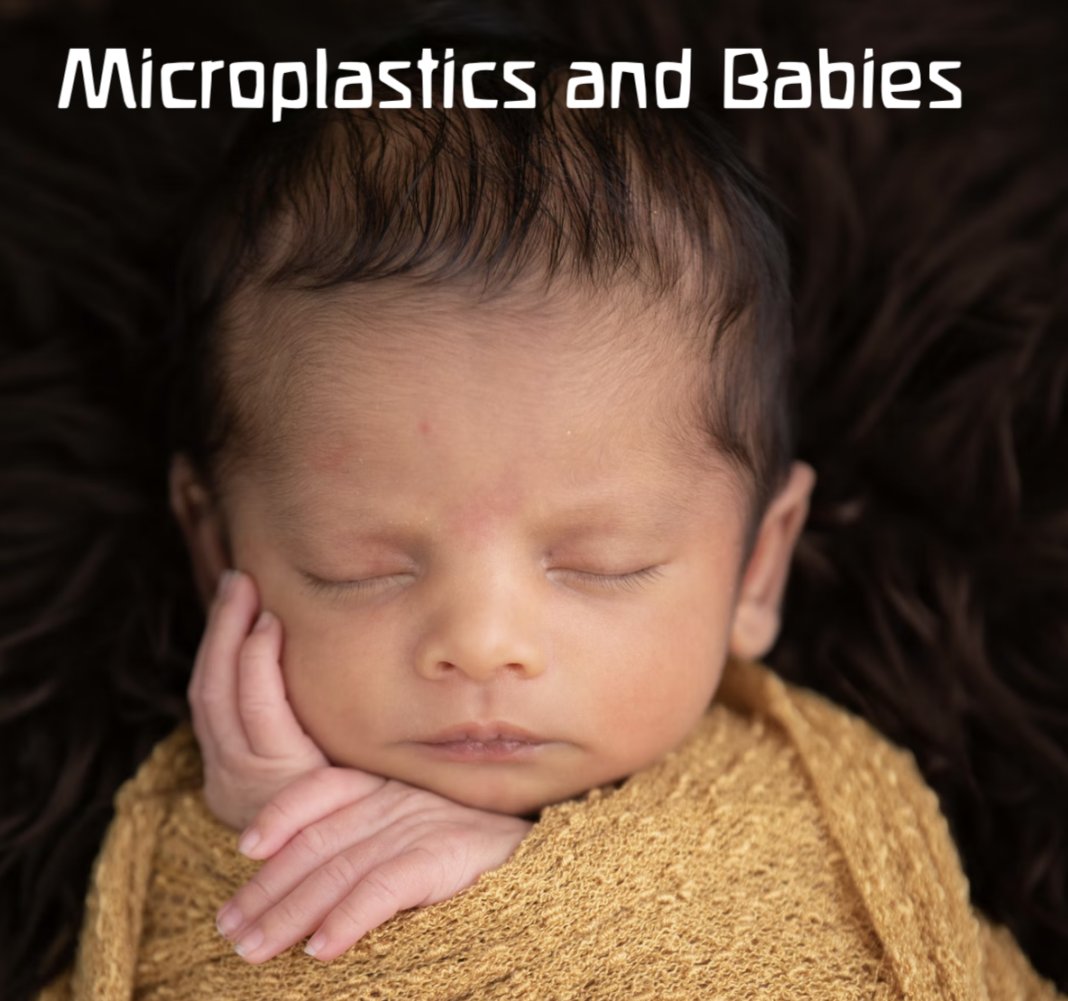
Microplastics found in baby poop

microplastics in babies, baby wrapped in yellow swaddle It started with the plastic Pacific gyre some years ago in the sea. David de Rothschild set sail with a plastic boat, The Plastiki, to document the extent of it all and we interviewed him about it, concerned obviously.

Fast forward and we have Dutchman Boyan Slat trying to clean it all up, and researchers taking stock on how many single flipflops wind up on the shores of paradise on the Seychelles

boyan slat ocean cleanup

But plastics – why should you care if you don’t care about turtles choking? It turns out microplastics are terribly bad for you if you consume them and can amplify the effects of other toxins in the environment by clinging to them, found a recent study out of Israel.

And the amount of microplastics being found in our bodies from drinking out of plastic bottles to eating fish that eat plastic, is frightening. One study has found an alarming amount of microplastics in the poop of babies. How it gets there and what will happen later in life is anyone’s guess – or your new research mission. 

Some of the microplastics were found in meconium, the first stool from a newborn, meaning they came through the mother. Some were found later and it is guessed that it is getting to the babies through teethers, water bottles, and toys. BPA-free? Probably not enough. Read below for more details on the pilot study.

What are microplastics?

Microplastics — tiny plastic pieces less than 5 mm in size — are everywhere, from indoor dust to food to bottled water. So it’s not surprising that scientists have detected these particles in the feces of people and pets. In a small pilot study, researchers reporting in Environmental Science & Technology Letters discovered that infants have higher amounts of one type of microplastic in their stool than adults. Health effects, if any, are uncertain.

Little is known about the magnitude of human exposure to microplastics or their health effects. Although microplastics were once thought to pass harmlessly through the gastrointestinal tract and exit the body, recent studies suggest that the tiniest pieces can cross cell membranes and enter the circulation system.

In cells and laboratory animals, microplastic exposure can cause cell death, inflammation and metabolic disorders. Kurunthachalam Kannan at the New York University School of Medicine and colleagues wanted to assess human exposure to two common microplastics — polyethylene terephthalate (PET) and polycarbonate (PC) — by measuring levels in infant and adult feces.

Microplasics in meconium?!?

The researchers used mass spectrometry to determine the concentrations of PET and PC microplastics in six infant and 10 adult feces samples collected from New York state, as well as in three samples of meconium (a newborn infant’s first stool).

All samples contained at least one type of microplastic. Although average levels of fecal PC microplastics were similar between adults and infants, infant stool contained, on average, more than 10 times higher PET concentrations than that of adults.

plastic soup, boy with plastic heap at sea
Plastic Soup draws an atlas of plastics and where they are accumulating around the world.

Infants could be exposed to higher levels of microplastics through their extensive use of products such as bottles, teethers and toys, the researchers say. However, they note that larger studies are needed to corroborate these findings.


Karin Kloosterman
Karin Kloostermanhttp://www.greenprophet.com
Karin Kloosterman is an award-winning journalist, innovation strategist, and founder of Green Prophet, one of the Middle East’s pioneering sustainability platforms. She has ranked in the Top 10 of Verizon innovation competitions, participated in NASA-linked challenges, and spoken worldwide on climate, food security, and future resilience. With an IoT technology patent, features in Canada’s National Post, and leadership inside teams building next-generation agricultural and planetary systems — including Mars-farming concepts — Karin operates at the intersection of storytelling, science, and systems change. She doesn’t report on the future – she helps design it. Reach out directly to [email protected]

Read More

TRENDING

Baby teeth read like tree rings paint a picture of toxins in early life

A new study from the Icahn School of Medicine at Mount Sinai in New York offers a striking insight into how the environments we are born into can quietly shape our brains years later. By analyzing naturally shed baby teeth, the ones tucked under pillows for the tooth fairy, researchers have reconstructed a detailed timeline of exposure to environmental metals during pregnancy and early infancy.

Lululemon pants leech PFAS and plastics into bodies, Texas attorney general claims

Back in late 2025, Green Prophet began asking uncomfortable questions about what’s really inside your yoga pants, from transparency failures (yes, those infamous see-through leggings) to the less visible and scarier issue: Your sweat is unlocking microplastics and chemical coatings sitting in the most absorbent parts of the human body.

Is artificial turf bad for your health?

Artificial turf, the green plastic stuff that is supposed to look like grass, was sold to many home-owners as a clever compromise: a green-looking surface that makes you feel homey, but which needs no mowing. It survives heavy use, and in dry places like Middle East deserts, and in California or Texas, it can replace thirsty lawns. But it is toxic.

How plastics can increase food poisoning

Banerjee’s research team is among the first to examine the interactions between foodborne pathogens and plastic particles, thereby advancing this emerging field from a food safety perspective.

erthos uses AI to scale bio-plastics that work in industry

AI and bio-plastics have a formidable crew looking to solve the plastics problem. It uses AI to match opportunities to existing machinery.

Mining Afghanistan’s Mineral Discoveries Similar to Avatar

Now that American forces in Afghanistan are commemorating the longest period of any war that America has been involved in, including the 1965-73 Vietnam War, the recent discoveries of large and extremely valuable mineral and metal deposits may finally bring to light a reason to continue the presence of US fighting forces in this war torn and backward country.

From Pilot Plant to Global Stage: How Aduro Clean Technologies’ 2026 Expansion Signals a Turning Point for Chemical Recycling Investors Like Yazan Al Homsi

The company's Next Generation Process (NGP) Pilot Plant in London, Ontario, has officially moved into initial operating campaigns, generating the kind of structured, repeatable data that separates laboratory promise from commercial viability.

Nobul’s Regan McGee on Shareholder Value: “Complacency Is the Silent Killer” 

Why the governance framework designed to protect shareholders so...

Should You Invest in the Private Market?

startustartup Unlike public stock exchanges, which offer daily trading, strict...

How to build a 100-year-company

Kongō Gumi is a Japanese construction company, purportedly founded in 578 A.D., making it the world's oldest documented company. What can we learn about building sustainable businesses from them?

How AI Helps SaaS Companies Reduce Repetitive Customer Support Work

SaaS products are designed for large numbers of users with different levels of experience, and also in renewable energy.

Pulling Water from the Air

Faced with water shortage in Amman, Laurie digs up...

Turning Your Energy Consultancy into an LLC: 4 Legal Steps for Founders in Texas

If you are starting a renewable energy business in Texas, learn how to start an LLC by the books.

Popular Categories