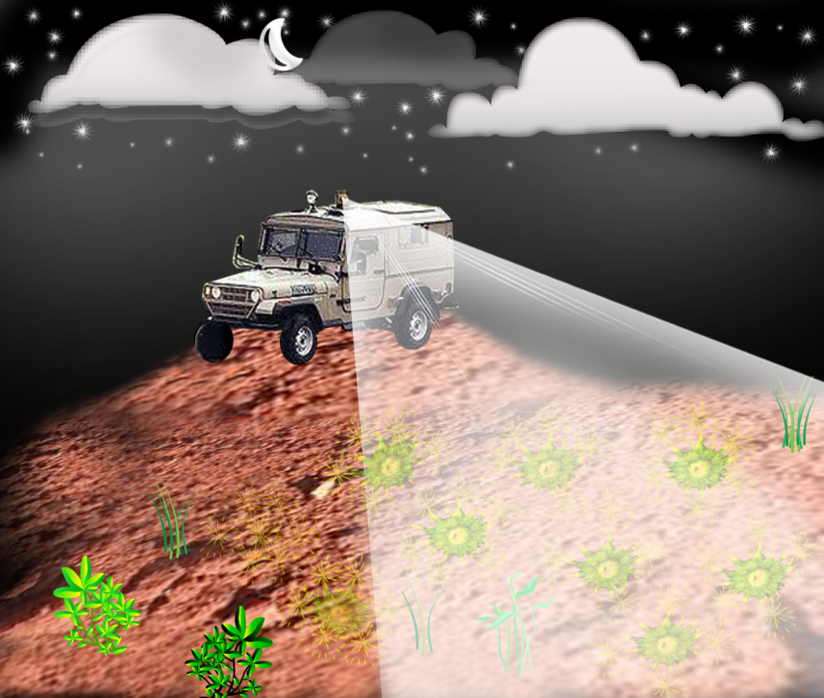

Glow bacteria activated to sniff out nitrogen oxide, a gas emitted from old landmines
Buried landmines left and forgotten from wars and conflict of the past maim women, children and men alike. All sorts of technological solutions have been proposed to clear landmines from the Middle East, and years ago we reported on how Egyptian scientists proposed bacteria to do do just that.
A solution is badly needed as 20% of the world’s land mines are planted in Egypt, where they have killed or maimed a total of more than 7,000 people in the last 30 years. They are scattered in the western desert and Sinai and pose an enormous impediment to development as well as considerable risks to animal and human safety. In Cambodia they employ an award-winning rat to sniff out landmines:
Magawa is a Tanzanian-born African giant pouched rat who has been trained by the nonprofit APOPO to sniff out explosives. With careful training, he and his rat colleagues learn to identify land mines and alert their human handlers, so the mines can be safely removed.
A standout landmine sniffer
Even among his skilled cohorts working in Cambodia, Magawa is a standout sniffer: In four years he has helped to clear more than 1.5 million square feet of land – an area about the size of 20 soccer fields. In the process, he has found 39 land mines and 28 items of unexploded ordnance.
Globally about half a million people around the world are suffering from mine-inflicted injuries, and each year an additional 15 to 20,000 more are injured or killed by these devices. More than 100 million such devices are still buried in over 70 countries.
The major technical challenge in clearing minefields is detecting the mines. Where are those menacing objects just under the sand? Maybe trees have grown around them? The technologies used today are not much different from those used in World War II as shown the classic film The English Patient, requiring detection teams to risk life and limb by physically entering the minefields. There is a critical need for an efficient solution for the remote detection of buried landmines and unexploded ordnance.
Researchers from the Hebrew University of Jerusalem have updated existing research in researching engineered glow bacteria from E.coli to help armies and humanitarians with the task and report their findings in New Biotechnology. A couple of years ago they published similar research in Nature Biotechnology. There they offer a system combining lasers and bacteria to remotely map the location of buried landmines and unexploded ordnances.
Biosensors activated: Smells like grenade
The system is based on the observation that all landmines leak minute quantities of explosive chemical gas, which accumulate in the soil above them and serve as markers for their presence. The researchers molecularly engineered live bacteria that emit a fluorescent signal when they come into contact with these specific type of gas. This signal can be recorded and quantified from a remote location.
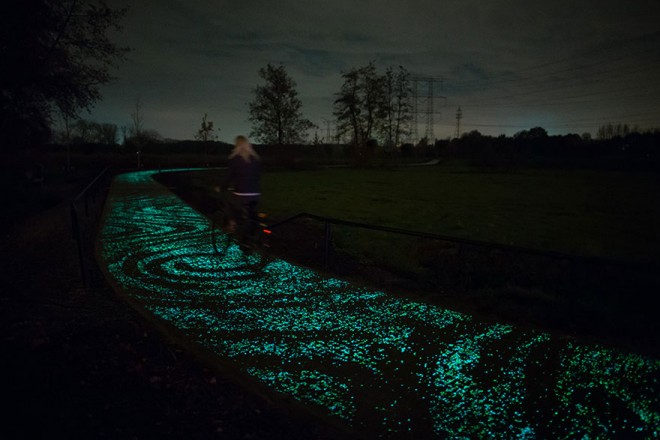
How do they do it? The bacteria are covered in small beads, which are scattered across the surface of a test field in which real antipersonnel landmines were buried. Using a laser-based scanning system, the test field was remotely scanned and the location of the buried landmines was determined. This appear to be the first demonstration of a functional standoff landmine detection system.
“Our field data show that engineered biosensors may be useful in a landmine detection system. For this to be possible, several challenges need to be overcome, such as enhancing the sensitivity and stability of the sensor bacteria, improving scanning speeds to cover large areas, and making the scanning apparatus more compact so it can be used on board a light unmanned aircraft or drone,” said Prof. Shimshon Belkin, from the Hebrew University, who was responsible for genetically engineering the bacterial sensors.
Egyptians diffuse bombs with bacteria
Over in Egypt, the researchers also proposed a biological system for removing landmines by degrading them. By activating the bacteria that will attack the gas emitted from landmines.
Their biological solution involves three stages: detecting the mines, corroding its iron case, and then neutralizing its explosive power.
Aresa Biodetection, a company from from Norway, designed the first phase of the study in March, 2004 by creating a strain of mustard plant called Arabidopsis thaliana that turns red in the presence of nitrogen oxide that leaks from land mines.
Researchers hoped to spray seeds from an airplane with help from the air force.
The next phase of the then proposed idea involved spreading bacteria that will eat away at the iron casings so that the trinitrotoluene (TNT) gas will be released, but Laurel Anne Hill, moderator of the Minds Clearing Landmines, questioned whether Egypt’s land mines have iron casings.
The final stage would entails planting plants such as tobacco or sugar beet that absorbs nitrogen, which the Egyptians claim will finally deactivate the mines.
Landmine detection for the birds?
But Richard Butler, program Managing of Halo Trust which specializes in disarming hazardous war debris told the paper back in 2012 that birds will eat the seeds. Researchers countered by claiming that the area of northern Egypt where they plan to test the technology does not have a lot of birds.
Looking further into the Egyptian idea, it’s not clear whether the solution came to light. But there are loads of others for inspiration, like the mine detection boot. And of course Afghani dreamers like came up with this idea: artistic mine sweepers.

Over in Egypt, the Bedouin have a creative solution to remember those maimed by mines. Awareness helps bring creative solutions from those who can help.
______________________
Have a creative landmine detection idea like the one below? Or a company that wants to work with creative teams to deploy your solution in a pilot. Reach out and hopefully we can help you connect to the right folks.
Email Green Prophet’s editor: [email protected]
Mine sweepers powered by the wind