Near-extinct gazelle brings Israelis and Palestinians to peace-making plan

gazelle
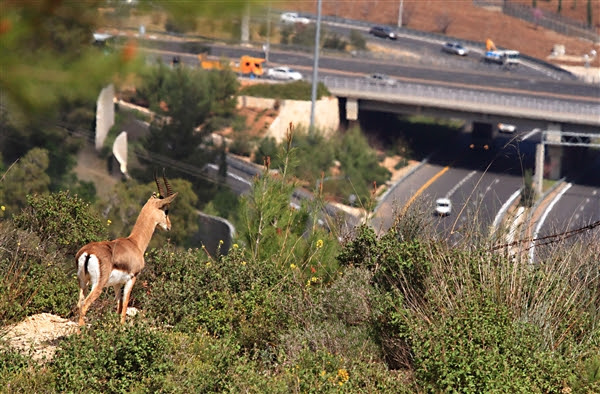
Why did the gazelle cross the road? In some parts of Israel underground or above ground bridges help the animals move like this wildlife bridge in Turkey, but it’s not enough. A new research project might bring them from the brink of extinction.

The endangered mountain gazelle Gazella gazella was once widespread throughout the Fertile Crescent in parts of present-day Israel, Palestinian Authority, Lebanon, Jordan, Syria, Turkey and Iraq. Most of its former distribution range overlaps with areas in the region that are now densely populated by people.

Archaeological remains also indicate that gazelles were the main prey hunted by people throughout the Pleistocene. Nevertheless, until the 19th century, the mountain gazelle survived this hunting pressure, and thrived.

It’s the same story everywhere: the rise in human population in this region from 1900 to 2016, together with the increased use of firearms and off-road vehicles for hunting, led to the extinction of gazelles from most of this area. Israel and the Palestinian Authority are currently the last strongholds of the mountain gazelle and are home to about 5,000 individuals.
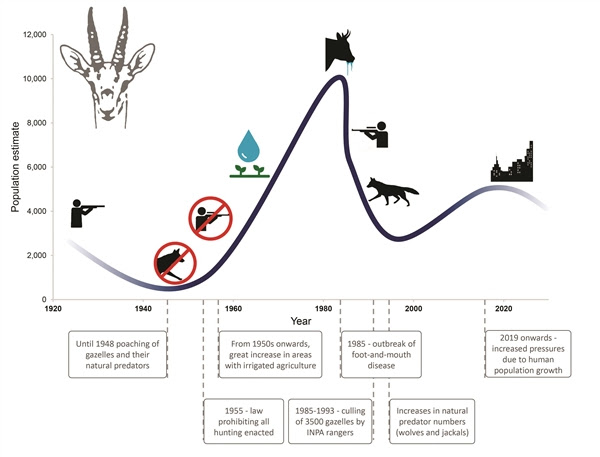
A new research effort led by Prof. Yoram Yom-Tov of Tel-Aviv University and Dr. Uri Roll of Ben-Gurion University of the Negev, together with Amir Balaban, Ezra Hadad, and Gilad Weil, reviews mountain gazelle dynamics in Israel from the beginning of the 20th century and provides an outlook for the conservation of the species. Their findings were published in Oryx—The International Journal of Conservation on Wednesday.

During the 1900s, Israel’s human population increased steadily by 2% per year. The human population density is currently c. 430 persons per km2 and is forecasted to continue to rise. This presents an array of threats to the mountain gazelle. These include: habitat change; fragmentation and isolation by roads, railways and fences, predation by an increasing population of natural predators and feral dogs, poaching, and collisions with road traffic. These threats often act in synergy, amplifying their effects.

In their article, they present an overview of how these factors threatened and continue to threaten the survival of this species. They also review the policy and management actions, both implemented and still required, to ensure the persistence of the mountain gazelle.

In addition, they analyze connectivity of gazelle populations in the landscape, highlighting highly fragmented populations, and suggesting potential interventions. To improve connectivity, they suggest construction of road over/under passes in strategic locations, translocation of individuals when needed, and better monitoring of potential genetic bottlenecks of the at-risk population.

Reducing feral dogs that roam the wild, no poaching

To reduce the effects of predation, they suggest reinstating the control of feral dogs, and improved management of anthropogenic waste. Furthermore, greater efforts should be made to eliminate poaching of gazelles, on the legislative, enforcement, and education fronts. More broadly, Israel’s human population is expected to double in the next thirty years – which will have grave implications on many local species and ecosystems, some of which are of global importance. Efforts should be made at the national level to limit this growth and stop further land conversions from natural habitats to other uses.

The mountain gazelle exemplifies an ungulate with both great vulnerability to anthropogenic pressures and a large breeding potential. As more and more regions are converted to human-dominated landscapes, pressures on wildlife will continue to increase, and lessons from the mountain gazelle could prove valuable elsewhere.

Karin Kloosterman
Karin Kloostermanhttp://www.greenprophet.com
Karin Kloosterman is an award-winning journalist, innovation strategist, and founder of Green Prophet, one of the Middle East’s pioneering sustainability platforms. She has ranked in the Top 10 of Verizon innovation competitions, participated in NASA-linked challenges, and spoken worldwide on climate, food security, and future resilience. With an IoT technology patent, features in Canada’s National Post, and leadership inside teams building next-generation agricultural and planetary systems — including Mars-farming concepts — Karin operates at the intersection of storytelling, science, and systems change. She doesn’t report on the future – she helps design it. Reach out directly to [email protected]

Read More

TRENDING

40 more migratory animals need protecting, warns UN group

The Convention on the Conservation of Migratory Species of Wild Animals (CMS), governments agreed to extend protection to 40 more migratory species, from cheetahs and striped hyenas to snowy owls, giant otters, and great hammerhead sharks. Too many of them are slipping toward extinction .

Koh Phangan’s angels for the dogs and the cats

Koh Phangan may be known for yoga, detox retreats, and full moon parties, but beyond the curated paradise lies a different reality—one of injured stray animals and the quiet work of rescue. This story explores PACS (Phangan Animal Care for Strays), a grassroots animal shelter tackling overpopulation, disease, and neglect on the island. Through firsthand experience with teens, it reveals how meaningful travel, volunteerism, and compassion offer a deeper kind of healing—far from the Instagram version of paradise.

What Happens When Hyenas Pee On Bedouins?

According to an anecdote Bedouin people believe that if a hyena urinates on them, it will proceed to drag them to a cave and feast on their body. Because of this, they won't hesitate to kill them on the spot if they come across one.

Microplastics Are Becoming Superbug Highways — New Study Warns Beachgoers to Wear Gloves

Prof. Pennie Lindeque added that microplastics “act as carriers for antimicrobial-resistant bacteria, enhancing their survival and spread… each particle becomes a tiny vehicle capable of transporting pathogens from sewage works to beaches, swimming areas and shellfish-growing sites.”

Who gave the first kiss?

When you experience your first kiss you might feel like you are the first in the world to feel that way. Kissing, scientists say, occurs in a variety of animals (even if today it's not in every culture), and it presents an evolutionary puzzle: kissing, a learned behavior, carries high risks, such as disease transmission like herpes and hepititis, while offering no obvious reproductive or survival advantage.

Yerukim Forms a New Green Economy Where the Money is Really Green

The Yerukim members who pick up the recyclables get to keep the monetary reward, the public earns "green" bills that can be used in shops, and business owners get to be associated with environmentalism.

Choosing Riyadh over Dubai? What Investors Should Know

Saudi Arabia is deploying capital at unmatched scale to catalyze tourism and advanced industry while rewiring its power-and-water backbone. The investable frontier is widening—especially in renewables, grid storage, water efficiency/desal retrofits, and hospitality operating platforms. Prudent investors will insist on phased delivery, enforceable KPIs (energy, water, biodiversity), and RHQ/zone compliance—while pricing political-economy and reputational risks alongside growth upside.

Sell your cooking oil for biodiesel money

Want to make money on old french fry oil? Sell it.

Qatar Alternative Energy Summit Pairs Investors And Innovators

Alternative energy investors and innovators can meet n' greet in Doha, Qatar March 16 and 17.

Here’s How To Implement The Four Pillars Of Employee Engagement

If you throw a party for your work team and they are vegans, don't make it a barbecue. Know the sustainability values of your team to boost moral and retain good people.

Locals From Rishon Fight IKEA

Big Box stores are a pretty new concept in Israel, and thank God that not every Israeli city wants them in their backyard. A word from someone who has see the beautiful farmland around her hometown Newmarket, Ontario stripped and converted into vulgar strip malls of big box shops: they have no place in a healthy and sustainable town or city.

The Jewish National Fund Meets An Inconvenient Truth

According to the JNF, it has transformed thousands of acres of barren land into green forests in Israel. They state that each person emits about 23 tons of carbon per year, estimating that each tree planted can absorb one ton of carbon in its lifetime. That's a whole lot of trees you'd need to be planting. Could so many fit in Israel?

How to quiet noise from construction in your office

Streets need to be resurfaced in New York but the humming and grinding noise is unsettling. Noise is environmental pollution. 

Popular Categories