
With killer virus Ebola out of control, Israel’s Protalix shares surge

protalix-ebola-zmapp

Ebola was suspected to have spread to countries like Saudi Arabia and even by plane to the United Arab Emirates. Wishful thinkers believe it could kill 20,000 people before it’s contained. Pessimists believe that this killer virus could be a worldwide problem if it’s not stopped in its tracks.

Besides the experimental drug ZMapp made in the US in tiny amounts, an Israeli biotech company called Protalix has a solution in the makings that could help ZMapp ramp up production and eventually offer a reasonable treatment to the virus that kills 9 out of 10 people that get infected.

The shares of the company recently surged when it was realized that the Protalix platform could be used to create a novel therapy against Ebola, a worldwide concern.

I interviewed the company in 2010 when it was developing a solution against nerve gas.

Developed through the genetic engineering of carrot cells, their first drug PRX-105 is an enzyme which is based on a molecule licensed to Protalix by Hebrew University’s Yissum, the technology transfer arm of the university in Jerusalem.

The drug was first developed by Prof. Hermona Soreq, the dean of the university’s math and natural sciences department, and by Yissum’s commercial counterpart at Cornell University in the United States.

In addition to its anti-nerve agent drug, the company produces a drug called Uplyso, which is a therapeutic protein-based drug for treating Gaucher disease. This is a genetic illness that is carried in about 1% of all people in the US. As many as 10% of the Jewish Ashkenazi population carry it, putting Jews especially at risk.

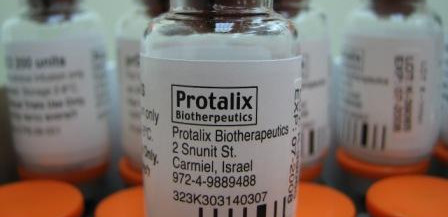
Protalix makes its drug inside a genetically altered tobacco plant, which is the same methods in which ZMapp makes its drug.
protalix-drug

Israel’s facilities in the north (address above) are one of few that can mass-produce medicine like ZMapp. It is a factory that makes antibodies using tobacco plants.

Because of the hope, Protalix shares rose by as much as 22% in Tel Aviv Stock Exchange trading yesterday.

CEO David Aviezer told the media said that while future collaboration with the manufacturer of ZMapp was possible, it was still purely theoretical at this stage.

ZMapp produced in America gained worldwide attention this year as it appeared to have “cured” two Americans who contracted Ebola in Liberia this summer. It is not yet known if they would have recovered without the medication.

Since Protalix is able to genetically engineer tobacco to produce antibodies it could help ZMapp ramp up its supply. The company is already approved by the FDA to treat Gaucher disease.

“In theory, we probably could also produce the antibody used for treating Ebola in our plant cell system,” the CEO said. “Based on our technology and their technology, we believe this can be done.”

“We have to receive the DNA sequence of the antibody, which is a proprietary asset. It does not belong to us. We would insert it into our plant cells and then purify the antibody protein that would be made in these cells,” said Aviezer.

More than 2000 people have died from Ebola to date, while about 4000 people are infected. The rates could be much higher as it’s common for Africans to hide those who are infected from local authorities and healthcare workers.

Ebola is also linked in unusual ways to the way our food is produced and delivered. Read this article about Ebola and chocolate for some stimulating debate on how a disease may be seemingly far from you is actually closer than you might think.

Karin Kloosterman
Karin Kloostermanhttp://www.greenprophet.com
Karin Kloosterman is an award-winning journalist, innovation strategist, and founder of Green Prophet, one of the Middle East’s pioneering sustainability platforms. She has ranked in the Top 10 of Verizon innovation competitions, participated in NASA-linked challenges, and spoken worldwide on climate, food security, and future resilience. With an IoT technology patent, features in Canada’s National Post, and leadership inside teams building next-generation agricultural and planetary systems — including Mars-farming concepts — Karin operates at the intersection of storytelling, science, and systems change. She doesn’t report on the future – she helps design it. Reach out directly to [email protected]

Read More

TRENDING

Mona Khalil, Orange House Project founder, sea turtle protector killed in Lebanon

Mona Khalil spent decades protecting Lebanon's sea turtles and coastal ecosystems. Her death in the ongoing conflict between Israel and Hezbollah shines a light on a broader environmental tragedy unfolding across northern Israel and southern Lebanon. From damaged wetlands and disrupted bird migrations to threatened seed banks and endangered wildlife, the region's ecosystems are becoming casualties of a war with no clear end in sight.

Dan Zaslavsky’s energy tower dream is rising again in Iran and China

The Energy Tower idea never made the leap from drawings and engineering studies to full-scale construction. But nearly two decades after most people stopped talking about it, the concept is quietly evolving in two unexpected places: China and Iran. The concept let dreamers dream and doers do - figuring out more pleasing designs and engineering.

A visit to Amirim, Israel’s first all-vegetarian village in the Galilee

Just 15 kilometers from Tzfat there is a moshav that was founded in the late 50s that was ideologically influenced by organic, vegetarian and vegan principles. My hostess at Ohn-Bar, the tzimmer where I stayed, explained that the people of Amirim were among the pioneers of Israel’s strong vegetarian movement.

Israeli Hydrogen Startup H2Pro Are Trying to Solve Clean Energy’s Hardest Problem

The company has attracted backing from major investors including Breakthrough Energy Ventures, the climate fund founded by Bill Gates, along with industrial partners such as Sumitomo, ArcelorMittal, and Temasek, a multi-billion dollar company that owns Singapore airlines. H2Pro has raised more than $100 million USD and is moving from pilot projects toward commercial-scale deployments.

Desalination experts debunk Aqua Solaire, the floating desalination barge

AI makes it easy to dream, develop, and create images of what could be world-changing ideas, until the reality sets in. A new project making the rounds is Aqua Solaire, an allged French concept for a solar-powered desalination vessel designed to bring drinking water to coastal communities facing drought, storms, and infrastructure failures.

Yerukim Forms a New Green Economy Where the Money is Really Green

The Yerukim members who pick up the recyclables get to keep the monetary reward, the public earns "green" bills that can be used in shops, and business owners get to be associated with environmentalism.

Choosing Riyadh over Dubai? What Investors Should Know

Saudi Arabia is deploying capital at unmatched scale to catalyze tourism and advanced industry while rewiring its power-and-water backbone. The investable frontier is widening—especially in renewables, grid storage, water efficiency/desal retrofits, and hospitality operating platforms. Prudent investors will insist on phased delivery, enforceable KPIs (energy, water, biodiversity), and RHQ/zone compliance—while pricing political-economy and reputational risks alongside growth upside.

Sell your cooking oil for biodiesel money

Want to make money on old french fry oil? Sell it.

Qatar Alternative Energy Summit Pairs Investors And Innovators

Alternative energy investors and innovators can meet n' greet in Doha, Qatar March 16 and 17.

Here’s How To Implement The Four Pillars Of Employee Engagement

If you throw a party for your work team and they are vegans, don't make it a barbecue. Know the sustainability values of your team to boost moral and retain good people.

Locals From Rishon Fight IKEA

Big Box stores are a pretty new concept in Israel, and thank God that not every Israeli city wants them in their backyard. A word from someone who has see the beautiful farmland around her hometown Newmarket, Ontario stripped and converted into vulgar strip malls of big box shops: they have no place in a healthy and sustainable town or city.

The Jewish National Fund Meets An Inconvenient Truth

According to the JNF, it has transformed thousands of acres of barren land into green forests in Israel. They state that each person emits about 23 tons of carbon per year, estimating that each tree planted can absorb one ton of carbon in its lifetime. That's a whole lot of trees you'd need to be planting. Could so many fit in Israel?

How to quiet noise from construction in your office

Streets need to be resurfaced in New York but the humming and grinding noise is unsettling. Noise is environmental pollution. 

Popular Categories